


Development-Forms. Living Organisms
Description
This section is from the book "Food - What It Is And Does", by Edith Greer. Also available from Amazon: Food: What it is and Does.
Development-Forms. Living Organisms
When conditions are not favorable to bacterial life some bacteria die, others pass into resistant, resting forms. These are called spores. They are not easily destroyed, therefore may remain alive in water or food or air even after subjected to great heat. When favorable conditions for bacterial growth are reestablished, spores become active, change back into the growing form of bacteria, and these then multiply.
Seeds of plants are not like bacterial spores. The two should not be confused. Seeds are more than alive forms that return to a growing state under reinstatement of favorable conditions. Seeds bring forth new plants. Spores are bacteria that remain alive when deprived of what they need to grow. Spores form under conditions of destitution; seeds under conditions favorable to growth. Bacteria reproduce in general by the subdividing of the bacterial organism itself and the repeated redividing of the subdivisions. See diagrams below.
Humankind, animals, plants, bacteria, are all living organisms. Their processes of living, growing, reproducing, and readjusting themselves differ somewhat, but they all interwork. Organisms are forms of life that, in addition to existing, are somewhat active and change somewhat. They live, grow, reproduce their kind similarly, but tend to change slightly in response to whatever differs in their action. It is living and working that provides food to sustain life. It is through reproduction that generation follows generation, and that the species or race lives on: It is through a new response in action that any advance occurs.
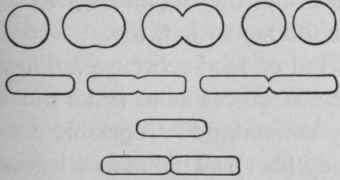
Reproduction by fission. (After Conn).
Continue to:


My Books

