


B. Gastric Digestion
Description
This section is from the book "Nutrition And Dietetics", by Winfield S. Hall. Also available from Amazon: Nutrition And Dietetics.
B. Gastric Digestion
Gastric digestion is so called because it takes place in the stomach under the influence of the gastric juice. Gastric juice consists of ninety-nine and a half per cent water, one half per cent solids. Essential among the solids are the enzymes (pepsin and rennin), hydrochloric acid, and mucus; the latter serves in part for the lubrication and in part as a protection to the mucous membrance against the digestion of its own substance. The constituents which bring about the chemical change of gastric digestion are the acids and the enzymes, particularly the pepsin. Gastric juice begins to be secreted into the stomach soon after eating begins, but it does not for some time (varying under different conditions from twenty or thirty minutes to three quarters of an hour) reach an amount sufficient to cause a distinct and marked acidity of stomach contents, thus superseding salivary digestion and actively beginning the gastric digestion called peptic proteolysis. If the conditions are all favorable - if the foods have been well chosen, properly cooked and masticated - gastric digestion should be completed within two or three hours after a meal. If any one of these preliminaries above named has not been properly accomplished, then the digestion may be prolonged for one or two hours longer.
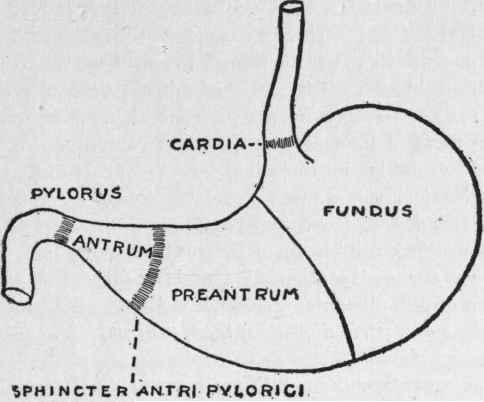
Fig. 4. - Diagram of the Stomach. The antrum and preantrum together make the so-called "pyloric end" of the stomach. The pyloric end is the active motor portion of the stomach; while the fundus serves as the food reservoir.
As in the case of the saliva, so also in the case of the gastric juice, its flow is governed by the nervous system. The sight, taste, and flavor of a much-relished dish eaten with keen appetite greatly influences the flow of the gastric juice, not only starting it more promptly but producing it in greater quantities. A Russian investigator, Pavlow, has called this flow in response to appetite, "appetite juice." The flow of gastric juice is also modified by the character of the food. As stated before, the gastric juice digests proteins only. So we find that, all other things being equal, the richer a meal is in proteins, the more abundant the flow of gastric juice. This flow of gastric juice induced by the chemical quality of the foods has been called by Pavlow, "food juice."
The digestion of proteins in the stomach begins, as a rule, with their change under the influence of the acid of the gastric juice into soluble acid albumates. This soluble albumin, also called syn-tonin, is next acted upon by the pepsin which changes it first into proteoses; these in turn are changed into peptones. Proteoses and peptones are soluble and diffusible forms of protein, much simpler in their chemical composition than the "native" proteins, such as egg albumen, lean meat, and casein that are taken in as foods. In this simplified, soluble form the proteins now in the condition of peptones are easily absorbable and readily pass through the epithelium of the alimentary canal into the blood and lymph.
The steps of gastric digestion, then, are: protein, syntonin, proteoses, Peptone.
The movements of the mouth are movements of mastication and swallowing. These movements are under the control of the will directly. The movements of the stomach are peristaltic and are not under the influence of the will directly. After food has accumulated in the stomach to a considerable extent in the progress of the meal, that organ begins a series of peristaltic waves that pass down from the cardiac end of the stomach, which serves as sort of reservoir for the accumulation of food, along the antrum to the pylorus. These contractions get progressively stronger as they pass to the pylorus and take the form of a traveling, contracting ring that moves from the fundus down to the pylorus. In the earlier stages of gastric digestion the pylorus sphincter remains tightly closed. This necessitates a pouring back of the stomach contents, which have been forced toward the pylorus through the contracted peristaltic ring, thus causing a very complete mixture of the food with the gastric juice. After a short time the pylorus begins to relax slightly, permitting a small portion of the liquid which is forced against it to pass through. This acid chyme passing down into the duodenum stimulates there the flow of those digestive juices which cause the intestinal digestion. If the food has been thoroughly masticated, its passage from the stomach will proceed rapidly. If it has not been thus thoroughly divided and triturated, the solid pieces of food touching the mucous membrane and sphincter pylorus will cause that sphincter to contract tightly, thus retaining the solid substance within the stomach cavity. The presence of uncooked and unchewed solid masses of food may thus result in the retention of a considerable portion of the stomach contents for hours. It is unnecessary to state that this imposes a very much greater labor on the part of the stomach, which long-suffering organ may eventually and will probably sooner or later rebel at the imposition and subject the careless individual, whose patient servant it has been, to a case of indigestion. In this way the stomach will get a much-needed vacation. Cases of indigestion are nothing more nor less than a demand of Nature for rest for the digestive system.
Continue to:


My Books

