


Chapter V. The Tray
Description
This section is from the book "Practical Dietetics: With Reference To Diet In Disease", by Alida Frances Pattee. Also available from Amazon: Practical Dietetics: With Reference to Diet in Disease.
Chapter V. The Tray
The writer's intention is only to suggest to the nurse the best and simplest methods of arranging the tray and a few of the important details.
These things seem trivial, but it must be remembered that the horizon of the sick room is limited, and that the patient who has long been confined to bed with a serious illness thinks much of his immediate surroundings.
He may seem too ill to notice these details, whereas he is only too ill to speak of them, for one feeds with the eyes quite as much as with the lips, and by some carelessness of the nurse the appetite of a refined, fastidious, or nervous patient may be wholly destroyed.
While the natural stimulants to appetite, such as fresh air, exercise and enlivening companionship, are necessarily wanting, the taking of food is the chief event of the day, and too much care cannot be bestowed upon its preparation and service, as, has been said, the appearance and manner of offering have much to do with its acceptance or rejection.
Attractive Arrangement Of A Tray
The cover and the arrangement of the tray is of the utmost importance, and the slightest departure from regularity and immaculate cleanliness should be avoided.
The tray should be covered with fine linen damask, without crease or wrinkle - the best you can afford. Use the choicest silver, daintiest china and glassware; arrange neatly and conveniently. Place a single rose or flower on the tray; a quotation, added as a variety, will often attract the attention, and it is well, when possible, to divert the patient's mind from his ailments while eating. This can easily be done in these little ways, and also by the introduction of some cheerful and interesting topic of conversation.
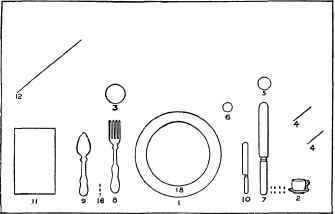
Proper Placing.
1 Plate.
2 Cup and saucer.
4 Individual creamer and sugar.
5 Tumbler.
6 Individual salt.
7 Knife.
8 Fork.
9 Spoon.
10 Butter spread.
11 Napkin.
12 Flowers.
13 Salad knife.
14 Soup spoon.
15 Oyster fork.
16 Salad fork.
17 After coffee spoon.
18 Soup or cereal or berry plate, etc.
N. B. - The dots between numbers 7 and 2 reading from left to right represent numbers 13, 14, 15, and 17. Sharp edge of knife turned toward plate; tines of forks, bowl of spoons, all dishes and tumblers placed right side up.
How To Serve. (General Rules)
The time of cooking food to be served, should be carefully considered in relation to the time of serving, for most palatable food may be spoiled by not serving it at the proper time.
Avoid serving too many things on tray. Cover tray with a clean napkin or tray cover in carrying it to its destination. When the dietary ordered is very limited in variety, the patient is often gratified by having his food served in courses, and will eat more than if given everything at once.
Only a small quantity should be served at one time. If possible, taste of all food and drinks before serving, to see if properly seasoned and at right temperature to serve.
Always use separate spoon for tasting.
Food to be served hot, should be served hot (not lukewarm), in heated dishes and covered in transit.
Cold drinks and fruits are more healthful when served cool than ice-cold.
When fluid foods are to be given, other receptacles should be used than those used for medicine, or the association of ideas may be strong enough to destroy what little appetite the patient has, and to even produce nausea. Do not fill cups or glasses full, but within one inch of the top. For individual dishes, for a luncheon, or drinks to be passed alone, use a small tray or plate, covered with a doily or folded napkin.
The finger-bowl should be placed on a small plate, covered with a dainty doily; fill one-fourth full of water, and put a few rose petals or green leaves in the water and on the side of the plate.
When possible, cover all foods and drinks left standing in the sick room.
The tray and all traces of a meal should be removed immediately after eating. Half-emptied cups or glasses should never be left in the room.
If the patient is restricted to any especial diet, vary as far as possible in the preparation and serving.
The diet of the patient should be under the supervision of the physician, and his directions followed implicitly, for much unnecessary suffering, and even death, has been the result of giving forbidden food.
Continue to:


My Books

