


Of The Mechanical Division Of Bodies. Part 6
Description
This section is from the book "The London Dispensatory", by Anthony Todd Thomson. Also available from Amazon: PDR: Physicians Desk Reference.
Of The Mechanical Division Of Bodies. Part 6
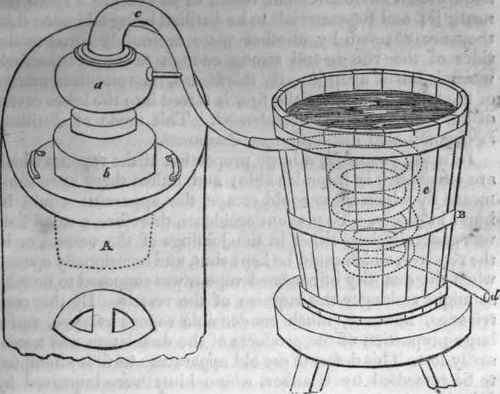
By degrees the water in the refrigeratory becomes warm, and requires to be renewed; and thence the necessity of the tub being furnished with a stop-cock, by which the heated water may be drawn off without disturbing the apparatus. As in this species of distillation the vapour ascends before it is condensed, it is named distillation per ascensum.
In some cases, as in the distillation of several essential oils, the vapour, instead of passing laterally, or ascending, is forced to descend. To produce this effect, a plate of tinned iron is fixed within any convenient vessel, so as to leave a space beneath it; and the materials to be distilled being laid upon this, they are covered by another plate accurately fitted to the sides of the vessel, and strong enough to support the fuel, which is burnt upon it. By this means, the volatilized matter of the materials, under the fire, is forced into the lower cavity of the vessel, and there condensed. This mode of distilling is denominated distillation per descensum.
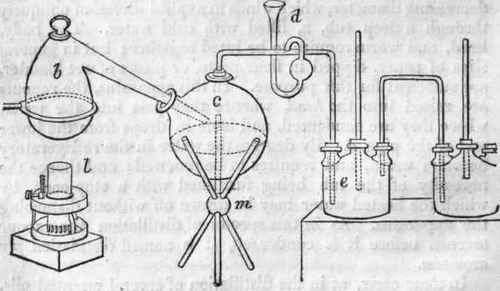
In many processes, a large proportion of the vapours which are extricated is incondensible; and unless there were some means by which these could escape, the apparatus would be burst in pieces. To prevent accidents, therefore, a small hole was generally left, either in the joinings of the vessels, or in the receiver, which could be kept shut, and occasionally opened when the quantity of confined vapour was supposed to be such as might endanger the rupture of the vessels. By this contrivance, however, much condensible vapour escaped, and a large proportion of the products of the distillation was necessarily lost. This defect of the old apparatus was first attempted to be remedied by Glauber, whose hints were improved by Woulfe, the inventor of the apparatus now commonly employed. It consists of a retort, b, generally tubulated, in which the materials are heated by a lamp, l; a receiver, c, supported by a stand, m, to detain any part of the product which is condensible by cold; and a bent tube, proceeding from the receiver to the bottom of the bottle, e, with two apertures, and which is about half full of water.
Several bottles, however, are generally employed; and these being placed side by side, are connected with one another by means of bent tubes, one limb of each proceeding from the top of the bottle immediately preceding, and the other plunging to the bottom of the liquid of the bottle next in order. The joinings of the apparatus are all made air-tight, except the opening of the last bottle farthest from the retort, so that any vapour which escapes must have passed through the liquid in the whole series of bottles, and left all its condensible matter, before it can escape. One inconvenience, however, attends this apparatus, when it contains no other parts than the above; which is, that after the distillation, as the retort cools, a vacuum is produced in it and the first receiver, which induces a suction or absorption from the other receivers through the bent tubes, and a retrograde motion of the liquid contained in them takes place through the whole apparatus; so that the products are mixed, unless the operator be on the watch to separate the retort and receiver, the moment the liquor begins to rise in the bent tube between the receiver and the first bottle. The best contrivance for remedying this defect, is the tube of safety, invented by Welter, and represented at d.
It is a bent tube, with a bulb blown in that part of it which lies between the upper and lower flexure; and a small funnel at the top. This tube is sometimes used as a stopper to the tubulure of the retort, or to a separate opening in the receiver; or, as is represented in the cut, it is cemented into the tube passing from the receiver to the first bottle. When it is to be used, a little mercury is dropped into the funnel, so as to occupy the space of the tube which lies between the two lower flexures. The mercury excludes the external air during the distillation; but as soon as the vacuum is formed by the cooling of the vessel, the mercury is forced by the pressure of the atmosphere into the bulb; and not being in sufficient quantity to fill it, the external air passes by it in the bulb, and rushes into the apparatus: by which means the vacuum is filled up, and the absorption of the liquor prevented. Various modifications of this have been suggested; but the best is the invention of M. Pepys. It consists of a globular, or rather pyriform vessel, c, with which the receiver is surmounted, and into which it is accurately ground.
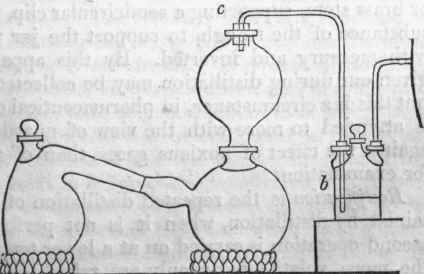
This is furnished with a glass valve, which allows gas to pass freely into it from the receiver, but prevents the water which it contains from falling into the receiver. From this a common tube rises, to connect the tubulated receiver, b, as in the former apparatus.
In chymieal operations, when the gases which are separated during a process are to be preserved, the pneumatic trough, k, with its inverted jar, i, under which the curved tube, h, proceeding from the bottle, g, opens, is attached to Woulfe's apparatus. The construction of the trough differs according to the nature of the fluid with which it is filled. If water be employed, the trough may be of stone ware, or of tinned iron, well japanned, and of an oblong or a circular shape. It may be about 18 inches long, 14 broad, and 8 inches deep; with a shelf of the same materials, which should extend entirely across the trough, and have two small holes in it, to convey the gas into the inverted jars set upon it; and two larger holes, to receive two bottle supporters. This trough should be nearly filled with water, and the jars intended to hold the gas should be also filled with the same liquid, and inverted; so that, when placed upon the shelf, the water in the trough may ascend about half an inch up their sides, which enables them to retain either water or gas, If mercury be employed, which is essential when the gases to be extricated are absorbable by water, the trough may be made of some hard wood, as mahogany, or of marble.
Continue to:


My Books

