


Liquor Potassae. Lond. Solution of Potassa
Description
This section is from the book "The London Dispensatory", by Anthony Todd Thomson. Also available from Amazon: PDR: Physicians Desk Reference.
Liquor Potassae. Lond. Solution of Potassa
"Take of carbonate of potassa, fifteen ounces; lime, eight ounces; boiling distilled water, a gallon. Dissolve the carbonate of potassa in half a gallon of the water. Sprinkle a little of the water on the lime in an earthen vessel, and the lime being slaked; add the rest of the water. Mix the hot liquors together in a covered vessel, and agitate them frequently until they are cold. Then set aside until the carbonate of lime subsides. Lastly, keep the supernatant liquor, when poured off, in a well-stopped green glass bottle."
1 Aqua Kali Puri, P. L. 1787. Lixivium Causticum, Potassa pura liquida.
Aqua Potassae, Edin. Water of Potassa.
"Take of lime fresh burnt, eight ounces; subcarbonate of potassa, six ounces; boiling water, twenty-eight ounces. Let the lime be put into an iron or earthen vessel, with twenty ounces of the water. When the ebullition ceases, immediately add the salt, dissolved in the remaining eight ounces of the water; and having thoroughly mixed the whole, cover the vessel till the mixture cool. The mixture being cooled, agitate it well, and pour it into a glass funnel, the tube of which is obstructed with a piece of clean linen. Cover the upper orifice of the funnel while its tube is inserted into another glass vessel, that the solution of potassa may gradually drop through the linen into the lower vessel. When it first ceases to drop, pour a few ounces of water into the funnel, but cautiously, so that the fluid may swim above the matter. The water of potassa will again begin to drop. The effusion of water, however, must be repeated until three pounds have filtered, which will be in the space of two or three days; then let the upper parts of the solution be mixed with the lower by agitation, and preserve it in a well-stopped vessel."
Aqua Potassae causticae, Dub. Water of Caustic Potassa,
"Take of lime fresh burnt, carbonate of potassa, each two parts; water, fifteen parts. Pour upon the lime, put into an earthen vessel, one part of the water, made hot; and when it is slaked, mix the salt with the lime, and the rest of the water. Pour the materials, as soon as they are cold, into a well-stopped bottle, and keep it for three days, frequently shaking the bottle: after the carbonate of lime shall have subsided, pour off the supernatant liquor, and preserve it in well-closed green glass bottles.
"The specific gravity of this solution is, to that of distilled water, as 1080 to 1000."
Syn. Dissolution de Potasse (F.), Flussiges atzendes Kali (G.), Potachlog (Dutch), Liquore di Potassa (I.).
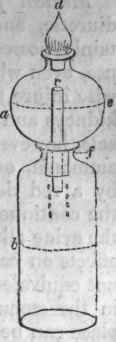
The rationale of these processes is very obvious: the lime attracts the carbonic acid of the carbonate of potassa, and leaves its alkaline base in a state of purity dissolved in the water. In considering the proportions of the two latter of these processes, there appears a priori a much larger proportion of lime ordered than is necessary for the decomposition of the carbonate of potassa: but the superabundance is necessary to ensure the entire separation of the carbonic acid from the potassa. If the solution be filtered, unless much care be taken to exclude the air during the filtration, carbonic acid will be rapidly attracted from the atmosphere. Calico is the best substance for stopping the mouth of the funnel, and it should be supported on a rough pebble or silicious stone, previously dropped into the funnel, and allowed to settle itself: but the method of the present Pharmacopoeia is preferable to filtering in an open funnel, as no carbonic acid is attracted when the supernatant fluid is simply decanted from the carbonate of lime. When the solution requires to be filtered, the simplest apparatus is that figured in the margin.
It consists of a globular vessel a, fitted with a ground stopper d, and furnished with a perforated neck f, ground into the bottle b: a tube c is fixed into this neck, wrapped round with as much clean linen or calico as is required to fill up the orifice. In using this filter, the solution is to be introduced into a, as high as e, so that the upper extremity of c shall be above the level of the fluid. The globular filter is then closed by the stopper, and as the filtering proceeds, the air displaced by the fluid dropping into b, passes up through c, and thereby does not interrupt the process. The solution should be kept in small green glass bottles, fitted with ground stoppers, to prevent the absorption of carbonic acid from the atmosphere.
Qualities. - Solution of potassa is inodorous, and so caustic as not to admit of being tasted. It is limpid, colourless, dense, and has an oily appearance when agitated; displays a strong alkaline reaction; does not effervesce with acids; and ought not to afford a precipitate with lime-water; but it is seldom procured so pure. It feels soapy when rubbed between the fingers, owing to the solution of the cuticle. When perfectly pure, it remains transparent on the addition of barytic water. Prepared according to the formulae of the Pharmacopoeias, it is not a simple solution of potassa, but contains small portions of hydrochlorate and of sulphate of potassa, silica, and generally some lime. The presence of hydrochlorates may be discovered by saturating a portion of the solution with nitric acid, then adding nitrate of baryta to precipitate the sulphates, if any; and, lastly, adding a solution of nitrate of silver, which is precipitated if any hydrochlorate be present. Sulphates are discovered by saturating with hydrochloric acid, and adding chloride of barium; and, if lime be present, the addition of a carbonate of potassa; or blowing into the solution through a tube will render it turbid; but these contaminations do not alter its properties as a remedy, nor as a pharmaceutical agent.
One pint of it should weigh sixteen ounces; or the specific oravity be 1.063; and it should contain 4.7 per cent, of pure potassa.1 It dissolves alumina, gum, extractive, and resin, and converts fat and oils into soaps. It is incompatible with acids, acidulous salts, sesquicarbonate, acetate, and hydro-chlorate of ammonia, metallic salts, especially the chlorides of mercury.2
Medical properties and uses. - This solution is antacid, diuretic, and lithontriptic. The two first properties it certainly possesses in a considerable degree: but its continued use, even when much diluted, is said to debilitate, and otherwise injure the stomach. As a solvent of calculus, both in the kidneys and bladder, this alkali has long been celebrated: it acts, however, on calculi composed of uric acid, or of urate of ammonia, only; the presence of which in the habit is known by a red deposit in the urine of the patient. But although the continued use of solution of pure potassa certainly renders the urine alkaline, yet there is reason to believe that its solvent effects on calculous matter in the kidney or the bladder are not equivalent to the irritation which its long use excites both in the stomach and the bladder; and as a prophylactic, its place can be much better supplied by magnesia and the alkaline carbonate. This alkaline solution has also been found useful in gout; in indurations and enlargements of the glands, and in scrofula, and even secondary syphilis.
Dr. Willan says, he has seen the most beneficial effects experienced from the internal use of this solution in lepra3: and from my own experience I can assert, that it may be almost regarded as a specific in the various species of psoriasis, which depend altogether on acidity of the primae viae, and a hasty and consequently imperfect formation of the juices of the stomach. It is also used as a local stimulant, much diluted, in the form of lotion, to. the joints, in rachitis and gouty swellings; and, in its concentrated state, as a caustic, to destroy the poison introduced by the bite of rabid or venomous animals.
The dose of this solution may be from x. to f 3 j. taken in
Table Of The Strength Of Solutions Of Potassa
Spec. Grav. | Per cent, of Potassa. |
1.47 | 39.6 |
1.42 | 34.4 |
1.33 | 26.3 |
1.23 | 19.5 |
Spec. Grav. | Per cent, of Potassa. |
1.15 | 13. |
1.11 | 9.5 |
1.06 | 4.7 |
2 Pure soda when rendered incandescent emits a yellow light, which distinguishes it from pure potassa.
3 Willan on Cutaneous Diseases, p. 141.
chicken broth, milk, or almond mixture1; but in cases of psoriasis, it should be gradually increased to f 3 ij. In cases of simple acidity of the stomach it may be administered in some bitter infusion, namely, infusion of orange peel, or in mild ale, or in broth, or in milk.
When over-dosed, or taken as poisons, the influence of the alkalies is best counteracted by acids; administering at the same time oil and demulcents.
Officinal preparations. - Potassae Hydras, L. E. D. Potassacum Calce, L. E. D. Liquor Sulphureti Kali, D. Antimonii Oxysul-phuretum, L. E.
Continue to:


My Books

