


Arsenicum. Arsenic. Part 4
Description
This section is from the book "The London Dispensatory", by Anthony Todd Thomson. Also available from Amazon: PDR: Physicians Desk Reference.
Arsenicum. Arsenic. Part 4
The first objection is obviated by making the trial on paper, as recommended by Dr. Paris : drop a little of the suspected fluid on writing-paper, and draw several times over it a stick of lunar caustic; which, if arsenious acid be present, will leave a streak of colour, that becomes a very bright queen's yellow, if brushed with some liquid ammonia; but if no arsenious acid be present, and only alkaline phosphates, the streak will be uniform, and in a few minutes will fade into a sad green, and gradually become black. Dr. Marcet has shown us how to obviate the difficulty with regard to the muriates, by adding to the suspected fluid dilute nitric acid, and then applying the nitrate of silver to its surface until no more precipitation is produced; by which means the whole of the muriatic acid is removed : and as the arsenite of silver remains in solution, it is rendered evident by a yellow precipitate being instantly formed on the addition of ammonia. A still better method is to precipitate all the muriates by nitrate of silver, leaving the mixture at rest to become clear, then filtering, and touching the surface of the fluid with a glass rod dipped in ammonia; if any arsenite of silver be present, it will be directly recognised by the yellow precipitate.
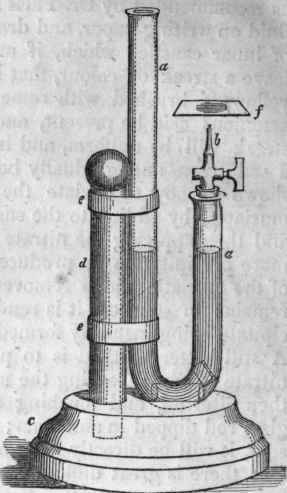
But there is great difficulty in detecting the presence of the poison in the stomach. Besides examining the contents of this viscus by filtration and dilution, if no arsenic can be detected, Orfila advises the viscus to be cut in pieces, and then separately examined1, by boiling the fragments in water and testing the decoction. In this case, the fragments should be boiled in distilled vinegar and water; and then a current of sulphuretted hydrogen gas passed through the filtered decoction, which will diffuse a fine yellow colour in the fluid if any arsenic be present: this, the sesquisulphuret of arsenic, when the fluid is boiled to drive off any superfluous sulphuretted hydrogen gas, falls as a lemon-yellow powder, which, if dried and mixed with black flux, and reduced, yields metallic arsenic. But the best of all tests is to throw some of the suspected fluid into a mixture of one part of sulphuric acid and six parts of water, and having added some pure zinc, as in the marginal cut, set fire to the gas as it issues from the jet, and hold over it a plate of glass: if any arsenious acid be present in the fluid, a spot of metallic arsenic will be obtained; and this may again be converted into arsenious acid by merely turning the plate, and passing under it the flame of a spirit lamp.
The one hundred and fiftieth of a grain can be detected by this method.2

1 The ammoniacal sulphate of copper is prepared by precipitating a strong solution of sulphate of copper, by means of ammonia, then partly redissoiving the precipitate by an excess of ammonia.
2 Prepared in the same manner as the above, substituting nitrate of silver for sulphate of copper: it should not cause a precipitate with solution of phosphate of soda.
3 Philosophical Mag., May 1809.
4 Bostock, Edin. Med. and Surg. Journ., v. 170.
Traite des Poisons, etc. par M. P. Orfila, vol. ii. p. 169. 2 This beautiful test was suggested by Mr. Marsh of Woolwich.
Mr. Marsh's apparatus is a glass tube, a, a, bent into the form of a syphon, the shorter leg being five inches and the longer eight inches in length. A stop cock, b, ending in a jet of a fine bone, passes tightly through a hole in the axis of a soft sound cork, which fits airtight into the opening of the lower bend of the tube: it may be rendered more tight by common turpentine luting. The apparatus is fixed on the stand, c, and attached to the pillar, d, by two elastic slips of Indian rubber, e, e. When the apparatus is to be used, the fluid to be examined, mixed with diluted sulphuric acid, is to be poured into the long leg until it stands in the short one about a quarter of an inch below the cork. A piece of glass rod, an inch long, is then to be put into the short leg, and afterwards a piece of sheet zinc bent double, which will fall down until stopped by the glass rod. The stopcock being then inserted and left open, in a few minutes the gas that issues should be lighted. If arsenious acid be present, metallic arsenic and a circle of oxide will be formed on the piece of glass, f, held over the flame.
When any of the solution of the poison which has been exhibited can be procured, more satisfactory results will be obtained from the examination of it than from that of the contents of the stomach. If a white powder be found in it, the most satisfactory proof is that of reducing this to the metallic form, as already described; but, if the whole of the arsenic be dissolved, it must then be tested by the different re-agents, or the process with hydrogen gas. One of the simplest methods as a preliminary step which I have tried is the following : - Into the suspected solution stir a moderate quantity of charcoal in powder; allow it to settle; then pour off the clear supernatant fluid, or filter the mixture; and when the powder which remains on the filter is dry, sprinkle some of it on a red-hot poker: if the solution contain arsenic, the odour of garlic will be rendered sensible. This effect becomes more obvious, if a few grains of dried subcarbonate of potassa be added to the dried charcoal-powder.1 Dr. Christison has, objected to this test as not likely to answer when the quantity of the arsenious acid is small2; but it is intended as a preliminary step only; and in almost all cases of suicide the quantity of the poison swallowed is large.
Another method less objectionable I have to recommend: it is to heat the charcoal thus treated on platinum foil; if arsenic be present, it leaves a beautiful silvery mark on the foil from the arsenic forming an amalgam with the platinum.
Continue to:


My Books

