


Some Points In The Physiology And Psychology Of Hypnotism. Part 2
Description
This section is from the book "Treatment By Hypnotism And Suggestion Or Psycho-Therapeutics", by Charles Lloyd Tuckey. Also available from Amazon: Treatment By Hypnotism And Suggestion, Or Psycho-Therapeutics.
Some Points In The Physiology And Psychology Of Hypnotism. Part 2
If I am told to raise my arm, the order is conveyed to the auditory centre, and thence referred to the ganglionic cells of the cortex, in which the highest functions - attention, volition, comparison, etc. - may be supposed to reside; if endorsed by the will, it is despatched through the motor centres, basal ganglia, and spinal cord to the muscles, which perform the required action. Even if my will refuses to obey the order, it may happen that an involuntary stimulus is sent downwards, sufficient to cause some slight muscular movement, which, however, is promptly checked by the inhibitory action of the highest centres. But suppose the order is given in an imperative tone to one accustomed to obey the voice of authority - a soldier, * for example - it will probably be executed automatically, without any functioning whatever of the will; the command is referred from the auditory centres, where it is taken in, direct to the motor centres, and through the basal ganglia to the muscles of the arm. In such a case, a like order has been so frequently followed by its execution that the two have become cause and effect, and the action is automatic or cerebro-rerlex, and almost beyond the man's control.
A hypnotized subject is in much the same position; his intellectual centres do not work, and an order suggests its fulfilment without, and, indeed, sometimes contrary to, volition and reason.
* There is a well-known story of an old soldier who, while carrying home his Sunday dinner, was hailed by a practical joker, who called 'Attention!' His arms immediately fell into the required position, and the dinner rolled in the gutter. Assuredly, volition had no voice in this matter.
The subjoined diagram (adapted from the 'Encyclopaedia Britannica,' article 'Physiology') will assist the comprehension of voluntary and automatic actions.
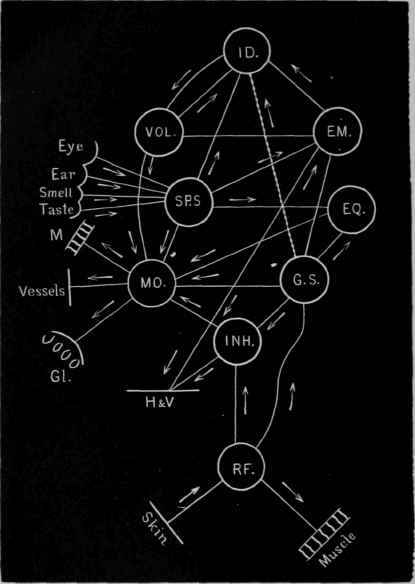
Id., Ideational centre; Vol., Volitional centre; Em., Emotional centre; Sp. S., Centres for special sensations; Eq., Centre for sense of equilibrium; Mo., Motor centre; ('.. S., Centre for general sensation; Inh., Inhibitory centre; Rf., Keflex centre: M., Muscle; Gl., Gland; H. and V., Heart and Vessels. The lines show the association of one centre with the others, and the arrows indicate the direction taken by nervous impulses. Hypnotism may be supposed to cut off or inhibit some of these associations - e.g., the volitional from the motor.
A severe mental shock will sometimes induce this automatism; the various duties and actions of everyday life will then be gone through as in a dream, and often without leaving any recollection of their performance. A severe blow on the head will occasionally bring about a like condition - as in the case of a gentleman, aged twenty-one, a patient of mine, who was thrown from his horse while hunting. He subsequently recollected riding at the fence at which he came to grief, but had totally forgotten everything that followed until the end of the run, which lasted for about fifteen minutes after his fall. Yet I have the report of eye-witnesses, who state that he was up in a moment, mounted his horse, and joined the field as if nothing had happened; but that he wore a dazed expression, and made unintelligible answers to the remarks addressed to him. He is always a plucky rider, but on this occasion he surpassed himself, taking a dangerous fence which only one other horseman attempted, and which he would probably have avoided had his reasoning faculties been at work.
He felt a severe pain in the vertex, which had been struck in his fall, and for a few hours remained in a somewhat dazed condition.
There is no memory of acts done in the somnambulic state, because that association of centres and balancing of one mental function by another which constitute ideation, self-control, attention, volition, comparison, and memory are for the time being rendered inoperative. A patient under hypnotic influence may be compared to a complicated machine, which is thrown out of gear, and yet can be so adjusted that some parts can be made to act independently of the others.
As regards the physical basis of the phenomena, recent researches in physiology enable us to form a fair working hypothesis. Heidenhain supposed that there must be anaemia of the brain, until he found that his brother could be hypnotized as easily as usual immediately after taking a physiological dose of amyl nitrite.
Dr. Barwise thinks nitrite of amyl, by lowering the blood tension, leads to congestion of the membranes of the brain, and that these exert direct pressure on the contained organ, and so empty its vessels. He finds that his best hypnotic subjects blush readily, and that they commonly become flushed while being hypnotized. He also finds that persons may be more easily hypnotized if the head is bent back so as to obstruct the return of venous blood from the brain. He therefore supposes that hypnosis depends upon congestion of the membranes with coincident anaemia of the cerebrum.*
Dr. Gerald Yeo, late Professor of Physiology at King's College, thinks Heidenhain*s inference that nitrite of amyl causes general congestion of the brain is not a necessary corollary of the fact that it produces flushing of the face. He supposes that in hypnosis we have a condition of partial and local ansemia of certain areas of the cortex.
Dr. Yeo has made a special study of hypnotism, and his lecture before the King's College Science Society in 1883 was almost the first serious attempt in this country to bring modern physiological science to bear on the subject. Starting from the analogy afforded by the innervation of the heart, which is supplied with excitor and inhibitory centres, he argues that the more complex an organ the greater will be the need of a double check action, and he considers the brain the most complex of all the organs. He supposes that the functioning of the cortical cells, which forms the basis of higher cerebration, depends, as does the activity of other organs, upon their supply of blood, and to regulate their supply he infers the existence of centres which he calls neuro-regulatory. Their action is of two kinds - neuro-inhibitory and excito-neural.
Continue to:


My Books

