


Tuberculosis In Animals
Description
This section is from the book "A Manual Of Pathology", by Joseph Coats, Lewis K. Sutherland. Also available from Amazon: A Manual Of Pathology.
Tuberculosis In Animals
It has been already mentioned that tuberculosis has been communicated to a large number of animals by inoculation, and that probably all warm-blooded animals are susceptible. As a spontaneous disease it occurs in many domestic animals. In these the lesions observed are similar to those in man, consisting in tubercles formed of giant-cells and epithelioid cells with varying proportions of leucocytes. There are, however, certain minor variations in structure in certain animals. Bacilli presenting all the characters of the tubercle bacillus have been found in the affected structures. For practical purposes the most important form is that which occurs in cattle.
Bovine Tuberculosis
Tuberculosis is exceedingly common in cattle. It is a suggestive fact that, according to Nocard, in stall cattle, about eight or nine out of every ten are tuberculous, while amongst the young who have not yet been stalled there are eight, nine, or even ten, out of every ten which are not tuberculous. These facts were ascertained by the employment of Koch's tuberculin to diagnose the disease in the living animals. Considering the close relation between cattle and the food of man, both in regard to milk and butcher meat, these facts are very important.
The structures most frequently affected are the serous membranes - the pleura and peritoneum especially - and the lungs, but the disease often extends to lymphatic glands, alimentary canal, liver, spleen, nervous system, etc. In the serous membranes the tubercles are aggregated into considerable nodules, frequently as large as lentils. They are attached to the surface of the membrane or else supported on villous projections from the surface. (See Fig. 133.) There may be massive projections of these nodules hanging from the pleura or peritoneum. From the size of the nodules and their white appearance they have been compared to pearls, and the name Perlsucht has been used in Germany for the serous form of the disease. In internal organs we have also comparatively large rounded nodules, and sometimes considerable infiltrations.
The nodules in bovine tuberculosis are peculiarly prone to calcification. The calcification is probably always preceded by caseation, but the latter may be so rapidly overtaken by the calcareous infiltration as to be masked. According to some authors, tuberculosis may be communicated to calves and to man by the milk of tuberculous cows. It is said also that bacilli have been detected in the milk.
Tuberculosis in horses somewhat resembles that in cattle, there being usually pearl nodules on the peritoneum. There may be also numerous nodules in internal organs, and these are said to be more like those in human miliary tuberculosis. Tuberculosis in horses is said to be sometimes mistaken for sarcoma; it is not of common occurrence.
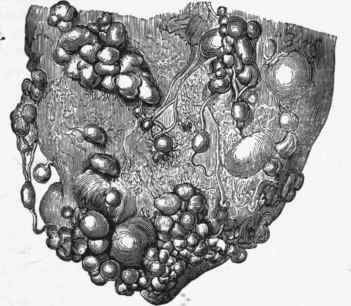
Fig. 133. - A piece of lung in bovine tuberculosis. On surface of lung many-rounded tumours are seen, some pendulous. (Virchow).
In swine tuberculosis is a frequent disease. It resembles bovine tuberculosis in its general characters as well as in its tendency to calcification.
Tuberculosis is very common in monkeys, in which animals it usually begins in the lungs, but is apt to extend to other organs in the form of chronic general tuberculosis, so as to form numerous comparatively large foci, which usually break down and produce cavities.
Tuberculosis In Fowls
This disease is due to a bacillus which closely resembles the ordinary tubercle bacillus, but differs in its appearance in cultures and in its virulence in different animals. (See in section on Bacteriology).
Literature
For an account of the various forms of tuberculosis in animals see Koch, Etiology of Tuberculosis, Syd. Soc. transl., 1886; and Johne, in Biroh-Hirschfeld's Lehrbuch d. path. Anat., where a full statement of the literature is given; see also Baumgarten, 1. c.; Creighton, Bovine tuberc. in man, 1881. Nocard, Congres pour l'etude de la tuberculose, iii., 1893, and Ann. de l'lnstitut Pasteur, 1892; Maffucci (Fowl tuberculosis), Zeitsch. f. Hygiene, vol. xi., 1892.
Continue to:


My Books

