


IV. Syphilis And Tuberculosis Of The Joints
Description
This section is from the book "A Manual Of Pathology", by Joseph Coats, Lewis K. Sutherland. Also available from Amazon: A Manual Of Pathology.
IV. Syphilis And Tuberculosis Of The Joints
Syphilis does not frequently attack the joints, but rheumatic attacks in syphilitic persons may have some relation to the specific virus. According to Lancereaux, there may be, in the secondary stage, an inflammation like that of acute or subacute rheumatic arthritis, and, in the tertiary stage, manifestations like those of chronic arthritis.
Tubercular Arthritis
This disease is also called strumous synovitis, gelatinous degeneration of the joint, tumor albus, fungous caries, etc. The tubercular virus is the essential factor in the Causation of the disease. In many cases it reaches the joint after having attacked the bone, but the proportion of cases in which it does so as compared with those in which it comes directly is matter of doubt. Tuberculosis of bone will extend to the joints much more readily in the case of some bones than others. As the head and neck of the femur are exposed in the hip-joint in immediate contact with the synovial membrane, extension very readily occurs here.
The disease is mostly one of children, a fact which favours the view that it generally takes origin in the bones. It is chiefly weakly children who are attacked.
The disease begins usually in the Synovial membrane, and consists in a formation of tubercles and a chronic inflammation with great production of granulation tissue. The soft, pulpy granulation tissue gives the synovial membrane a gelatinous appearance, from which one of the names of the disease is taken. There is also a slow enlargement of the joint from the increased bulk of the synovial membrane. The pulpy gelatinous tissue often presents to the naked eye distinct white bodies, the miliary tubercles, and under the microscope the most typical tubercles are visible, as shown in Fig. 299, and also in Fig. 129, p. 308.
The Ends of the bones constituting the joint are affected simultaneously or soon after, and here the characters presented are those of tuberculosis of bone. The medullary spaces become filled with granulation tissue and enlarged by destruction of the bony lamellae. In this granulation tissue there are also tubercles. There is thus, as it were, a pad of granulations under the articular cartilage.
The cartilage also at the sides is partly encroached on and overlapped by the altered synovial membrane which advances over it. In this way it is partly enclosed between two layers of granulation tissue, and it gradually becomes eaten into. The granulations, chiefly those of the medulla, extend into the cartilage, and their encroachment is assisted by proliferation of the cartilage corpuscles, which enlarge and cause softening of the matrix around.
By the absorption of the cartilage the whole joint may be converted into a cavity lined with granulation tissue, and the ligaments also are frequently transformed in a similar way.
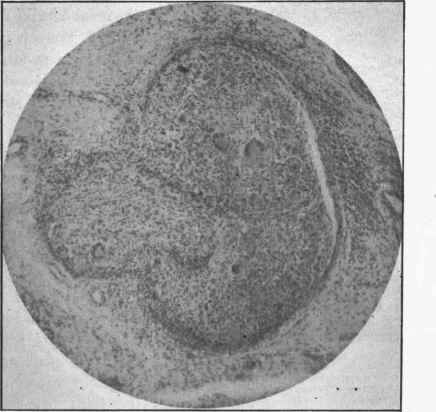
Fig. 299. - A group of tubercles with giant-cells In tuberculosis of the synovial membrane, x 00.
Generally suppuration results, and the joint becomes filled with a fluid which contains debris of tissue and pus corpuscles. Abscesses also not uncommonly form around the joints. Through time the fluid contents of the joint generally find their way outwards, and are discharged by an aperture in the skin. A fistulous canal is the result, forming a communication between the cavity of the joint and the surface, and this canal is also lined with exuberant granulations, which pout out at the opening in the skin. Among the granulations here, as elsewhere, tubercles are found.
The rubbing of the two ends of the bones, which are now covered by granulations, leads to an ulcerative destruction of those soft structures.
The inflammation extends more deeply in the bone as the superficial parts are ulcerated, and so we have progressive caries. For some distance beneath the surface the medullary spaces are filled with granulations and the bony trabecular thinned. It will be understood from this how the disease is apt to recur unless the whole carious portion be removed, for tubercles are present in the granulation tissue filling the medullary spaces, and unless they be removed a fresh extension may occur.
In the neighbourhood of tuberculous joints there is commonly a considerable new-formation of bone by a formative ostitis such as that referred to at p. 552. There may thus be produced irregular projections or osteophytes such as those shown in Fig. 300.
In an early period of the disease, before suppuration has occurred, there may be recovery; but after the occurrence of suppuration, there is seldom a spontaneous restoration, which at best is a slow process. If recovery takes place the granulating surfaces unite more or less, and the joint being partly or completely obliterated, a fibrous union may come about, leading, it may be, to anchylosis.
The author has met with a case in which an early and pure tuberculosis of the synovial membrane presented peculiar characters. There was very great thickening, so that the synovial membrane was converted into a bulky soft grey tissue which overlapped the cartilages, and was so prominent that when the joint was opened for the purpose of excision, the idea of a tumour was suggested. In this case there were large numbers of the most typical tubercles, many consisting almost entirely of giant-cells and epithelioid cells.
Literature
Lancereaux, Traite de la syph., 1874; Konig, Tuberculose der Knochen und Gelenke, 1884; Croft, Path, trans., xxxii., 1881; Watson Cheynk, Brit. Med. Jour., Nov. and Dec, 1890.
Continue to:


My Books

