


5. Bacillus Pyocyaneus (Bacillus Of Blue Or Green Pus)
Description
This section is from the book "A Manual Of Pathology", by Joseph Coats, Lewis K. Sutherland. Also available from Amazon: A Manual Of Pathology.
5. Bacillus Pyocyaneus (Bacillus Of Blue Or Green Pus)
Surgeons sometimes find that the dressings suddenly assume a bright green or blue colour, which may occur without disturbing the process of healing. This is due to a small bacillus which has found access to the secretions of the wound, and has multiplied there. It is a slender rod, often united in small chains of four to six cells. It has very lively movements; no formation of spores has been observed. It has been cultivated in various nutrient media, the culture usually giving a greenish colour. The pigment has been extracted by chloroform, and separated as long needles. It has been observed also in the pus of cases in which the dressings have been stained. This pigment is named by Gessard pyocyanin. This form of bacterium produces in certain animals, especially rabbits and guinea-pigs, suppurative inflammation. In man it is not definitely pathogenic.
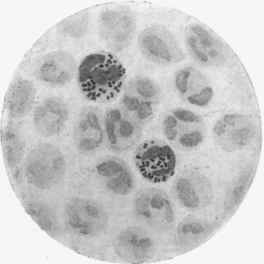
Fig. 140. - Gonococcus. Two pus corpuscles are seen whose protoplasm is filled with diplococci. The nuclei are at one side. From a case of gonorrhoeal ophthalmia, x about 800.
Continue to:


My Books

