


2. Obliteration Of Arteries
Description
This section is from the book "A Manual Of Pathology", by Joseph Coats, Lewis K. Sutherland. Also available from Amazon: A Manual Of Pathology.
2. Obliteration Of Arteries
In several of the affections to be considered in the succeeding paragraphs, partial or complete occlusion and obliteration of arteries occurs, and the processes, although differing somewhat in detail, have many points in common. In all of them there are usually conjoined the two processes of thrombosis and inflammation.
Obliteration by ligature affords the simplest illustration. When an artery is ligatured, the internal and middle coats are torn through, as shown in Fig. 235. In consequence of the injury and stagnation of blood thrombosis occurs, and the thrombus, which contains a considerable excess of leucocytes, extends to the nearest branch, as is well shown in Fig. 27, p. 98. This is followed by inflammatory changes affecting primarily the internal coat. This tunic becomes cellular and swollen so that it bulges inwards and impinges on the coagulum. The inflamed internal coat becomes vascularized, new-formed vessels penetrating into it from the vasa vasorum. The internal goat thus sends buds or projections inwards which replace the thrombus by vascularized grauulation tissue. The new-formed vessels are produced by budding from the vessels of the external and middle coats, and these tunics also take some part in the inflammatory process, but the middle coat is much less active than the external, and its special character disappears in the process. The granulation tissue thus formed has the usual tendency to form connective tissue, and the final result is that the-portion of artery concerned is resolved into a piece of connective tissue-which may form part of the cicatrix of a wound.
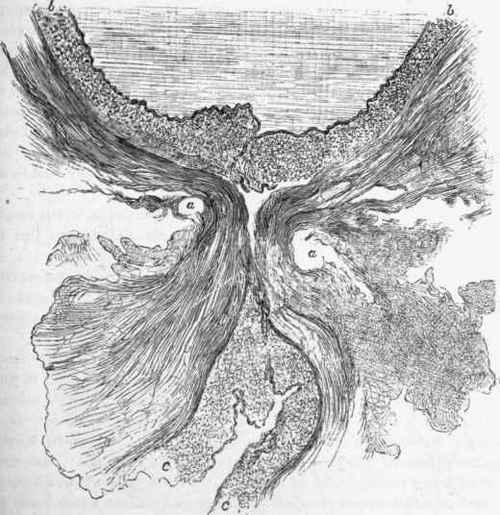
Fig. 235. - Longitudinal section of an artery at seat of ligature, u, a, apertures in which the silk ligature was found. The external coat is drawn in at this place, while the middle and internal coats are absent, being absolutely disjoined. These coats are seen above at b and below at c. x 35.
When Arteries have been wounded a somewhat similar process occurs. If the artery is cut across, the muscular coat by its contraction narrows the calibre of the artery and withdraws it within its sheath. The blood flowing out through the orifice deposits leucocytes, and a clot forms within the sheath and at the orifice of the vessel, by and by completely obstructing it. This coagulum will be a white thrombus. The ensuing processes will be similar to those just de-Bcribed. (See Fig. 27. p. 98, and Fig. 29, p. 100).
In the case of .obliteration from other causes, the process of final organization may go on in the manner described, but it is sometimesinterfered with by the diseased condition of the wall of the artery or by the character of the obliterating agent. If the latter be of an irritating nature, as in septic embolism, then there can be no organization, and if the vessel wall be seriously diseased, as is often the case in atheroma, then the whole process of organization may remain absent. .
Continue to:


My Books

