


Massage Treatment For Digestive System Disorders. Part 7
Description
This section is from the book "Massage Its Principles And Practice", by James B. Mennell. Also available from Amazon: Massage It's Principles and Practice.
Massage Treatment For Digestive System Disorders. Part 7
Treatment must be administered only after due consideration of the cause. We find that there are four main groups of cases, and treatment must be designed to suit the special needs of each group. The first comprises the victims of habit, and those in whom the trouble arises from taking an insufficiency of fluid, from poisoning, from disorder or disease of various portions of the bowel or the liver, from visceroptosis and kinking, or from muscular atony, and also post-operation cases.
The second comprises cases in which a definite accusation of over-feeding and insufficient exercise can be established, and hysterical patients.
The third comprises all cases of deficient innervation from whatever cause.
The fourth comprises all those cases in which the constipation is due to the presence of growths in the bowel, to narrowing by stricture of the bowel, or to pressure from external growths or tumours. It should also include most cases in which there is obstruction by bands or adhesions, and all cases in which the constipation is dependent, in whole or in part, on the presence of irreducible herniae.
Massage should ordinarily find no place in the treatment of a case of constipation the origin of which can be traced to any of the causes mentioned in group four. Occasionally it may be used in an attempt to stretch intra-abdominal adhesions. The chance of success is small, and there are possibilities of damaging a piece of bowel that is attached to, or pressed on by, the adhesion. Great care should therefore be exercised, and treatment should consist of slow, steady, and gentle pushing movements. If possible, the abdominal wall may be picked up and tension made on the adhesion by gentle pulling.
Treatment for cases comprised under the third heading should follow on the lines advocated for the treatment of neurasthenia. The constipation is purely secondary, and depends for its cure on that of the main illness. To try to enforce activity by direct massage is to risk the effects we should expect from flogging the over-tired horse. Slow, gentle, rhythmical stroking over the ascending and descending colons - provided, of course, that the abdominal wall is perfectly relaxed - will help the local condition, but nothing in the form of vibration of the iliac colon or of an attempt to secure the gluteal or sacral reflexes should be allowed.
In treating the glutton or the bon-vivant we can go "all out." For reflex effect the patient may, if desired, be treated prone, and a firm beating over the sacral region may be administered with the ulnar borders of the clenched fists. In addition to, or instead of, this treatment, the patient is rolled on to the right side, the pillows are taken away, and the back is bowed. The left hip is well flexed and hacking is administered to the gluteal region to secure the so-called sciatic reflex. Then the patient is placed upon the back with the pillows under the head, so arranged that the shoulders also are slightly raised and the knees flexed over another pillow. The whole abdomen is treated by small circular frictions with moderate pressure, the skin moving with the fingers. Deep stroking of ascending and descending colons is then performed, an occasional break being made for vibration over various parts of the colon, but particularly over the iliac colon. However vigorous our treatment may have been hus far, it must not now be other than slow, gentle and rhythmical, and the vibrations must be well spaced.
This description has been misinterpreted to an extent that seemed hardly possible, and I have seen a mild, gentle "pawing" of the skin of the abdomen administered under the impression that it was what I advocated. By "slow" I wish to indicate that very rapid and heavy-handed deep-strokings should be avoided, and that a second stroke should not be begun over any given part until sufficient time has elapsed to allow the peristaltic wave of contraction to pass through all its stages, not only of contraction but also of relaxation. By "gentle" I mean that, provided the bowel is definitely pressed upon, there is no need to grind it between the fingers and the posterior abdominal wall. Compression is essential: crushing is detrimental. By "rhythmical" I wish to imply that unevenness in movement should find no place in treatment. A regular, even movement will not excite reflex contraction (protective) of the abdominal muscles, and, if these are maintained relaxed, our task is far more easy than if they are irritable and constantly passing into spasm.
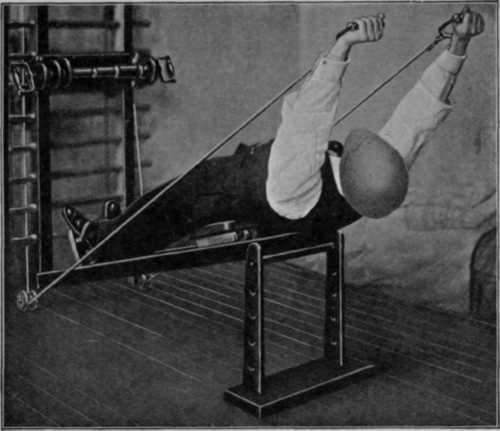
Fig. 149. - To show how the use of the sliding-seat and of the weight and pulley can be combined to afford a full dose of exercise to most of the muscles in the body.
Gentle kneading over the region of the gall-bladder follows - the chest, over the liver area, may be hacked, if so desired - and then the pillows are taken away from the head and shoulders and placed under the thighs and knees so as to secure a marked flexion at the hip-joints. Every assistance is now given to the portal circulation, and the local portion of the seance has come to an end so far as the actual massage is concerned. Many of these patients require treatment for obesity (see p. 373), and, as is usual in nearly all massage work, the prescription of exercises is absolutely essential to success (see Fig. 149). In every table breathing exercises should find prominent place. A little general massage to the back and to the limbs will not be amiss.
When treating the cases classified together under the first group due regard should be made to the requirements of each individual. The victim of lack of habit will derive most benefit from stroking of the ascending and descending colons and friction of the iliac colon. Even the old remedy of rolling a five-pound cannon ball over the colon may prove effective! But treatment will prove unavailing unless the necessity of establishing a regular habit is insisted upon, and to this end a pipe or cigar between breakfast and the start of the day's work may prove of valuable assistance. Sometimes a glass of cold water after breakfast may prove efficacious, or even a compulsory pause for reading or needlework.
Continue to:


My Books

