


Chapter XXVI. The Treatment Of Constitutional Disorders
Description
This section is from the book "Massage Its Principles And Practice", by James B. Mennell. Also available from Amazon: Massage It's Principles and Practice.
Chapter XXVI. The Treatment Of Constitutional Disorders
The symptoms which massage treatment is called upon to relieve, when dealing with general constitutional disorders, are those arising from toxicity, whether this be due to sepsis, rheumatism, or to the accumulation of waste products within the body.
Lumbago may be taken as typical of all myalgias. Massage treatment can frequently abort an attack, and can usually cure one when fully established. It cannot prevent repetition. Nothing can do this except the removal of the cause, which may entail appendicectomy, extraction of all the teeth, the cure of constipation, or proper regulation of diet and exercise. Sometimes the attack is a pure rheumatic symptom. Similar symptoms may be due to causes referred to in the previous chapter, where appropriate treatment was considered.
By some means or another the patient must be rolled on to the face - a very painful proceeding in an acute case, though the return journey may be a very simple matter. In the so-called "rheumatic" lumbago the cause of the pain is unknown; but, judging from the effects of treatment, we can only conclude that some deposit has been formed in the deep structures of the back, and that the nerves which pass through them are thereby involved. It is possible that the muscles collect waste products within themselves, and that the pain originates in pressure on the sensory nerves in the muscles.
Whatever the cause, treatment is simple and effective. Surface stroking is followed in three or four minutes by ever-increasing depth of stroking from the region of the sacrum to the upper dorsal region. The hands should work on either side of the spinous processes. The whole erector spinae should then be lateralised by stroking with the ball of the thumb along the edge of the processes so as to push the muscle mass away from them. Then the movement should be repeated from the outer border of the muscle, the pressure being directed towards the spine. Deep kneading should follow, beginning over the mid-dorsal region and working upwards. The lower dorsal region is next treated, then the upper again, and slowly each successive segment is attacked right down to the sacrum. Before starting to treat a new segment, all the area above should be dealt with anew, either by kneading or by deep stroking.
Dry cupping is a very favourite remedy. The technique is simple: all the apparatus required is a Bier's cupping glass of about 2 inches diameter and plenty of vaseline. The latter is spread thickly over the area to be treated and the cup is then applied. The skin is drawn up into the cup by the suction and the treatment begins. The glass cup is pulled directly away from the surface, care being taken not to elevate or depress any one part of the circumference of the glass. Not only is the skin under the cup thus elevated, but also all the surrounding area. The cup is then pushed to and fro over the surface, the upward traction being maintained and the circumference of the cup being kept flat. At times air will leak in and the cup become detached. It is then replaced, and the process is renewed till the whole surface is a uniform pink colour. At the start the cup will become detached whenever a bony prominence is approached; as treatment continues this liability lessens, till finally it is usual to be able to pass the cup right over most of the bony prominences. The skin should show no sign of bruising next day. Occasionally, especially if sepsis has been present, cupping is liable to produce a pustular rash. It should then be discontinued.
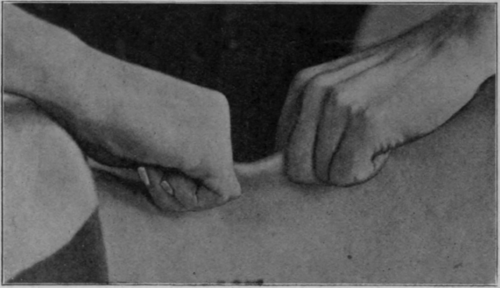
Fig. 148. - To show "dry cupping" of the back by massage.
In China a similar process is performed by the hands as a special movement of massage. The skin and subcutaneous tissues are gripped between the middle phalanges of the first and second fingers, and they are then elevated as far as possible (see Fig. 148). It is a useful movement and may be freely administered as soon as the pain is subsiding.
Throughout treatment care must be taken that no manipulation is performed that increases the pain. Anything that tends to do so should be postponed, and one of the earlier movements must be persevered with until the deeper movements can be tolerated with impunity. The seance should not be unduly prolonged, about half an hour being fully adequate. The deeper movements especially must not be continued for more than a few minutes over any one spot. The aim of treatment is to hasten the onflow of the lymph and of the venous circulation, and to ensure that the arterioles are toned up. Prolonged treatment may defeat the object by producing a paralytic dilatation. The seance should terminate with stroking.
In a chronic case of some standing, percussion may be essential to secure relief. Deep vibrations are probably more effective than any other form. Local areas of tenderness or thickening should be treated by frictions.
Not infrequently, and particularly in gouty subjects, definite deposits can be felt in the tissues. These may consist of "nests of crystals." One such "nest" has been examined. Dr. F. Radcliffe reports the result in the Lancet, p. 103, 1918: "The material was found to consist of a mass of fat-cells lying in a coarse stroma of connective tissue, fibrin and some elastic tissue. No crystals were found." Yet previously, at operation, "crystal-like" structures had been distinctly felt, and these "disappeared" within two minutes of being placed upon the slide. He asks: "Were these crystals volatile?" and there is little doubt they were. For our present purpose this speculation is unimportant; the point is that definite pathological nodules do exist and that they cause intense pain. It is certain, too, that much can be done by frictions to cause them to disappear. Dr. Radcliffe's account of the technique used is so identical with my own that I merely quote from the above article. "After some weeks of constant practice," he says, "I was able myself to localise the tender areas," thus showing the necessity of cultivating the sense of touch in a very specialised way before attempting to undertake treatment. He. continues: -
Continue to:


My Books

