


IV. Exercises For The Rotators Of The Trunk. Part 4
Description
This section is from the book "Massage And Medical Gymnastics", by Emil A. G. Kleen. Also available from Amazon: Massage and medical gymnastics.
IV. Exercises For The Rotators Of The Trunk. Part 4
Wing-stride-standing Wing-loin-lean-stride-standing Wing-high-ride-sitting Spring-sitting Trunk-rolling.
Trunk-rolling can be done actively as well as passively, but as the passive form is most used in medical gymnastics the movement is described here together with the other passive trunk exercises.
It is performed by the trunk being carried, in as large circles as the mobility allows (forward, to the left, backward, to the right, and forward again), eight to twelve times in each direction. Inspiration during the backward part, expiration during the forward part, of the circle of movement.
Effects And Uses
(a) Mobility of the joints is increased.
(b) Respiration is aided. .
(c) Portal circulation is aided.
(All in practically the same way as in circle-turning, though more strongly.)
(d) By the strongly increased pressure in the abdomen in forward and side bendings a mechanical stimulation is produced on the whole alimentary canal, so that the activity of the cells, secretion of the digestive juices, and peristalsis are strongly stimulated.
(e) When the movement is done actively there is also exercise of the muscles round the trunk, going between the pelvis and the thorax, and a stronger effect upon digestion and peristalsis. On this account the movement has an extensive use in general gymnastic treatment, and in the treatment of diseases both of the digestive and respiratory organs. For heart patients, on the contrary, it is often too strong.
Wing-Stride-Standing And Wing-Loin-Lean-Stride-Standing Trunk-Rolling
In these positions it is most often done actively.
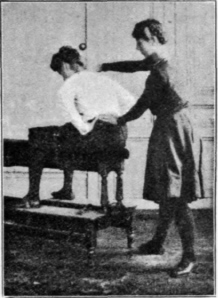
Fig. 113a.
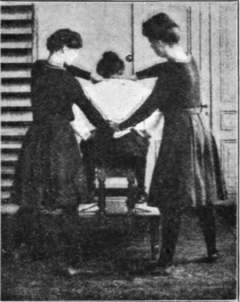
Fig. 113 b.
It takes place both in the hip joints and in the joints of the spine : most of the muscles going between the thigh and the pelvis and between the pelvis and the trunk arc brought into action.
Used especially for home gymnastics.
Wing-high-ride-sitting Trunk-rolling (Fig. 113, a and b).-Here the movement is usually passive, and the patient is best fixed by a.strap across the legs (near the pelvis). The gymnast stands behind the patient and lays one hand on his shoulder (close to the neck), the other on the sacrum if he is working alone.
If two gymnasts are obtainable the movement is considerably easier. They grasp with their outer hands the patient's shoulders; the inner hands are laid on the sacrum so that the pelvis can be supported both at the sides and behind. The movement is performed as described above, but ought to take place chiefly in the joints of the spine and as little as possible in the hip joints. (N. B. - When the patient is bent forward the pressure on the sacrum is lessened so that the pelvis can move slightly backward.)
If the patient has difficulty in being quite passive he may help a little with the movement.
Spring-Sitting Trunk-Rolling
Used for treatment of scoliosis (see the Special Scoliosis Exercises).
Wing-stoop-stride-sitting Wing-high-ride-sitting Wing-arch-low-knee-stride-standing Wing-arch-high-knee-stride-standing Screw-twisting.
This movement is always passive. It is performed by the patient's trunk being turned from one side to the other, first slowly and a little way, then more quickly and with larger excursions, which decrease again, at the same time diminishing in speed. The movement is repeated with short pauses two to three times, with ten to fifteen rotations in each series.
Effects And Uses
(a) Loosens the joints,
(b) Produces a mechanical stimulation of the walls of the alimentary canal, so that the activity of the cells and the secretion of digestive juices and peristalsis are increased.
(c) The lungs are also affected by the shaking, so that the activity of the cells and the interchange of gases between the tidal air and the residual air are increased. The movement helps the loosening and expectoration of mucus and stretches any adhesions present between the lung and chest wall.
(d) If the movement is given in strong arch position it repletes strongly the abdominal and pelvic organs (Brandt).
Wing-Stoop-Stride-Sitting Screw-Twisting
Two gymnasts, standing behind the patient, lay their outer hands in front of his shoulders, the inner hands between his shoulder-blades and on each other.
The movement is performed as described above. Care is taken that the patient maintains stoop position throughout.
In this form the exercise works most strongly upon the abdominal organs; also stoop position depletes them.
Wing-High-Ride-Sitting Screw-Twisting
Grasp as in the preceding. Acts chiefly on the thoracic organs.
Wing-Arch-Low-Knee-Stride-St.Screw-Twisting. - The gymnast stands in walk-st. position behind the patient, the front foot pushed well forward between the patient's knees. Grasp at the axilla either from below or in front. The patient is first drawn somewhat forward and then bent backward over the gymnast's knee, which supports him at the sacrum, so that strong arch position arises, after which the movement is given.
N.B. - Stretch in the long axis of the trunk.
Continue to:


My Books

