


III. Movements For Side Muscles Of The Trunk
Description
This section is from the book "Massage And Medical Gymnastics", by Emil A. G. Kleen. Also available from Amazon: Massage and medical gymnastics.
III. Movements For Side Muscles Of The Trunk
By "side muscles" are meant all the muscles going lengthwise and lying on the same side of the middle line, both at the back and front. We divide the exercises for these muscles into two large groups.
A. Movements with eccentric and concentric work in Lengthening (i.e., In The Outer Part Of The Range Of Movement) For The Muscles Of The Side From Which The Flexion Is Made.
The common effects of the movements belonging to this group are: -
(a) Exercise for and development of the muscles, and increase of the mobility of the joints (also of the ribs).
(b) Alternate expansion and compression of the sides of the chest, so that ventilation of the lungs is assisted, and the adhesions which may exist between the lung and the chest wall, or contractions of the pleura and lung tissue, are stretched. (N.B. - They cannot be used as special exercises for scoliosis.)
Free-standing
Neck-rest-standing
Half-stretch-standing
Stretch-standing
Stretch-stride-standing
Free movement. The patient bends the body, without any rotation, to the side as far as possible, but tries to localise the flexion to the upper part of the spine (= dorsal region) and straightens again. Repeated alternately to both sides three to five times in time with breathing. Expiration during side-flexion, inspiration during raising. (N.B. - In these side - bendings the muscles also work on the side towards which the flexion is made concentrically, slightly at the very beginning of the exercise, until the line of gravity falls to one side of the vertebrae, and at the end of the flexion to take the movement to the very limit.)
The exercise can also be taken in turn position, when the flexion is made to the same side to which the body is turned. It is repeated three to five times to the same side, and then an equal number of times to the other side (after changing turn position).
In Half-stretch-turn-standing-position the arm of the forward turned shoulder is stretched, and the side-bending takes place to the side away from the stretched arm.
Turn position causes the action of the muscles to be varied and the mobility of the joints to be increased, but the most important effect is that the stretching of contractions and adhesions is considerably increased.
Wing-high-ride-sitting Neck-rest-high-ride-sitting Half-stretch-high-ride-sitting Stretch-high-ride-sitting
Side-bending (and -raising) (Fig. 103).
Wing-High-Ride-Sitting Side-Bending
Resistance exercise. The gymnast stands behind the patient and grasps him in the axilla so that the hand is close to the trunk. Supporting the patient's back with his own chest, he bends him straight to the side while the latter resists. Then the patient raises himself again to the starting position against the resistance of the gymnast.
Like the preceding exercise, it may also be done in turn position. and the same applies to this as was said of the last exercise.
In Neck-rest-sitting starting position the grasp is at the elbows, in Stretch-sitting at the wrists, in Half-stretch-sitting with one hand on the wrist, the other in the other axilla. (N.B. - Stretching in the long axis of the body must not be omitted.)
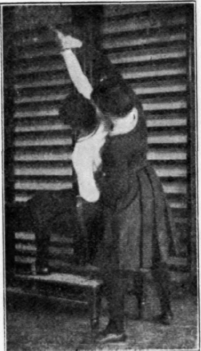
Fig. 103.
This movement can be regulated better than the preceding, and the muscular action is limited to the muscles of the trunk, because the pelvis is so firmly fixed by the starting position.
Wing-hip-lean-walk-standing
Neck-rest -hip-lean -walk -standing
Half-stretch -hip-lean-walk-standing
Stretch-hip-lean-walk-standing.
Side-bending (and -raising) (Fig. 104).
The inner leg (nearest to the support) forward. The gymnast stands behind the patient. Grasp as in preceding exercise. Flexion towards supported side. Otherwise similar to preceding exercise.
Effects And Uses
Chiefly similar to the preceding, but because the pelvis is not so firmly fixed the hip muscles also work to fix the pelvis.
B. Movements with concentric work in shortening (i.e., the Inner Part Of The Range Of Movement) For The Muscles Of The Side Towards Which Flexion Takes Place.
These exercises as well as the strong passive side-bendings of the trunk are used in treatment of scoliosis and are described in connection with the other special scoliosis exercises.
Continue to:


My Books

