


Part 196. Cryptograms And Phenogams - Plant Life-Histories. Part 2
Description
This section is from the book "Plants And Their Uses - An Introduction To Botany", by Frederick Leroy Sargent. Also available from Amazon: Plants And Their Uses; An Introduction To Botany
Part 196. Cryptograms And Phenogams - Plant Life-Histories. Part 2

Fig. 380.-Norway Spruce. Growth of embryo. A, early stage, 190/1. B, later stage, 22/1. C, half-ripe embryo, showing below the protrusions from which the cotyledons are formed, 22/1. D, same, cut vertically. E, same, end view, showing the eight rudimentary cotyledons surrounding the stem-tip. F, embryo, fully formed (8/1), cut vertically to show the seed-leaves or cotyledons (c), the seed-stem (h), the beginning of the root (pl), root-cap (cp), fibrovascular cylinder of root (cl), pith of stem (m), and rudimentary fibrovascular strands (op) surrounding it. (Strasburger.)
In view of the many resemblances between Pinaceae and Lycopodiaceae it has been thought that plants closely related to the club-moss trees of the coal-period may have been the ancestors of both of these cone bearing groups. It should be said, however, that the remains of extinct gymnosperms represented by Cordaites (Fig. 277, 5) contemporaneous with Lepidodendron, show resemblances to the ancient ferns which indicate that the ancestor of the conifers was more fern-like than might appear merely from a comparison of modern types.
Cycas (Fig. 381) shows even closer affinity with ferns, as for instance, in the ample branched foliage-leaves which unroll as they develop, and the numerous sporangia borne upon a sac-leaf. In general the life-history is similar to that of Pinus, pollen spores being carried by the wind to a little chamber at the tip of a naked ovule to fertilize an egg-cell; but in this case the microspore upon germinating produces in the pollen-tube two motile gametes provided with numerous swimming-hairs. One of these fertilizes the egg-cell. After fertilization a seed is formed, an abundance of extra food being stored about the single embryo. The sporophyte as it develops becomes, as we have seen, singularly like a tree-fern and at the same time so closely resembles a Metroxylon as to be called by florists a "sago-palm." While we must of course regard this outward resemblance as more or less superficial, it gains significance from the presence of much deeper, resemblances which have led botanists to regard the Cycad-type as a connecting link between the fern and the angiosperm.
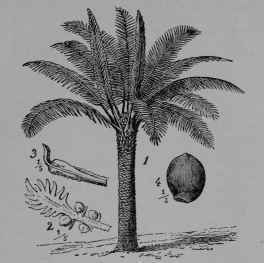
Fig. 381.-Japanese Cycad (Cycas revoluta, Cycad Family, Cycadaceoe). 1, seed-bearing plant. 2, macrosporangial leaf or carpel showing the naked ovules (macrosporangia) near its base. 3, microsporangial leaf, or stamen, showing the numerous microsporangia (anthers) on its lower face. (Wossidlo.)-Tree growing about 3 m. tall; fruit densely hairy. Native home, Japan; commonly cultivated as "sago-palm."
As already shown, the main difference between a gymnosperm and an angiosperm is that the latter incases its macrosporangia in carpellary leaves. Fertilization is accomplished, however, as before by means of a pollen-tube, which, starting from the stigma, has simply a longer road to travel before its tip reaches the egg-cell. Moisture to enable the microspore to germinate is afforded by a stigma, while food for the tubular cell is supplied by the tissues along its route. The parts concerned in angiospermic fertilization are shown in Fig. 382. When germinating, the pollen-cell produces two nuclei, one of which represents the vegetative part of the male gametophyte, while the other is the essential part of a gamete. Here then is a gametophyte reduced to the simplest terms. The female gametophyte formed within the embryo-sac consists of a few cells forming two groups which lie at opposite ends of the macrospore. Those at the micropylar end (ei) include an egg-cell which is thus advantageously situated for fertilization by the pollen-tube entering the micropyle. The growth of the embryo from the fertilized egg-cell involves, as shown in Fig. 383, the formation of a suspensor (et) which pushes the developing germ well into the mass of food. In this example the embryo comes to fill the sporangium completely while still attached to the parent, thus forming an exalbuminous seed, in which radicle, caulicle, and cotyledons are well developed.
Continue to:


My Books

