


Part 193. The Scouring Rushes - Plant Life-Histories
Description
This section is from the book "Plants And Their Uses - An Introduction To Botany", by Frederick Leroy Sargent. Also available from Amazon: Plants And Their Uses; An Introduction To Botany
Part 193. The Scouring Rushes - Plant Life-Histories
Part 193. The scouring-rushes (Class Equisetinae) are represented in modern times only by comparatively small plants of the genus Equisetum (Fig. 369)-about 25 species- which, however, are closely related to numerous gigantic rush-like coal plants, typified by the genus Calamités (Fig. 277, 2).
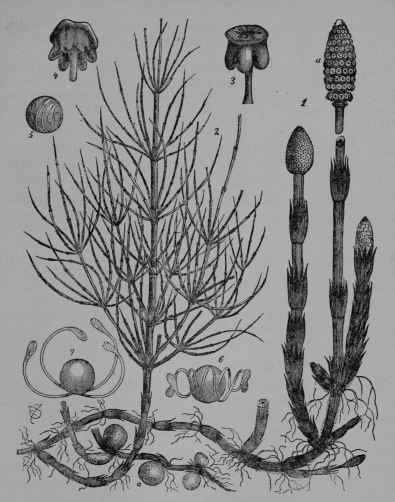
Fig. 369.-Scouring-rush (Equisetum arvense, Scouring-rush Family, Equisetaceoe). 1, spore-bearing shoot with erect branches ending in cone-like clusters (a) of sporophylls or sporangia-bearing leaves. 2, vegetative shoot, with underground stem bearing tubers (a) gorged with food. 3, a sporophyll with sporangia, enlarged. same, showing sporangia split open after discharging the spores. 5, 6, 7, spores with "elaters" wrapping closely, or more or less spread. (Wossidlo.)- Common in moist places.
In Equisetum cross-fertilization is accomplished by having male and female gametophytes which, as shown in Figs. 370, 371, differ considerably from one another, the female being much the larger and suggesting somewhat by its pseudo-leaves the nurse-plant of a moss. The sporophyte differs remarkably from that of any fern in the comparatively great development of the stem. This is hollow except at the nodes, and performs nearly all the work of photosynthesis.
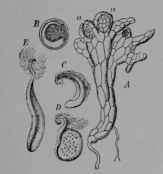
Fig. 370.-Scouring-rush. A, male gametophyte or prothallus (150/1) showing antheridia (a, a). B-E, spermatozoids of various ages, much more highly magnified. (Hofmeister, Schacht.)
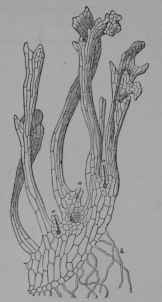
Fig. 371.-Scouring-rush. Female gametophyte or prothallus(45/1) showing archegonia (a, a, a) and pseudo-roots (h). (Hofmeister.)
The roots do not differ essentially from those of ferns, but the foliage leaves are reduced to toothed sheaths serving chiefly to protect the tender regions of the stem. The fibrovascular bundles of the stem are arranged in a ring, and in some forms (mostly extinct) a cambium like that of higher plants is developed which gives rise to successive rings of tissue. Such additional material by which increase in thickness is accomplished takes the name of secondary tissue, to distinguish it from the primary tissue formed by the primary meristem. The epidermis is often so filled with silica or flint, as to render the plants useful for scouring metal, and this accounts for the popular name. Certain subterranean branches of the rhizoma (a, Fig. 369) may have their fundamental tissue gorged with reserve food, and thus form tubers which feed new growth in spring, and may sometimes serve as a means of vegetative reproduction. Among the vertical branches there is often a differentiation into the purely vegetative and the purely reproductive. The latter terminate in a cone-like aggregation of whorled sac-leaves. Each of these has a stalk ending in a shield-shaped expansion, six-sided from pressure. Behind each angle of the shield is a large sporangium dehiscing by a longitudinal slit (3, 4). The spores are peculiar in having four slender arms which close tightly about the spore when moist, and spread apart in drying, thus serving to eject the spores. They are therefore called elaters (5, 6, 7).
The massive, much-lobed gametophyte bearing gametangia above, and the comparatively large sessile sporangia of the scouring-rushes, indicate a closer kinship with the adder-tongues than with the true ferns, and suggest that the Equisetinae may have evolved from Hepaticae somewhat more moss-like perhaps than Anthoceros. They may be characterized as plants similar to ferns except in having relatively much greater stem-development, and in having the leaf-members whorled, the sac-leaves in cones, and the spores with elaters.
Continue to:


My Books

