


Gathering And Preservation Of Fruits. Part 3
Description
This section is from "The Horticulturist, And Journal Of Rural Art And Rural Taste", by P. Barry, A. J. Downing, J. Jay Smith, Peter B. Mead, F. W. Woodward, Henry T. Williams. Also available from Amazon: Horticulturist and Journal of Rural Art and Rural Taste.
Gathering And Preservation Of Fruits. Part 3
" 2. Two windows, (E,) about 20 inches square, placed on each side and opening at 18 inches from the soil, and closed by a double sash, of which the one opens out and the other in. The space between the two sashes should also be carefully filled with straw at the commencement of winter.
" The inside wall has a door (F) and two windows (C); but here the door is simple; the windows are also closed with two sashes, the outside one sliding in a groove and the other opening out.
"As soon as the fruits are collected in the fruit-room, the joints and openings around the windows should be filled with paper, to prevent the air from the space between the walls entering the fruit-room. The four windows are only intended to admit air and light necessary to dry and ventilate the fruit-room before gathering in the fruit. We shall presently see that it is easy to get rid of the interior humidity produced by the presence of fruits, without employing currents of air.
"The ceiling, sustained by beams, is composed of a layer of moss sustained by laths, and covered above and below with a layer of plaster; the whole being one foot thick. This mode of construction is necessary to exclude the influence of the exterior temperature.
"The roof is thatched a foot thick with straw, and the dormer may be used for storing fodder in; but the points of union between the dormer and outer wall must be perfectly close.
"The floor is of.oak. The walls, and even the ceiling, should have a covering of boards. These precautions serve to maintain an equal temperature, to exclude exterior moisture, and to completely separate the atmosphere of the fruit-room from that without.
" All the interior walls, from within 18 inches of the floor to the ceiling, are furnished with board shelves, 2 feet wide, placed 10 inches apart To facilitate the arrangement of the fruit, the upper shelves (A, fig. 3,) are made to slope downwards in front at an angle of 45 deg.; and this decreases as they come down, until the lower ones within four or five feet of the floor are horizontal.
"The tables or shelves are all made of narrow strips about 4 inches wide; and to facilitate the circulation of air, about an inch of space is left between each strip. The shelves are fixed to the wall by brackets sustained in front by upright posts (D) placed 4 1/2 feet from each other. The cross-pieces (E) attached to the uprights, support horizontal laths (F) or oblique ones (G). "In the center of the fruit-room we reserve a table (I, fig. 2,) 6 feet long and 2 1/2 feet wide, separated from the shelves by a space of 3 feet. This table serves to receive the fruit temporarily, and has a narrow moulding round the edge to keep it from falling off. All the shelves have similar borders.
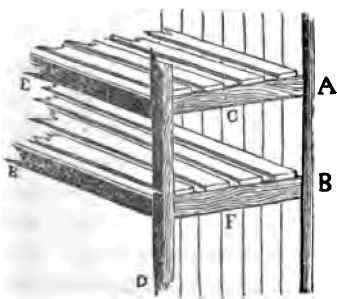
Fig. 3.
"Such is the mode of construction we propose for a fruit-room, by the aid of which we can easily obtain many of the results we have indicated as necessary; that is to say, it will enable us to maintain an equal temperature of 46 to 50 deg. Fahrenheit above zero, and that the action of the light is prevented. As for the other necessary conditions, we shall presently point out the means to secure them. In certain circumstances, much of the expense of a construction like the above might be avoided. If, for example, there were a subterranean cave or a grotto in a rock, a fruit-room might be established in either place, provided they be very dry. The interior fitting up would be the same.
"As the fruits are brought into the fruit-room, they are deposited on the table, which is covered with a thin layer of dry moss. There they are assorted; each variety is placed separate, and all unsound and bruised specimens are taken out. The sound fruits are left on the table two or three days, in order that they may part with some of their moisture. The shelves are then covered with a thin layer of dry moss or cotton, to prevent the fruits from being bruised by their own weight We then proceed to wipe the fruits lightly with a piece of soft flannel, and arrange them in rows on the shelves, leaving a space of a fourth of an inch between each, and keeping each variety separate, and placing similar varieties next each other.
"The fruit-room may not only serve for the preservation of kernel fruits, but for grapes. The Chasselas varieties in particular keep well in this way. We proceed with them as follows : Each bunch is cleared of all decaying or unsound berries and fixed by the point on a small wire hook formed like an s (fig. 4). Thus attached it is less liable to decay, as the berries have a tendency to separate from each other. The bunches are then hung by the other end of the $ hook around one or two hoops (fig. 6) placed one above the other, and suspended from the ceiling of the room, and rendered moveable by two small pul-lies. If it be desired to keep in this way a large quantity of grapes, space may be economized by substituting for the hoops wooden frames (fig. 6) about four feet square. These frames are furnished with strips or rods separated from each other by a space of 3 or 4 inches, and having on one side small pins to suspend the crotchets of grapes on. These frames are also fixed to the ceiling so as to occupy all the surface, and, like the hoops, to move up and down as may be necessary.
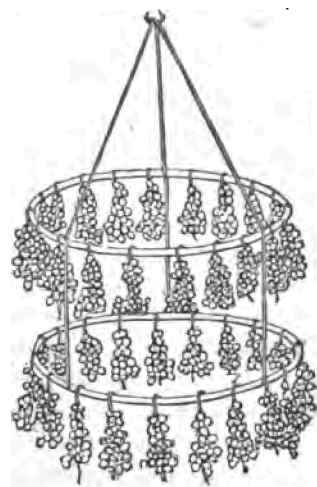
Fig. 5.
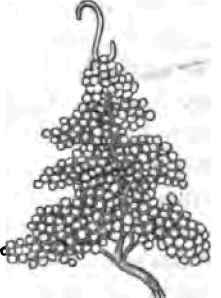
Fig. 4.
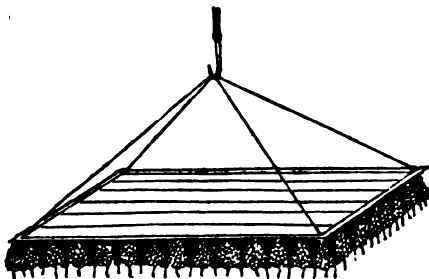
Fig. 6.
"The grape-growers of Thomery, who preserve a large quantity of grapes, content themselves with placing bunches on wire frames, on which they probably spread a thin layer of very dry fern.
Continue to:


My Books

