


Garden Wheelbarrow - The Whimsie
Description
This section is from "The Horticulturist, And Journal Of Rural Art And Rural Taste", by P. Barry, A. J. Downing, J. Jay Smith, Peter B. Mead, F. W. Woodward, Henry T. Williams. Also available from Amazon: Horticulturist and Journal of Rural Art and Rural Taste.
Garden Wheelbarrow - The Whimsie
This barrow, although light and simple in its construction, is composed of eight different parts, which may be used as a whole or separately. We translate from the Revue Horticole.
These parts are: 1st, a tilting or self-unloading barrow (a bascule); 2d, a hand-barrow; 3d, a roller for settling the earth of platbanks and seedbeds; 4th, a plough for scraping walks; 5th, a rake; 6th, a watering-pot; 7th, a single ladder; 8th, a double ladder.
The garden barrow may be used for carting earth, sand, bundles of straw or hay, fagots, etc.; it is intended for watering, settling, and raking walks, rolling the platbanks or seedbeds so as to level the earth; it can also serve in the gathering of fruits, the pruning of trees, and, lastly, in the building of pale-fence.
The roller which acts as the wheel of this barrow prevents its being so readily overturned as the ordinary one, and is much less fatiguing to the workman, inasmuch as it merely requires to be pushed or drawn, keeping itself in equilibrium. It possesses another advantage; namely, the roller makes no rents in the garden, but, on the contrary, settles and levels the walks and sod.
The barrow is arranged in such a manner that nine-tenths of the weight bears upon the roller, so that a loaded barrow can be easily managed by a child of twelve years of age. The barrow is readily unloaded, by simply tilting it.
By the removal of a single bolt, the upper portion, or body, is removed, and the handbarrow remains.
The plough, or scraper, serves as the foot of the handbarrow. This plough, of which the coulter has an oblique direction, is easily managed and admirably adapted to cutting roots; the rake which follows is of iron, and collects the large weeds, which can be thrown into the barrow.
The plough and rake can be readily removed; to effect this, it is only necessary to take out a bolt and two keys.
This part, as well as the body, being removed, there remains the handbarrow, which, when half opened, forms a double ladder, the separation of which is limited by a brass rod; if entirely opened, it presents a single ladder, solid and light, and of four or more metres* in length.
The following description more clearly explains the details of this useful addition to the implements of the gardener. The figures are on a scale of 0.05 for 1 metre: -
A. Roller which serves as the wheel of the barrow.
B. Axle of the roller.
C. The tilting body.
D. Axle of this body.
E. A line indicating the position of this body whon it is tilted in order to unload it.
FF, Frame of the barrow, forming a handbarrow when the body is removed, and ladders when the plough is taken off. G. Bolt connecting the two parts of the machine. HH. Iron points for holding the ladders firmly in the ground, I. Handles of the barrow. J. The levelling plough (Fig. 3).
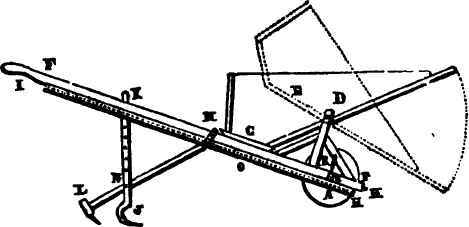
Fig. 1. - General aspect of the barrow.
A metre is equal to 1.093633 yard. - Trans.
K. Mortises for fastening the plough by means of keys. These mortises are pierced with several holes so as to decrease or augment the length of the coulter of the plough.
L. Rake (Fig. 3).
M. Bolt which fastens the rake.
N. Screw-bolts which connect the plough with the rake.
0. Watering-pot placed underneath the barrow, and which can be closed at pleasure by means of a valve.
R. Rods moving in the frame, and serving, by means of a key which traverses them, to fasten together the two parts of the frame which constitute the double ladder. These rods will likewise keep the ladder at a proper distance from the wall, so as not to injure the trees.
P. Rod which limits the separation of the double ladder. (For the other letters of this figure, see description of Fig. 1).
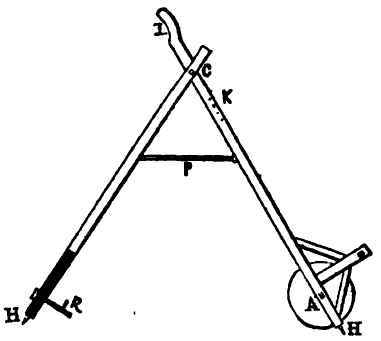
Fig. 2. - Double ladder.

Fig. 3. - SlNGLE LADDER.
II. The handles which serve as a resting point for the ladder when open.
Q Q. Iron plate which keeps the roller clear of dirt. When the single ladder is used the roller is beneath. RR. Ends of the rods which protect the trees when the ladder is applied against a wall. (For the other letters of this figure, see description of Fig. 1.) N J. Screw-bolts which fasten the scraper to the rake. (For the other letters of this figure, see Fig. 1).
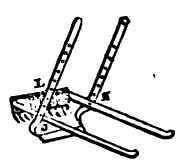
Fig. 4. - Side VIEW OF THE SCRAPER AND RASE.
The above implement will be found of immense advantage to the owners of parks and large gardens. Its construction is not expensive, as it may readily be made for from $15 to $20. Its various component parts, if purchased separately, would cost from $30 to $40.
Continue to:


My Books

