


Garden Furniture (2)
Description
This section is from "The Horticulturist, And Journal Of Rural Art And Rural Taste", by P. Barry, A. J. Downing, J. Jay Smith, Peter B. Mead, F. W. Woodward, Henry T. Williams. Also available from Amazon: Horticulturist and Journal of Rural Art and Rural Taste.
Garden Furniture (2)
We continue our extracts and illustrations from Mcintosh's Book of the Garden : "Fig. 9 shows the elevation of the very elaborate moss-house in the grounds at Dalkeith Palace. It is now thatched with straw, but was formerly with heath. The roof projects four feet over the walls, forming a piazza or colonnade round the four sides, and is supported in front with oak rustic columns, and curvilinear brackets between. The floor is laid in manner of a brick floor along the front and ends.
"Fig. 10 is an elevation of the front wall under the colonnade, showing the casement windows, of which there are four in the building, the other two being placed one in each end. In front of these two windows are placed two rustic seats with open backs, which protect the glass, and, at the same time, do not much exclude the light. The mullions and frames of these windows are of oak, with the bark carefully preserved. The other parts are, as usual, of lead and iron, the center part of each opening for ventilation. The door is in two parts, and simply covered with thick pieces of oak bark on both sides. The door frame is the same as that of the windows. The three panels over the door and windows are inlaid with pieces of oak, each cut into four sections, as are also the margins at the two ends. The roof of the colonnade all round is covered with different colored mosses within.
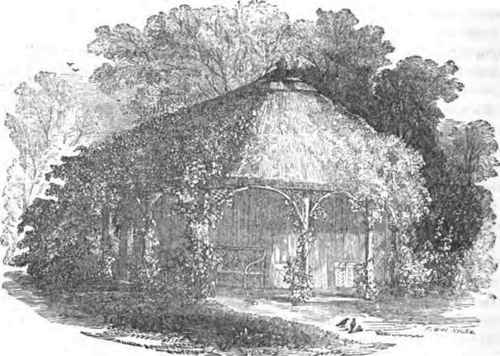
Fig. 9.
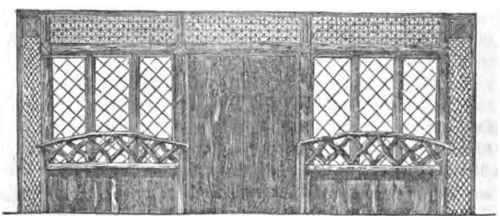
Fig. 10.
"Fig. 11 is the elevation of the two ends, showing the position of the windows. The surface is covered with shells, set in plaster of Paris, those under the windows being oyster shells, the other parts being done with smaller ones, found abundantly by the sea-side.
"The floor of the interior is of brick, not by any means in accordance with the other parts of the building. The seats are all portable, and consist of a sofa and six chairs, two of which are representations of arm-chairs, hollowed out of the trunks of two old oak tress very much covered with excrescences: the others are light chairs formed of hazel, and the seats cushioned with Poly-trickium commune. The sofa is also cuishoned with the same, the back being open wickerwork. The table is circular, set on a clawed stand, and covered with a matting of Polytrickium.
"The side walls are covered with moss. In the center of the back wall is a representation of a ducal coronet, done in fir cones. The roof is of Sphagnum palustre, a white moss; and in the center is a stag, three-fourths of the natural size, (the crest of the Scotts of Buccleuch,) done in a very ingenious manner with small rods of young larch. A cornice runs round the interior, formed of spruce cones, (fig. 12, a,) with those of Pinus sylves-tris, or Scottish fir, (c c,) and of both alternately, as at d, and square knobs of oak, divided into four sections, as at b.
" Summer-houses are and may be constructed in a great variety of forms, and of different materials. Very neat resting-houses may be formed of 4-inch quartering, set upon a base of brick or stone, so as to raise the timbers one foot from the ground. These may be lined on one or both sides with boarding, and that covered with imitation basketwork, or designs formed of larch, oak, hazel, or any other wood, selecting the smooth branches; or, if desired, it may be covered with cones of various species of pines, so arranged as to produce a very pleasing effect. The rough bark of trees - oak, for example - may be used to cover the whole, or the sides may be divided into panels, with pieces of branches or cones, and the panels filled in with smooth or rough bark, according to fancy. Similar houses may also be constructed, by covering the quartering with lath, and plastering with good sound hair plaster, the surface of which, while wet, may be dashed with clean gravel, pebbles, small shells, scoriae, spars, etc., sifted so as to be of a uniform size. Shells of various kinds are often used for such purposes, and are stuck in while the plaster is soft, and very pretty devices are often formed by them.
As this work requires to be done expeditiously, it is necessary to have the shells sorted and close at hand; and to render the pattern or design as perfect as possible, it should be traced on the plaster first; and this process will be much facilitated, if the pattern is cut out in sheet-iron, thin boarding, etc., which being laid on the plaster, the lines can be traced with great accuracy and despatch.
" Again, great variety of design may be given to the plastered walls, 'Lines may be drawn by the trowel, straight, wavy, angular, intersecting, or irregular. Stripes, checks, squares, circles, or trellis-work, may be also imitated. Wickerwork is a very general subject of imitation, and this is produced by pressing a panel, generally a foot square, of neatly wrought wickerwork against the plaster when moist. It is evident that this description of ornament might be greatly varied and extended, and that, instead of the panel of wickerwork, wooden plates, of patterns such as those used by room-paper printers, might cover the walls with hieroglyphics, with sculptures of various kinds, with imitation of natural objects, or with memorable or instructive savings, or chronological facts.' - Encyclopedia of Villa Architecture.
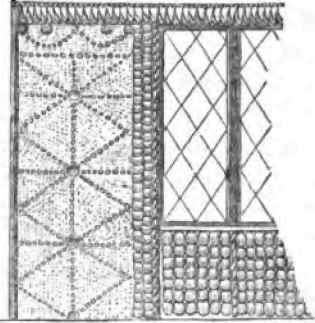
Fig. 11.
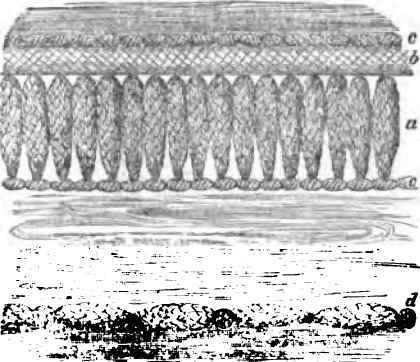
Fig. 12.
" Such walls may have the appearance of age given them by the process called splashing; but in this case they require to be thoroughly dried, if the splashing is to be composed of glutinous material, or in oil colors, which are by far the most durable. If splashing is to be done in water colors, it matters not whether the walls be dry or not. As a general rule in splashing or even plain-coloring walls with oil colors or with glutinous material, the walls should be thoroughly dry, and it should be done at a season when they are not saturated with moisture. 'The reason for these rules is, that water colors do not impede the evaporation of moisture from the wall, and the absorption by the mortar of carbonic acid gas, by which it is hardened and rendered durable; while glutinous colors, by closing up the pores of the surface, do both.'
"Fig. 13 is in the simpler rustic style. One-half, which forms the front, is supported upon larch or oak posts, without plinth or pediment. The roof is simply thatched with heath or reeds, and the whole exterior nearly covered with creeping roses, clematis, etc. The whole of the inside is covered with moss of the commoner kinds.
The floor may be clay or dark-colored concrete. "Fig 14 is a very pretty garden seat. It may be attached to a stump, as in the drawing, or to a growing tree, which would be better.
" The fewer fences admitted into picturesque scenery, the better. Everything having the appearance of confinement, or defined limits, takes off from that freedom and expanse which form a leading feature in this style of gardening. " It becomes necessary, however, under certain circumstances, to introduce them as means of protection; and when such is the case they may be used with propriety, for what is useful can not be in bad taste.
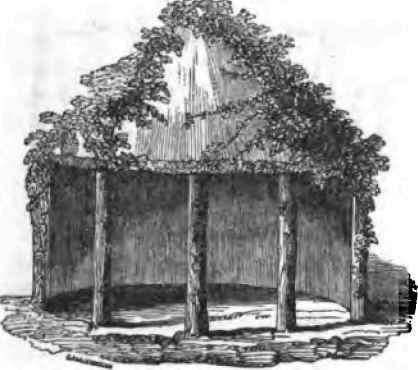
Fig. 18.
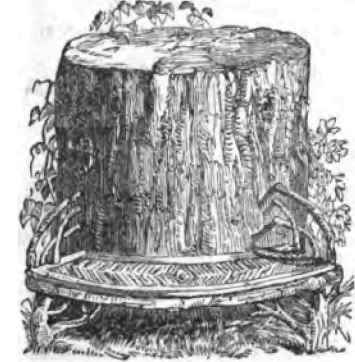
Fig. 14.
"The varieties of fences are numerous, and range from the rudest barriers, without nails or ironwork, to the highest grade of architectural pallisading. The fences admissible into the picturesque style should be of the simplest construction, and, excepting the ha-ha and chevaux-de-frisei chiefly of a rustic character. They are formed of young larch trees, generally on account of their bring straight, and, being the thinnings of plantations, they are unfit for purposes requiring more strength.
"Figs. 15 and 16 are of this description. They are generally fixed structures, although they may be easily constructed in separate pieces, and fitted up after the manner of portable hurdles. The side-posts or uprights should be of sufficient size to give, not only in appearance but in reality, the necessary strength. The longitudinal rails, or principal members, may be of less size; while the pieces used for the minor details should be proportionably more slender, as less strength is required of them. The chief difficulty in the construction of rustic fences is procuring proper material; and this difficulty is increased as we depart from straight lines. When curved lines are used, then dependence must be placed on wood of a flexible nature, such as the willow, hazel, mountain or common ash, etc. Much of the elegance of such fences depends on the correctness with which the joints are fitted together; and to do this in the best manner, mitred joints only should be employed* It is also of much importance, so far as appearance goes, that the bark of the wood be carefully preserved. No doubt rustic fences of peeled wood are often very prettily constructed; but these, till softened down by age, have a very harsh appearance, and few attempts at painting them have been very successful.
Those colors which most nearly resemble the natural bark are the best, and greens and reds are the the worst of all.
"The highest gratia of rustic fences is represented by fig. 17. They may be made portable, and moved about like hurdles, or be stationary and in continuous pieces as far as the fence extends. They may be barked or unbarked, according to taste, but should never be painted.
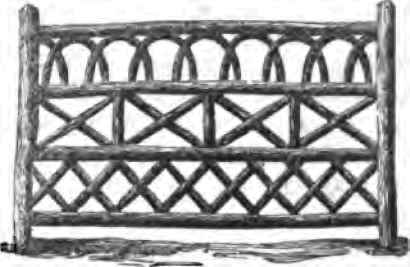
Fig. 15.
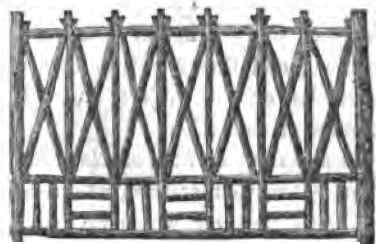
Fig. 16.
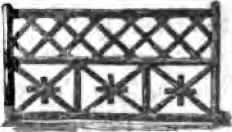
Fig. 17.
Continue to:


My Books

