


Garden Adornments - Designs For Covered Seats
Description
This section is from "The Horticulturist, And Journal Of Rural Art And Rural Taste", by P. Barry, A. J. Downing, J. Jay Smith, Peter B. Mead, F. W. Woodward, Henry T. Williams. Also available from Amazon: Horticulturist and Journal of Rural Art and Rural Taste.
Garden Adornments - Designs For Covered Seats
Op all rural adornments, the covered seat is one of the first things that should command our attention in laying out a garden; if it be but half an acre, it would not be out of place; only let its design and situation be chosen with judgment so as to harmonize with its surroundings, then it will add to the mere beauty of the place, if we say nothing of the health, comfort, and pleasure it will afford our family and friends to quietly enjoy the pure air, a fine view, or a book.
The following designs will be found particularly interesting, from their novelty, simplicity, and economy of construction; and may be built by any one with a little ingenuity, from the trunks, branches, and roots of trees; only being particular that the wood is cut at a time of year when the bark will stay on. One of the prettiest and most novel of these is the Arbor Seat, and one of the cheapest to build, as it takes but one post, and has a trellis roof, and may be built lighter and rougher than any other, with better effect, being covered with vines, which by judicious training could be made in a few years sclf - supporting, forming a natural arbor. To carry this out in the most interesting way, select six of the best hardy grapevines, of different kinds and colors, and plant them (in prepared ground) six feet apart, and the same from the center post. (Lay down and train to center according to rule.) The center post is the only piece of wood that need cost anything, as all the rest is mere firewood and bean poles. Make this of red cedar, not less than nine inches thick and twelve feet long, set firmly in the ground three feet deep, in a bed of lime concrete, to prevent decay; set the braces the same, as decaying wood is injurious to the vine.
The lower braces should be five inches thick, of oak or hickory; the upper ones three inches and the arms four inches, of cedar, with butts placed to center; the cross-pieces may be of wild vine, and the finial of roots. The seat should be made of half-rounded twigs, placed a little apart, round side up, to shed water and dust, with angle pieces of root on braces, for arms; and a piece of root or wild vine bent round to form a back to the seat and a protection to the vines.
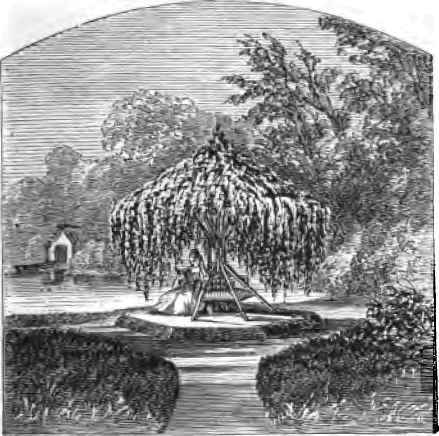
Fig. 73. - Arbor Seat.
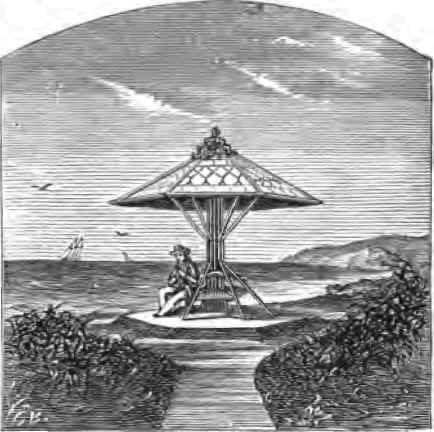
Fig. 74. - Umbrella Seat.
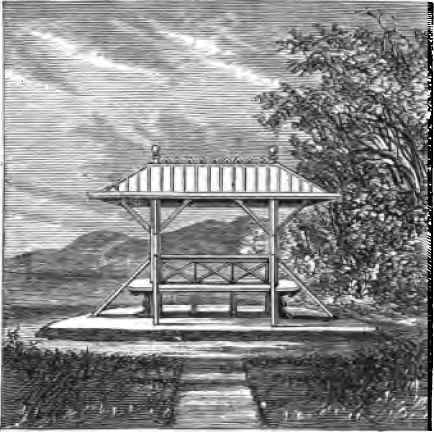
Fig. 75.
These should be trained up and round the post to the top, each sending out a branch along the upper brace (to take its place when removed); from the top, train each down its opposite arm, to the end, branching off at pleasure, and interlacing so as to be self-supporting when the frame decays. The floor should be raised a foot above the level, and the roots of the vines protected by a grating. When fruit is not an object, other hardy flowering vines may be used, such as the purple wistaria, red trumpet creeper, etc.
The Umbrella Seat is the same in size and plan, but differs in having a close roof; the design shown is of shingles, cut in patterns ; but pretty rustic roofs may be made of bark, moss, thatch, or sticks.
The frame, however, should be stouter, and the post thicker for this design than any other; being but one, the strain would be greater, and it would appear less. This is a foot thick, with six half-round pieces nailed round to form a cluster and receive the angle braces; the foot of these with the post should be mortised into a sunk cross-frame, well coated with coal-tar and sand. The floor should be covered with small stones and gravel, mixed with hot coal-tar, using as little tar as possible.
The plan of the third design is a parallelogram of two squares, supported by two posts, each six inches square, and set the same in the ground. The roof is of boards with battened joints, set off with an ornamental ridge-board and balls. The seat is made of hard wood, rounding on top, and placed a little apart. For the sake of variety this was made a little more architectural, but the plan is equally well adapted for a rustic treatment as any.
The plan of the fourth design is an equilateral triangle. This has a shingle roof supported by three cedar posts, a lattice frieze, and a rustic seat. A few inches of the branches should be left on the post, to facilitate the training of ornamental vines, as these would form its best and cheapest ornament.
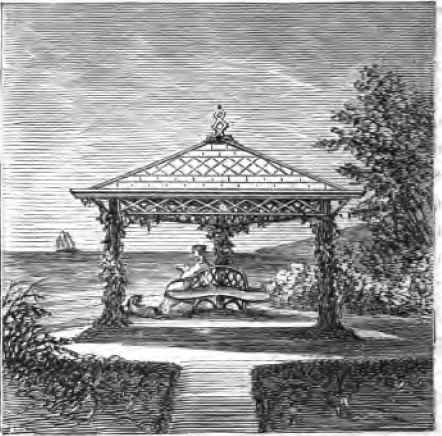
Fig. 76.
Continue to:


My Books

