


Fruit Bud Grafting
Description
This section is from "The Horticulturist, And Journal Of Rural Art And Rural Taste", by P. Barry, A. J. Downing, J. Jay Smith, Peter B. Mead, F. W. Woodward, Henry T. Williams. Also available from Amazon: Horticulturist and Journal of Rural Art and Rural Taste.
Fruit Bud Grafting
For the last eight years we have practised grafting blossom buds in order to cause barren trees to bear fruit; and the results have always been satisfactory. In endeavoring to extend the practice, we cannot do better than give some explanation as to the mode of proceeding.
In the course of the month of August, cut off fruit spurs from trees where they are too numerous. Let them be shortened to lengths of from 1/2 to 1 1/2 inch, and cut slanting as if for crown grafting; then make in the branch a ┬ cut for the reception of the scion as if in budding. The graft should be tightly tied with matting or rushes; and as there is always a space at the upper part of the wound, surround it with grafting clay, pitch, or liquid mastic. In the following spring the fruit buds thus inserted will flower and fruit quite as well as if they had not been removed. Frequently, indeed, the fruit is much larger than that on the tree from which the grafts were taken. We should endeavor as much as possible to graft on a vigorous branch, and near its base; and even on the main stem very handsome fruits are in this way produced. These fruit spurs retain their bearing properties in succeeding years; and if an eye produce a wood shoot, it must be successively pinched back in the usual way.
It will be seen that by this system it is easy to utilize fruit buds which have been cut off in pruning, as well as those on trees which have to be transplanted, or on branches which are to be cut off, etc. Every eye should be turned to account; those fruit buds which have no spurs may be raised up and worked like common buds; and spurs on which the fruit buds are crowded may be split longitudinally; in fact it is impossible to explain every mode of cutting the scion, for that must be left to the judgment of the operator.
The most suitable period for this operation is when the flow of sap is declining, for if performed too soon the fruit bud might become a wood bud; it is sufficient that the edges of the bark can be easily raised; and it is almost needless to add that the bud should have some alburnum attached to it, which must not be removed. We have made some experiments with this process, but the pear has always afforded the best results. We have one tree which bears, besides two varieties of pears, the White Beam and two sorts of Service, covered with fruit.
Fruit Bud Grafting #1
In the March number of the Horticulturist for 1859, are several articles on spur and fruit bud grafting, which I studied attentively, and attempted to follow the directions there given by Mr. Charles Battel, of Troyes, France, and also the graffe mixte, as described in the London Gardener's Chronicle; but I failed in both instances to get the scions to grow. It may have been that I misunderstood the directions; but this year-1 have made an alteration in the mode, .and have succeeded admirably. Believing it to be an improvement, I send you the drawing, which fully explains the mode. Take scions 5 or 6 inches long, with the fruit buds or spurs on them; pare the ends down thin with a slanting cut on one side only. The stock on which it is to be inserted is cut through the bark in the form of a t, and the lower end of the scion is pushed in as the bud is in budding, as shown at a. Opposite the upper end of the scion another cut is made in the form of an inverted L; the scion is bent, and the upper end pushed under the bark, as shown at c, and both ends are then secured with matting or candle-wick; then a ring of bark from 1/4 to 4 inch long is taken out, as at d, which completes the operation.
My plan, I think, has several ad vantages over those described in the articles referred to. First, in connecting both ends of the scion with the stock, securing a circulation of the sap through the scion, and thereby avoiding with more certainty the forming of branches out of the fruit spurs or buds by a too vigorous flow of sap. Second, it enables us to use a longer scion, with more buds on it. A scion a foot or more in length could be used as well as a shorter one. Third, the ringing of the stock throws the flow of sap through the scion, by interrupting it down the stock. There is no danger of killing the scion by the ringing, as in one season the bark will close over the ring, even should the graft fail to take. The operation is performed at the usual time of budding.
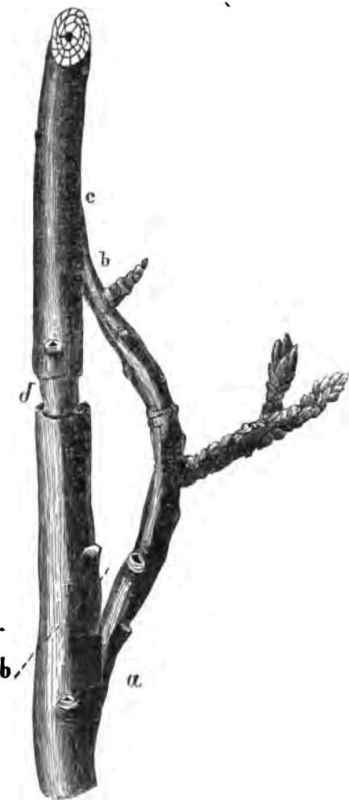
I find it unnecessary to use grafting wax or clay, as is absolutely necessary by the French mode. Such tying as is used for budding in the ordinary method is sufficient.
After the first year's growth, the stock and seion may be cut off at the dotted lines b b, and the graft permitted to form a limb.
[The above method of grafting is a novel and, we should think, a certain one. The process is similar to the one used on the grape by Mr. Corneilson of Philadelphia, as he described it to us at the last meeting of the American Pomological Society. We are inclined to question its durability on the vine, however, but should like to know that it had been thoroughly tried. On the pear and other fruit-trees we should think the union would be firm and permanent. Mr. Adair's experience would seem to be altogether in favor of it. Experiments like these are always interesting, and sometimes very useful. - Ed].
Continue to:


My Books

