


Drooping Deciduous Trees
Description
This section is from "The Horticulturist, And Journal Of Rural Art And Rural Taste", by P. Barry, A. J. Downing, J. Jay Smith, Peter B. Mead, F. W. Woodward, Henry T. Williams. Also available from Amazon: Horticulturist and Journal of Rural Art and Rural Taste.
Drooping Deciduous Trees
Within a few years the popular taste has been largely turned to the introduction of drooping trees as objects of graceful beauty, harmonizing with the smoothness and verdure of a lawn, or the high keeping and neatness of a pleasure-garden. Indeed, to such an extent has this taste prevailed, that the very object aimed at in their introduction has been often defeated by a too free use of them, as well as by their arrangement in masses, when their side branches - which are their peculiar beauty - are intermingled or hidden entirely, and their too heedless distribution on all sides.
Drooping trees, like water fountains, are dangerous in the hands of those who attempt their use in the decoration of grounds without possessing a considerable knowledge and good taste in the composition of a landscape. Gracefulness and elegance being the prominent characteristics of drooping trees, they are shown to best advantage either singly or in wide yet tasteful groups, on lawns or borders, where symmetrical art, rather than the natural picturesque, is sought to be embodied as the leading feature. Where bold expression is desired, they are entirely unfitted, and when planted mixed indiscriminately with those of upright, round-headed forms, their individual character is lost. Placed on the borders of groups, at sufficient distance to enable them to exhibit their peculiar habits and develop freely their forms, many of the drooping trees may be used effectively, provided the group of which they form a part is composed of trees with similar pensile, although not so distinct, habits of foliage or spray, as exhibited in the American Elm, Black Birch, or Wild Cherry.
For planting on the borders of ponds, or streams of running water, or as symbols of sympathy between the living and the dead in cemeteries, they are all valuable; and with judicious knowledge of their expansion in growth, to arrange them on lots or in positions suitable to their future lives, they can not be too much used.
With these few remarks on the use of trees pendent in their habits of growth, considering the popular taste and demand for them, we can not perhaps better serve the wants of our readers than by briefly describing some of the most desirable varieties.
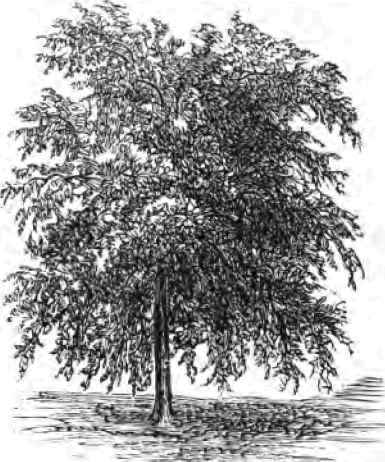
Fig. 35. - European Weeping Ash.
Drooping Deciduous Trees #1
A timely article that to many will be of great interest at this season of the year. It is deeply to be regretted that while we have many deciduous drooping trees perfectly hardy, we have but a very limited number among evergreens. Thuya filiformis, a weeping arborvitae, and Juniperus oblonga pendula and Virginiana pendula, two varieties of the Red Cedar class, being about the only ones which can be trusted out of doors in our Northern or Middle States. The first two named are, however, extremely well adapted to cemetery planting.
Continue to:


My Books

