


Designs In Rural Architecture - No. VIII. - A Cottage Stable
Description
This section is from "The Horticulturist, And Journal Of Rural Art And Rural Taste", by P. Barry, A. J. Downing, J. Jay Smith, Peter B. Mead, F. W. Woodward, Henry T. Williams. Also available from Amazon: Horticulturist and Journal of Rural Art and Rural Taste.
Designs In Rural Architecture - No. VIII. - A Cottage Stable
ThE subject of proper stabling and grooming for horses is one that has been wofully neglected in this country until within a very few years.
In former times a stable, and more especially a country stable, was oftentimes merely a shanty, serving only to shelter the animal from the hot sun of summer, or from being completely buried in the snows of winter. As for comfort, that was out of the question, and warmth was only partially preserved by the thick, clumsy coat of fur with which, for want of proper artificial clothing, Nature had mercifully provided him.
But we are happy to say things have changed in this respect, and people are beginning to enlighten themselves on the subject In these days a horse is looked upon as an intelligent creature, inferior only to man, his master, in tractability, and in requirements yielding to none but him; consequently we see the need of building stables thoroughly, with a plenty of room, a plenty of light, and of having them well ventilated, on scientific principles, that they may be cool in summer, and warm in winter, and airy at all sea-.sons; of giving the exterior a pleasing architectural appearance, according in style with the dwelling-house of which it is an adjunct; of keeping its yard and the adjoining grounds always clean and in good order; in fact, making the stable a pleasing object in the landscape picture of the estate, and a cheerful, comfortable, inviting place for its occupants.
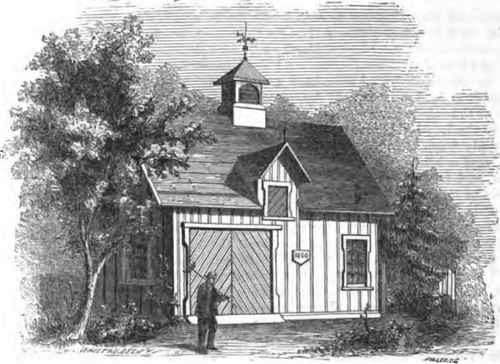
A COTTAGE STABLE.
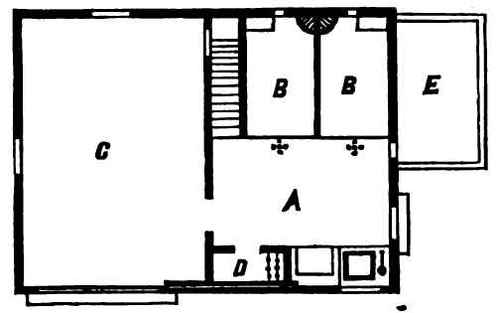
Every stable should consist of two distinct apartments; the one for carriages, and the other for horses. The horse apartment should contain the stalls, each five feet wide, and eight feet long, or eighteen feet to the back wall, with the floor, either of plank or brick set on edge, slanting backwards two and a half or three inches. At the rear of the stalls should be a depression in the floor, bored with half a dozen auger; holes to convey away urine. A cast-iron feed box should be fitted to one corner, and a hay-rack of iron wire to the other corner of each. From a convenient position stairs should rise to the hay-loft above. Near the outer door should be a pump and trough to supply fresh water at all times; and close by, chests for oats, meal, and corn, and a trough for mixing feed, all lined with zinc, and furnished with a cover and lock. A closet should contain half a dozen pegs for harness, a couple of drawers for blankets, etc., a rack for whips, and a small cupboard for medicines, oils, blackings, 4c. From the ceiling of the horse room an air shaft, supplied with a trap valve, should be carried through the hay-loft, terminating in the ventilator on the roof.
This, with ventilators in the doors, will give a thorough current of pure air at all times.
All the outside doors should have an extra set of hinges to hang gates upon, which should be used in summer instead of close doors.
Thus we have endeavored to give a few simple directions for building and furnishing a country stable of moderate size. The accompanying design will explain more fully the details we have noticed, and may answer as a guide to those about building.
It contains accommodation for two horses and two carriages, and may be constructed for two hundred and fifty dollars.
Continue to:


My Books

