


Design For A Village Residence
Description
This section is from "The Horticulturist, And Journal Of Rural Art And Rural Taste", by P. Barry, A. J. Downing, J. Jay Smith, Peter B. Mead, F. W. Woodward, Henry T. Williams. Also available from Amazon: Horticulturist and Journal of Rural Art and Rural Taste.
Design For A Village Residence
We show here a design for a medium-sized cottage, such as one might build on a Tillage lot of sixty or a hundred feet in width.
It is a framed building, filled in with brick (soft brick might be used), laid on their edges in mortar, and covered externally with weather boarding: the roof covered with shingles cut in patterns.
The framing may be of spruce or hemlock timber (the former is the best, but the latter is generally used), and the finishing of white pine; the details few, simple, and bold, with the roof quite steep, and the eaves of broad projection, to shield the sides, and the windows wide and airy. A light ridge ornament at the peak of the roof, a finial of iron over the dormer, and the piazza railing of scroll-sawed penetrations, give a character to the design.

Fig. 7. - Perspective.
The accommodation of the plan is as follows: A verandah, 10 feet wide, shields the front of the first story, from which leads a hall 7 feet wide, and containing the stairway to the chamber floor; a parlor, 13 feet by 18 feet, on the left of the hall, with a bay window opposite the door, with a library or chamber back of it; on the right hand of the hall is a dining-room, 13 feet by 18 feet, communicating with the kitchen, situated back of the dining-room, with closets and passage-way between; behind the kitchen fire-place is placed the private stairway to the chamber floor, and under the same the stairway to the cellar.
A porch covers the back door leading from the kitchen, which may be enclosed, and be used as a scullery.
The chamber floor contains five chambers, of large, medium, and smaller size, with closets to each; and in the back part of the hall are enclosed stairs leading to the garret, which is here meant to be left unfinished, but is capable of containing several good rooms.
The cellar is to be under the whole of the house, affording ample room for all sorts of storage, cold-room; store-room, bins, Ac.
It is not intended in this design to Intro-duce any superfluous fittings; the closets fitted simply with shelves and hooks; the wood-work white, or (which is better) to be grained or tinted with color; and the walls of the principal rooms may be enriched with some simple, tasty paper-hangings. The hall floor may be laid with alternate strips of walnut and ash, which costs but little more than good oilcloth, and does not need renewing.
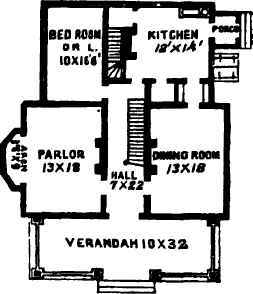
Fig. 8.
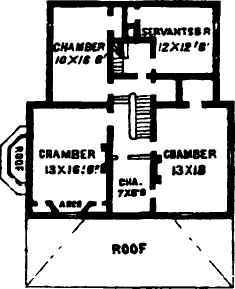
Fig. 9.
The exterior should be painted of a warm rich brown, or yellowish brown, using four tints, the lightest for the whole body of the house; the next darkest for the eaves, verandah, window-trimmings, etc.; the third darkest for window-sashes, blinds, etc.; and the darkest only for touching up here and there to make it appear lively.
Design For A Village Residence #1
All good and satisfactory to me, except the dormer. To my views, that is too small. It may be it is in architectural proportion, but even on paper it does not look well; and a house which I saw built this past season, with a dormer almost identical, provoked comments of an unfavorable tenor from every one. More breadth, height, and general character are needed to tone with the thirty-three feet of frontage. With some change to obtain this breadth and height, the otherwise plan of the house is economically cheap, convenient, and conveys the idea of substance and comfort rather than outside tinsel and show.
Continue to:


My Books

