


Travels. Florida And Her Resources - Tredde Spade
Description
This section is from "The Horticulturist, And Journal Of Rural Art And Rural Taste", by P. Barry, A. J. Downing, J. Jay Smith, Peter B. Mead, F. W. Woodward, Henry T. Williams. Also available from Amazon: Horticulturist and Journal of Rural Art and Rural Taste.
Travels. Florida And Her Resources - Tredde Spade
Travels. Florida And Her Resources
The readers of The Horticulturist will conclude that Al Fresco has " Florida on the brain;" and whilst admitting the soft impeachment, I shall offer as an excuse for my last effort at scribbling, an article I noticed in the Philadelphia Public Ledger, referring to the resources of the south, in which the writer remarks, "that some day, when the feverish desire to go west shall have somewhat abated, people may stop to, develop treasures nearer home." I am convinced that this prophecy will be verified, for the day is not far distant when enterprising horticulturists and pomologists will investigate the inducements for settlement in ancient and much neglected Florida.
We are convinced that the grape, banana, pine apple, orange, lemon, lime and citron will be the main and most profitable crops of the state; but they can be advantageously supplemented by others that will prove profitable, and to which we shall briefly refer:
Travels. Gardening In Europe And Austria
DR. J. A. Warder, of Ohio, was appointed to represent the United States Department of Agriculture at the Vienna Exhibition. In a recent address before the Ohio State Horticultural Society, he spoke of the condition of horticultural interests.
A Treatise On Agriculture
Comprising a concise History of its Origin and Progress; the present Condition of the Art, Abroad and at Home; and the Theory and Practice of Husbandry. By John Armstrong. With Notes, by Jesse Buel. To which is added a Dissertation on the Kitchen and Fruit Garden. 18mo, Half Sheep, - - - - - - 50.
Treatment of The Wine
The fermentation will be over in about two weeks after the Juice is put in the casks; then fill them up full, and drive the bungs in moderately tight. In two months (sometimes earlier), the wine will be clear, and pleasant to drink; but it should never be bottled until after the second fermentation, which takes place in May. In January, the wine is drawn off, and put into another cask, and the lees sent to the distillers with the pomace, to make brandy, or thrown on the manure pile. Some persons put the wine back into the same cask in which it was fermented, under the belief that it keeps better than in another.
Tredde Spade
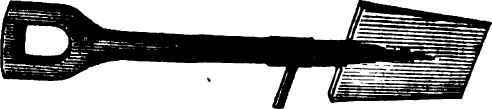
Subjoined is a sketch of my treddle spade. It is a most useful tool for raising trees, so powerful as a lever, and most convenient for root pruning; for, although it does not out cleanly, I find that the roots that are out with it heal more quickly. It is curious to see, in rural matters, such tenacious customs as one often finds. My men, a large body (seventy or eighty) of " 'cute" laborers, will not use a garden spade; they call them, for nursery purposes," old women's tools." The blade of the treddle is eleven inches long, eight inches wide at top, and six inches at bottom. From top of haft to blade is two feet three inches; entire length, three feet two inches. About four inches of lower part are of steel, so as always to be sharp. Thos. Rivers.
Continue to:


My Books

