


The Baldwin In Michigan - Bambusa Variegata
Description
This section is from "The Horticulturist, And Journal Of Rural Art And Rural Taste", by P. Barry, A. J. Downing, J. Jay Smith, Peter B. Mead, F. W. Woodward, Henry T. Williams. Also available from Amazon: Horticulturist and Journal of Rural Art and Rural Taste.
The Baldwin In Michigan - Bambusa Variegata
The Baldwin In Michigan
The Baldwin apple is reported more largely planted in the region of St. Joseph, Mich., and the demand for the fruit greater than that of any other variety. The preference given it over other sorts is on account of its early bearing, productiveness and fairness, rather than quality.
The Balm Of Gilead Fir
This is also a delicate ornamental tree, but it rarely attains to any considerable size. This species and the silver fir are often con. founded, but may be distinguished thus: The leaves of the silver fir are arranged nearly on opposite sides of the branch, comb-like. The under sides of the leaves have a white line running lengthwise on each side of the mid-rib, which gives them a silvery hue. The leaves of the Balm of Gilead fir are shorter, blunter, and stand nearly upright in double rows on the upper side of the branches; while in the silver fir they are flattened and irregularly single-rowed. Neither of these trees should be omitted in a lawn of any pretensions.
Baltimore Greening
Last autumn we received from John Edgerton, Coal Creek, Iowa, samples of an apple under name of Baltimore Greening. We have no record in fruit books of the variety, nor do we recognize it as identical with any variety under another name. "We made the accompanying outline and description of the fruit, and shall be glad to learn more of it. Fruit, large, globular, flattened, • somewhat angular, greenish, yellow with a brownish blush cheek in sun - some slight stripes of russet, and a few small but raised gray dots; stem, short; cavity, broad, open, and deep; calyx, closed, or nearly so; basin, open, deep, slightly furrowed next the eye; flesh, yellowish, rather coarse, tender; mild sub-acid; "very good;" core, medium; seeds, broad oval pointed. Season, December.
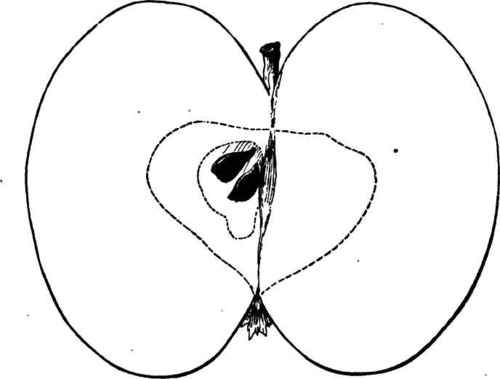
Fig. 68. - Baltimore Greening.
Baltimore Park
We have a copy of the proceedings which took place at the inauguration of the Baltimore Park, from which we shall hereafter make extracts. Our Baltimore friends have been fortunate in securing the services of Mr. Howard Daniels as Landscape Gardener. He has talent, and we have no doubt that in due time he will present the Balti-moreans a "thing of beauty."
The Bamboo
I did not, for a long time, recognize the bamboo, it has so many leaves and branches. It is the very beau ideal of flexile grace - some of them fifty feet high, and scarcely larger than one's arm.
Bambusa Striata
A native of China. Anthers are purple and showy. A specimen at Kew Gardens is about six feet high, but is described as attaining twenty feet. A plant flowered in gardens of Wm. Bull, England, in Nov. 1873; belongs to Munro's third section of the genus Bambusa, which has a long, hairy style, and to which the B. vulgaris, and two other species belong. It has been called B. Fortunei, but is an entirely different plant.
Bambusa Variegata
A pretty tufted, stripe-leaved Grass, apparently dwarf and perhaps useful in formal gardens. This had already received a Certificate of Merit.
Continue to:


My Books

