


Round Or Flat-Headed Section - Royal De Tours
Description
This section is from "The Horticulturist, And Journal Of Rural Art And Rural Taste", by P. Barry, A. J. Downing, J. Jay Smith, Peter B. Mead, F. W. Woodward, Henry T. Williams. Also available from Amazon: Horticulturist and Journal of Rural Art and Rural Taste.
Round Or Flat-Headed Section - Royal De Tours
Round Or Flat-Headed Section
Foremost, "the gnarled and unwedgable Oak" - everybody's favorite. Here we have one of the finest contributaries to a bold sky outline - in age exhibiting broad and heavy masses of foliage, disposed in well-defined, abrupt, and even angular breaks; added to which a tortuous and rugged bark - a bold relief among trees and shrubs of tamer character. The Beech, too, a tree for the park, the grove, the glade, or the vista. The Sycamore, which, although when young is of no significance, attains a character in age frequently of much consequence to the scenery where it is situate; the foliage in this case running into heavy masses, with deeply indented breaks in the outline. The Scotch Fir in age frequently attains a most picturesque appearance. In this section we have such trees as the Elm, the Lime, and various others.
Roup
As this is the season when fowls are apt to be more or less troubled with Roup, permit me to give a remedy which may prove useful to some of your readers. Wash the head of the diseased bird morning and evening with tepid water and castile soap, and give a bolus of lard and flour of sulphur mixed, of the size of an English walnut. Alum water may be used to cleanse the throat and mouth, if these are much affected. The fowl should be put in dry and comfortable quarters by itself till the disease is arrested. An English remedy for Roupe is to "Wash daily, once or twice, in tepid water, and give one grain of sulphate of copper mixed with oatmeal in ale, and give plenty of green food." E.
Rousselet Double, Esperen
Form - globular or obovate, acute piriform. Size - above medium. Stem - long, curved, rather stout; fleshy at the base. Calyx - open; sunk in a deep, furrowed basin. Color - dull yellowish green, thickly covered with cinnamon russet Flesh - white, melting, juicy. Flavor - vinous, sprightly, with pleasant aroma. Season - middle of October. - Promises to be classed as "very good".
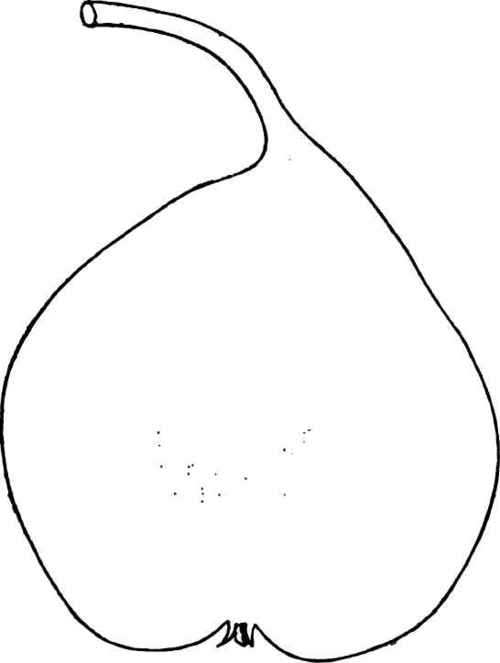
ROUSSELET DOUBLE, ESPEREN.
Roxbury Russet
Condemned by many as uncertain, and liable to speck and rot Passed as not worthy general commendation.
Royal De Tours
This is a handsome and excellent early variety, of French origin. Fruit - medium size, roundish, with a well-marked suture, and one side larger than the other. Stalk - short, slightly sunk, and a slight depression at the apex.

JAUNE HATIVE.
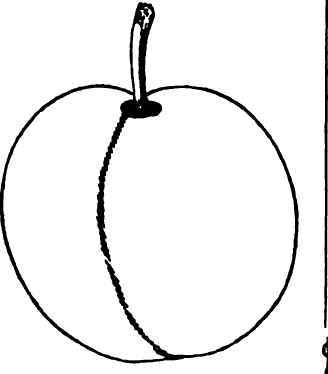
ROYAL DE TOURS.
Skin - reddish-purple in the shade, dark violet in the sun, with a thick white bloom, and thickly overspread with small yellow or golden dots, which give the surface a very beautiful appearance. Flesh - amber colored, firm, juicy, and rich; adheres to the stone, which is large, flat, oval, and rough. The tree is a stout grower, low and spreading, with stout, smooth shoots. Ripe here middle of August.
Continue to:


My Books

