


Pomological Conversations - Porcelain Fountain
Description
This section is from "The Horticulturist, And Journal Of Rural Art And Rural Taste", by P. Barry, A. J. Downing, J. Jay Smith, Peter B. Mead, F. W. Woodward, Henry T. Williams. Also available from Amazon: Horticulturist and Journal of Rural Art and Rural Taste.
Pomological Conversations - Porcelain Fountain
Pomological Conversations
During the State Fair at Saratoga, a small party of gentlemen particularly interested in pomology, spent a portion of their evenings in an informal or conversational discussion of some interesting topics. "We are indebted to the Country Gentleman for the report.
Pomological Society
Especial attention is called to the circular of the American Po-mological Society on page 375. This meeting will be an important one.
Mr. W. N. White's article on Hybridizing is full of information; it will well repay perusal.
Pomology
A large portion of pomological literature is dry reading, to say the very least of it. This is the principal reason why we have not devoted as much space to a detailed list of new and unknown varieties of fruit, as some others. It is useful to a certain extent, but we know from experience, that there is a growing interest in home gardening, the ornamentation of home grounds, small fruit, cultivation of standard orchard fruit, and we find that these subjects are much more profitable to us and welcome to our readers. Since we adopted this change of programme from Pomology to Home interests, our new subscribers have flocked in by hundreds.
Pond Lilies Easily Cultionted
Phineas Field, of East Claremont, writes to The New England Farmer as follows: "If you admire pond lilies (and who does not?) and have a springy place in your mowing, by digging a hole so that the water will stand from six to twenty inches deep in the same, and by setting roots in the bottom, you may have a supply of fresh ones through the season of blooming. Old roots will blossom the first season. One half day's digging, four years ago, has supplied me abundantly, and now I have hundreds of young roots."
Pond Lilies Easily Cultivated
Phin-eas Field, of East Claremont, writes to The New England Farmer as follows: " If you admire pond lilies (and who does not?) and have a springy place in your meadow, by digging a hole so that the water will stand from six to twenty inches deep in the same, and by setting roots in the bottom, you may have a supply of fresh ones through the season of blooming. Old roots will blossom the first season. One half day's digging, four years ago, has supplied me abundantly, and now I have hundreds of young roots." The best time to apply the pollen is in the early part of the day, and the plants seed more freely when they are kept rather dry, so as not to be gross,and dry, well ventilated atmosphere being necessary."
Pontederia Cordata, (Pickerel Weed.)
Before leaving the marsh we must visit this lit
Pontiac
Taken all in all for hardihood of tree, vigorous, upright, spreading habit, early in coming to maturity, abundant bearing, large size and good quality of fruit, with fineness for market, this is perhaps the best of the black cherries. In real richness of quality it is not perhaps equal to Knight's Early Black or Black Hawk, bat its other good qualities abound, and make it a superior sort for family or market use.
Porcelain Fountain
We have heretofore alluded to the importance to Art of the introduction of Parian into common use. Messrs. Copeland have made many lovers of statuary by their comparatively cheap statuettes now found in every house; and several others are little behind them. We. present an engraving of a porcelain fountain, Fig. 2, of this manufacturfe whose elegance will at once commend it to the reader. The ground color is an orange red, bearing white rosettes, while the remaining decorations are gilt. Its height is about four feet.
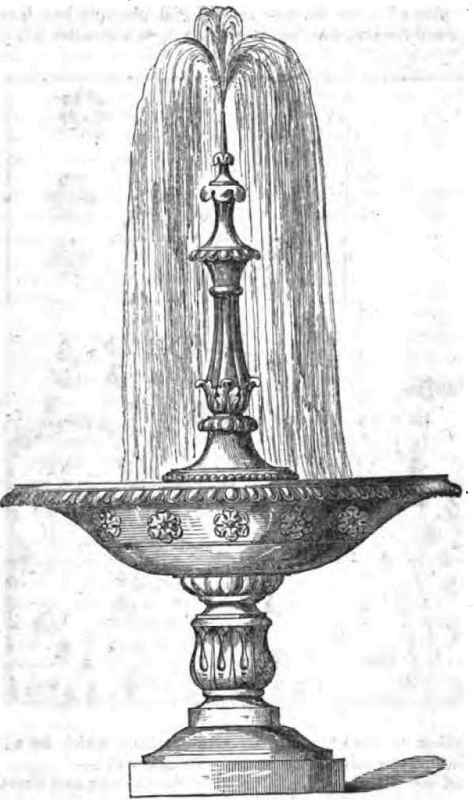
Fig. 2.
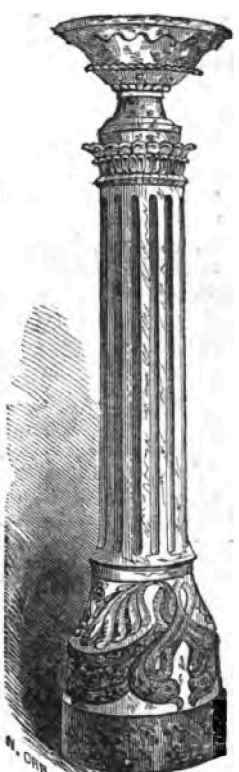
Fig. 3.
We also copy a column in Parian, designed for a parlor ornament, to hold a flower pot Fig. 3.
Continue to:


My Books

