


Ghisbornr's Early - Gigantic Strawberries
Description
This section is from "The Horticulturist, And Journal Of Rural Art And Rural Taste", by P. Barry, A. J. Downing, J. Jay Smith, Peter B. Mead, F. W. Woodward, Henry T. Williams. Also available from Amazon: Horticulturist and Journal of Rural Art and Rural Taste.
Ghisbornr's Early - Gigantic Strawberries
Ghisbornr's Early
This handsome early variety we received from England. It is of medium size, oval, with a distinct suture, and one side enlarged. Stalk - short, and rather deeply inserted. Skin - greenish-yellow, marbled with red next the sun, covered with a whitish bloom; and dotted over with gray specks.
Flesh - greenish-yellow, sweet, juicy, and pleasant Stone - very large, flat, oval.
Tree - vigorous and productive. Shoots - vigorous, downy. Described in the London Horticultural Society's Catalogue as a great bearer.
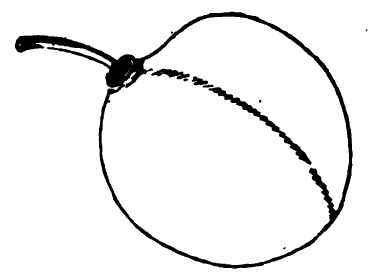
MAMELONE.
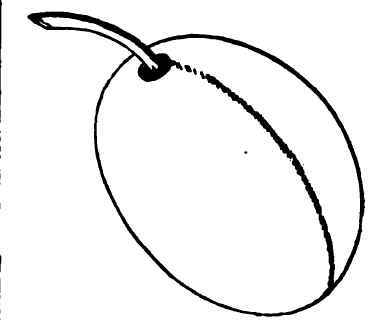
CHISBORNE's EARLY.
Giant
A very productive, green-colored, late and large sort Bears pulling all summer better than any other. Buist's Large Early Red, and Mammoth, and Cahoon's Seedling are said to be extremely fine. These three I have not yet seen, and here a word of advice: always buy rhubarb roots from some respectable nurseryman who has a character at stake, or you may be sorely disappointed in your future expectations.
Giant Emperor
It bears only a few flowers on a robust, strong stem, from which the side shoots grow in the form of a Candelabrum; the flowers are very brilliant, double, and immense size. In favorable cases the side shoots produce as many as five flowers, of which the chief blossom is four inches in diameter.
The Imbrique Pompone, with its numerous miniature flowers, is equally attractive, and particularly suitable for large flower beds or intermingling in the borders with dahlias, gladioli and roses. Of the dwarf varieties, the principal are the Chrysanthemum, its large flowers almost hiding the foliage, and the Bouquet Aster with its profusion of blossoms; this last, when well grown, will produce perfect plants, each of which forms a bouquet of from 150 to 200 flowers, completely hiding the foliage, and producing a fine effect in mixed borders.
Gifts
A copy of a biographical memoir of the late Francois Andre' Michaux, by Ellas Durand. Proceedings of the Sixth Session of the American Pomological Society. Grafts of the Lycurgus Pear, from F. R. Elliott.
Gigantic Grape-Vine
Much has been written regarding the sizes and ages of trees, and it is certainly a most interesting topic. Measurements of the largest vines in America we have rarely seen; as a contribution, or beginning, we present a portrait of a native vine, as drawn, at our request, by a most accomplished gentleman and scholar, the late Doctor Samuel George Morton, the celebrated ethnologist, and called in Europe the Humboldt, of America by Lepsius and others.
We first noticed this grape vine in the Horticulturist, vol. 1, 1847, page 530, as follows: •
Gigantic Strawberries
We understand from an eye-witness, that Mr. Pell, at his celebrated orchard farm, Petham, on the Hudson, has raised the largest strawberries ever grown in the country. The variety was Ho-vey's Seedling. The largest berry weighed 2 ounces, and measured 8 1/4 inches in circumference. We hope Mr. Pell will give our readers the key to this mammoth size - as we unPomological Convention.- Dear Sir: In reading the pages of the July Horticulturist, I notice you speak of the next Pomological Congress to be held at Philadelphia this coming fall. As this is undoubtedly an oversight on your part, and might not be noticed, without your attention was drawn to it by some one, I desire to remind yon, that the meeting at Philadelphia is to be held in the autumn of 1862. Tours respectfully, F. R. Elliott. Cleveland, O., July 8,1851. [We thank Mr. £. for correcting the error into which we had inadvertantly fallen. ED.]
Continue to:


My Books

