


Beurre Bachelier And Compte De Flandres Peaks - Beurre D'Avoine
Description
This section is from "The Horticulturist, And Journal Of Rural Art And Rural Taste", by P. Barry, A. J. Downing, J. Jay Smith, Peter B. Mead, F. W. Woodward, Henry T. Williams. Also available from Amazon: Horticulturist and Journal of Rural Art and Rural Taste.
Beurre Bachelier And Compte De Flandres Peaks - Beurre D'Avoine
Beurre Bachelier And Compte De Flandres Peaks
Not especially new, but, as you say, valuable. For general, or rather for market growing, we do not require too many sorts, but for the amateur grower one or two trees of a kind is enough, no matter how good they may be. There is a charm in variety, and there is in pear-growing a trait not perhaps applicable to all fruits, in that the orchard made up of a number of varieties will in every season produce some really superior fruit. Climatic changes, according as they affect the pear in its varieties, are, I think, less understood than almost any other one point in fruit culture, unless it be that of blight.
Beurre Bretonneau
Tree - vigorous, an abundant bearer, adapted for a standard or pyramid. Fruit - as yet variable in form, but generally it is long, pyriform, contracted near the stalk end, four inches in length, and about three inches in diameter at the widest part Skin - rough, pale green, changing to golden yellow at maturity; the side next the sun is reddish-brown, much dotted and freckled with distinct russet 6pecks. Flesh - fine, yellowish-white, buttery, half-melting, sugary, vinous, and perfumed. Keeps till May or June. Named in compliment to Dr. Bretonneau, of Tours, in 1846, by Major Esperen.
Beurre Bretonneau #1
A large handsome fruit, ripening in December or January. The flesh is melting, high flavored and excellent, promising to add another fine sort to the winter varieties.
Beurre Capiaumout Pear
A correspondent writes: "I have been much edified, nay, instructed, by Dr. Ward's chapters on Pears. I believe the Duchess d'Angouleme bears more abundantly, in a young state, on the quince than any other kind, except, perhaps, Beurre de Capiaumout, which, wherever I have met with it, shows its decided preference for the quince, by uniformly producing large crops of very handsome and good fruit on it".
The Beurre D'Anjou Pear
(M. P. L.)
This is not "the Beurre grit re-christened." It has been known in most of the French and Belgian catalogues as Ne plus meuris. Le Roy's catalogue, and some others, have it among the synonyms of the Brawn Beurre, which is a great mistake. We have received it from a French nursery as Mid d'hiver.
Beurre D'Anjou Pear #1
We are glad of an opportunity to give additional testimony to the Beurre d'Anjou as a tree. Lately in our climate (Delaware) we have observed that grown on the dwarf, it is not only earlier to come into bearing than the Duchess d'Angouleme, but also much more productive. In our climate (south of lat. 42 deg.) it is fully as deserving of extended planting as the Duchess, and we prefer it as a dwarf to the same tree as a standard for early and profitable returns. We have trees that bore in second year from planting, while the Duchess in same soil was four years before it began to produce.
Beurre D'Avoine
Fruit: size, medium; color, pale rich yellow with fine dull russet dots and rough fine russet marblings, especially around the stem and calyx; stem, varying in length, usually, as in our drawing, planted in a cavity, narrow and furrowed; flesh, yellowish white, fine grained, juicy, melting almost buttery, with a sweet vinous aroma and taste; calyx, with long segment nearly closed; basin, narrow, rather deep, and with a few broad furrows; core, medium; seeds, large obovate sharply acute pyri-form. Season, November to January or early winter.
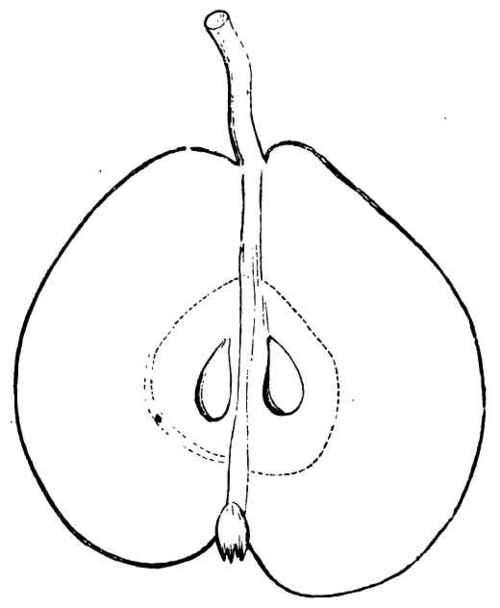
Fig. 35. - Beurre D'Avoine.
Thin out the old wood of currant and gooseberry bushes, and thus improve the size and quality of the fruit in future seasons.
Continue to:


My Books

