


A Villa-Mansion. Continued
Description
This section is from "The Horticulturist, And Journal Of Rural Art And Rural Taste", by P. Barry, A. J. Downing, J. Jay Smith, Peter B. Mead, F. W. Woodward, Henry T. Williams. Also available from Amazon: Horticulturist and Journal of Rural Art and Rural Taste.
A Villa-Mansion. Continued
The space below is occupied by a large kitchen under the dining-room provided with a range and boiler, an old-fashioned brick oven, and a large open fire-place for roasting. There is also a laundry beneath the family parlor, and, in the rear of that, a bathing-room for the use of the servants. Spacious provision is made for the furnace, which is below the vestibule, No. 7, and the rest of the space is filled with store-rooms, cellars, milk-room, larder, etc.; all carefully arranged and of liberal size. Below the summer-kitchen is the coal-cellar; and, under the entry that leads to it, space is left for a retired inclosure containing a water-closet for the servants.
The plan of the whole building is one affording absolute perfection of convenience, and the effect upon entering is exceedingly imposing. The wide and lofty hall, relieved by the columns that divide its length, and by those separating the recess that contains the principal stair-case, is a feature that is carried out in a manner not often seen, and at the same time the rooms are so disposed about it as to make its ample dimensions to involve no loss of space, but rather to afford an increased scale of internal accommodation. Few houses afford so liberal and yet so controllable a scale of accommodation; and the chamber floor is equally generous in its arrangements.
The staircase opens into a large central hall, the side of which, toward the stairs, is composed of pedestals supporting three shafts with arches between, the handrail and balusters being returned around the wall of the staircase behind this arcade, the purpose of which is to support the floor above. This portion of the hall is eighteen by twenty-two, and at one end an open arch leads into a narrow vestibule terminated by a window overlooking the rear balcony, and, at the other, sliding doors shut off a chamber over the front portion of the hall, which can be used or not, as may be required. These are designated upon the plan by the figures 1, 2, and 3, the latter being the chamber referred to, which is twelve feet wide and fifteen long, opens upon a balcony over the front terrace, and has a large closet fitted with drawers and shelves upon one side.
Near to this is a large bed-room, No. 4, over the library, having a closet similarly fitted to that of No. 3; and in the rear of this is a bed-room, No. 5, and a dressing-room or single chamber connecting with it, No. 6.
Upon the other side of the hall is an entry, No. 7, leading to a sleeping-room and dressing-room, Nos. 8 and 9, occupying the space above the drawing-room; and in the rear of these is No. 10, a chamber thirteen by seventeen, over the ante-chamber below, and shaped so as to make a large recess to contain the bed.
No. 11 is a cheerful room, the same size as the family sitting-room, and provided with a large closet and convenience for drawers.
In the hall or entry, No. 2, are spacious cedar and other closets for linen and for clothes not in use; and from this hall a noble room, No. 12, the same dimensions as the dining-room, is reached. From the main hall a passage leads to the private stairs, also to a bathing-room and two water-closets, one of which is entirely private from the bath-room. Beyond this is a sleeping-room, No. 13, over the summer-kitchen, to gain which a few steps are descended in a well-lighted entry.
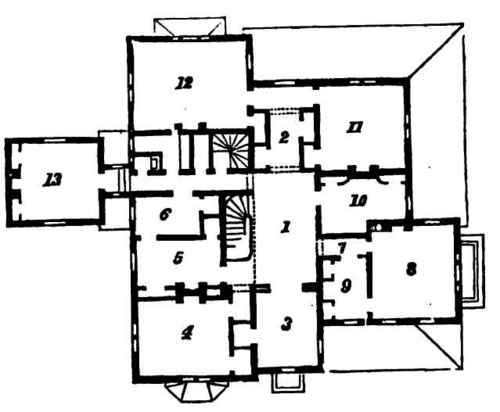
PLAN OF CHAMBER FLOOR.
All of these rooms are of large size, have fire-places, abundant closet accommodation, and are so arranged as to door or window openings as to afford convenient places for the bed and requisite chamber furniture - a matter of no trifling value.
Upon the floor above, the roofs are carried up in such a manner as to make attics over the drawing-room, and the whole of the rest of the house, excepting the lower portion above the family sitting-room and the summer-kitchen.
In addition to this, a tower is extended a clear story above the roofs, and is placed at the end of the hall; and as the external view of the building sufficiently exemplifies the position of this feature, and the space contained in the attic, a plan is not thought necessary.
The whole of the room above the drawing-room portion of the building, a space nearly forty feet in length by twenty in width, and six feet high upon the walls, rising, however, with an arched ceiling, to considerable elevation in the center, is made a drying-room for linen, is wanned by a heating apparatus below, and is made conveniently accessible by a dumb-waiter or lift, which is constructed in an inclosed shaft that runs from this story to the basement or kitchen floor below.
There is a very large reservoir or water-cistern also upon this floor, placed over where the bath-room and private hall are arranged in the chamber floor below. This cistern is so supported by the brick-work of the chimney-shaft, and by its position in regard to the frame of the building, as to be exposed to no danger from its weight; while, to prevent accident in winter, it is entirely surrounded by passages, so as not to come in contact with the outer walls, and has a hot-water pipe coiled within it, through which a circulation from the boiler below would keep the water at such a temperature as to prevent action of frost This reservoir is fed not only from the roofs, but also, in case of failure from such a source, can be supplied by a force-pump connecting with the large cisterns that are constructed below; and from this, pipes distribute the water, both cold and heated, to all portions of the house.
There are upon this floor four large sleeping-rooms for servants, and a room of noble size above the chamber over the dining-room, to be occupied either as a sleeping-room or children's play-room, as the family may prefer.
There is also a small room, about nine feet by twelve, in the tower, which I believe has been bespoken as a sleeping-room by a member of the family that appreciates the magnificent scenery that its windows command; and again, above this, is the upper room or observatory in the tower, twelve feet square, the space taken from the room below to contain the stairway to this upper room, being nearly all available therein. No description can do justice to the grandeur of the land and marine view that this tower commands; and not only is the presence of this feature amply justified, but the indweller or casual visitor would pronounce the house incomplete without its provision, which, by the way, cannot be said of all the towers that are seen in modern villas.
The whole interior effect has been obtained by elegant proportion and somewhat simple finishing, rather than by extravagant outlay. In the drawing-room and other apartments upon the principal floor, the cornices and ceiling decoration show somewhat of ornamental finish; but the rooms are so justly proportioned - height to width and length - that they could safely be left to the effect of a less ornate embellishment The hall, however, has features of very great beauty in the columns that have been before spoken of. There are in all, six of these, with their antae. Those supporting the wall above the recess containing the principal staircase are of Brocatelle marble; the other four across the hall itself, at right angles to these, are of Sienna, the caps white and the base and plinth of statuary marble. Their style is Ionic, with capitals designed in the simplest form of this beautiful order.
The staircase, with its balusters and rail, is massive and handsome, and the steps of peculiarly easy ascent.
Although the building is large, the composition of its parts is such as not to give an ostentatious appearance; and the details are all carried out so consistently with the spirit of the style determined upon, that the general effect of the whole mass is not hazarded by any discrepancy in any portion of the construction.
The architectural style is that of the modern Italian, having a general resemblance to many of the peculiarities of the buildings erected in the suburbs of Home - and hence of the Roman rather than of the Florentine or Venetian periods. I do not claim that it is a facsimile of any one of them; but, so far as material would permit, and modern convenience and common sense justify, the whole has been faithfully conceived in a spirit analogous to that which gives vitality to the buildings that originated this style. The walls, from the foundation to the level of the principal floor, are built of stone, and are laid in regular courses as to their horizontal lines, but in stones of unequal sizes and divisions. The masonry is of the very best description, and, from the top springs the building which above the ground is of frame, filled in with brick, double-boarded on the outside and covered with clapboards, the edges of the overlap of which are rounded, by which means they are not liable to be bruised or otherwise defaced.
The. stone placed within reach of the builder was one of such extreme hardness as to render the construction of the entire building a matter of very great expense, nor could the architectural features have been executed but in stone of different texture ; and it may be added that the owner was neither willing to delay completion of his house the time such a mode of construction would have required, nor to expend the vastly increased amount that would have been demanded.
This house was built carefully by day's work, and its cost, including all that thorough completion involved, was twenty thousand dollars. Of this sum, a very large amount was expended upon the heavy stone masonry of the foundations and lower story, and in almost any other situation the cost could be very materially lessened. The sum named, moreover, included furnace, painting, plumbing, and the provision of gas-pipes throughout the whole building, the owner intending to provide a gas-house and apparatus in a secluded situation below the house.
Continue to:


My Books

