


Treatment Of The Achimenes
Description
This section is from "The Horticulturist, And Journal Of Rural Art And Rural Taste", by P. Barry, A. J. Downing, J. Jay Smith, Peter B. Mead, F. W. Woodward, Henry T. Williams. Also available from Amazon: Horticulturist and Journal of Rural Art and Rural Taste.
Treatment Of The Achimenes
I would offer a few remarks on the cultivation of this most beautiful plant (the Achimenes), of which there are many sorts, viz: Patens coccinea, Rosea grandiflora, Longiflora, etc. To grow them to perfection, it will be necessary to prepare a place suitable for their reception; those who have not the convenience of a hot-house, may prepare a hotbed for a one-light frame, or mor;e, with a temperature of not less than 60°. Make a compost of one-half sand, and the other half leaf mould, with a small quantity of peat mixed together; let the pots be well drained with charcoal; fill the pots within two inches of the top with compost; place the roots around the sides of the pot (one inch apart), and then cover them with one inch of soil. The bed being ready, place the pots on the surface, or, if there is no danger of the bed being too hot, plunge them up to their rims; give them a gentle watering with a fine watering-pot, put on your lights, and, in a few days, the plants will be up. When the pots are well filled with roots, they must be potted off singly, with the same drainage as above mentioned; keep up a regular degree of heat by the application of hot dung lining a long time, shifting your plants, as often as they need it, into larger pots; syringe them once a day, and shade them immediately, if necessary, from the scorching sun, as shade, moisture, and heat, are the most essential points required to bring this most beautiful specimen of the tropics to perfection.
With this treatment, they will show signs of flowering very early, at which time they may be removed to the greenhouse or window, there to mingle with other plants, and enjoy the sun and air freely.
Cut No. 1.
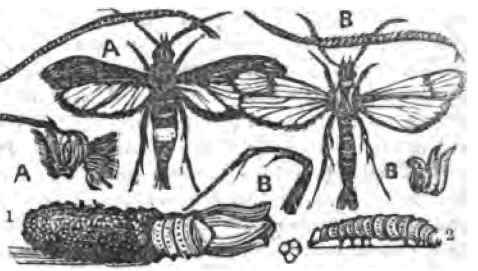
AEgeria exitiosa. - Say.
Cut No. 2.

Continue to:


My Books

