


Rheum Nobile
Description
This section is from "The Horticulturist, And Journal Of Rural Art And Rural Taste", by P. Barry, A. J. Downing, J. Jay Smith, Peter B. Mead, F. W. Woodward, Henry T. Williams. Also available from Amazon: Horticulturist and Journal of Rural Art and Rural Taste.
Rheum Nobile
"The present is certainly the most striking of the many fine Alpine plants of Sik-kim; and though in every botanical character, as also in the acid juice of the stem, a genuine Rhubarb, it differs so remarkably in habit and general appearance from any of its congeners, that at first sight it could not be recognised as one of them. I first saw it from a distance of fully a mile, dotting the black cliffs of the Lachen Valley at 14,000 feet elevation, in inaccessible situations, and was quite at a loss to conceive what it could be; nor was it till I had turned back the curious bracteal leaves and examined the flowers, that I was persuaded of its being a true Rhubarb. "The individual plants of Rheum nobile are upwards of a yard high, and form conical towers of the most delicate straw-coloured, shining, semi-transparent, concave, imbricating bracts, the upper of which have pink edges; the large, bright, glossy, shining, green, radical leaves, with red petioles and nerves, forming a broad base to the whole. On turning up the bracts the beautiful membranous, fragile, pink stipules are seen like red silver-paper, and within these again the short-branched panicles of insignificant green flowers.
The root is very long, often many feet, and winds amongst the rocks; it is as thick as the . arm, and bright yellow inside. After flowering, the stem legthens, the bracts separate one from another, become coarse red-brown, withered and torn; finally, as the fruit ripens they fall away, leaving a ragged looking stem covered with panicles of deep brown pendulous fruits. In the winter these naked black stems, projecting from the beetling cliffs or towering above the snow, are in dismal keeping with the surrounding desolation of that season".
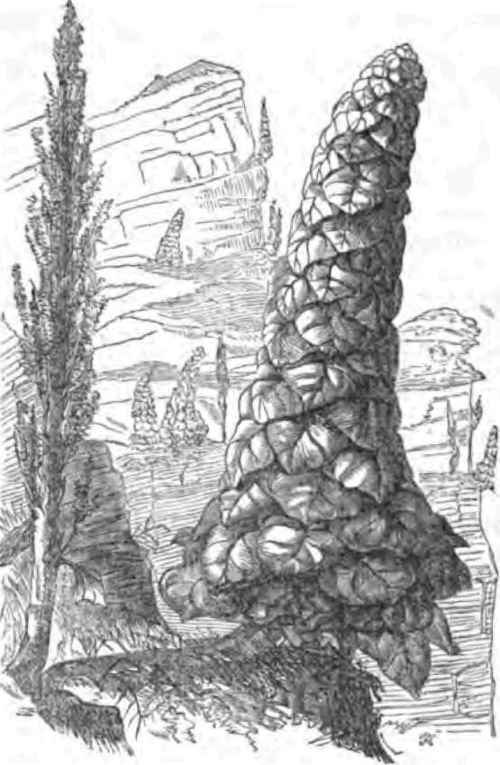
Such is Dr. Hooker's account of this curious Rhubarb, of which the accompanying sketch is taken from his recent work on Himalayan plants. The natives call its stems "chuka," and eat them, their acidity being pleasant. Some of the seeds which were sent to Kew grew, and the seedlings lived two years; but we regret to learn that they have now been lost. Let us hope that the plant will be re introduced with more success.
Continue to:


My Books

