


Question 6th. Is Not Some Good System Of Training Indispensable To The Continued Productive-Ness And Longevity Of The Vine?
Description
This section is from "The Horticulturist, And Journal Of Rural Art And Rural Taste", by P. Barry, A. J. Downing, J. Jay Smith, Peter B. Mead, F. W. Woodward, Henry T. Williams. Also available from Amazon: Horticulturist and Journal of Rural Art and Rural Taste.
Question 6th. Is Not Some Good System Of Training Indispensable To The Continued Productive-Ness And Longevity Of The Vine?
This question suggests a very wide field of speculation, upon which we will not step this; evening. A very few remarks will be sufficient to set forth clearly our affirmative position, and by the kindness of Mr. Bridgeman we have at hand just the vine which is desirable to illustrate this part of our subject. This vine, although now in a pot, is in all respects as a vine should be in garden or vineyard when well grown preparatory to training according to any judicious plan. I am not about to advocate any particular plan, for there are many whose merits are well known and universally recognized for accomplishing both the general and specific ends of training. The general object aimed at in training is the production of good wood, which shall produce large crops with certainty, and continue the vine in perpetual health. Without the aid of man it wastes its strength in apparently sportive efforts, and not only fails to produce good fruit within prescribed limits, but also fails to maintain its own health. The vine before us consists of one shoot, which is the present season's growth. It is about six feet high, of strong, well-ripened wood.
Its leaves are large, thick, and fleshy, with a firm leathery feel which denotes the healthy development, which is the result of good management and care.
At the junction of each leaf with the main shoot is a bud lying in the embrace of the foot-stalk of the leaf, and what appears to be the short stump of a shoot, on which may be seen two or three leaves. These leaves, as we shall soon see, are not unimportant., These stumps would have been each shoots of considerable length if they had not been "stopped;" that is, had their ends pinched off in their early growth. They are called laterals, and this pinching is one of the operations called summer pruning.
If these had been suffered to grow, instead of one tall, stout shoot, beautifully furnished with its strong healthy leaves, we should have had many slender shoots and a multitude of small. thin, unhealthy leaves, whose strength would not have been sufficient to enable them to resist uninjured the trials to which they are always subjected by atmospheric changes during the period of growth. Instead of one strong youth, now ready to take a short winter sleep, and wake in spring to perform joyfully the labors of early manhood, we should have a great number of feeble infants, that might have the misfortune to survive the winter, but only to linger through a short and profitless existence. These little stumps of the laterals are not now joined to the main shoot by a strong woody union, but only by inosculation, little more firmly than the leaves, and will fall off in spring if not removed. If suffered to acquire strength, they form a strong woody union, and become branches, and damage or destroy the bud at their base. At the base of every well-developed leaf at its first formation are two buds, one of which very soon shoots forth, and becomes the lateral of which we have spoken. These are called the anticipative buds.
By the side of these are now to be seen the other buds, which are called dormant buds, and which will make the shoots of next season. When well developed, as on the specimen before us, they are often called fruit buds, because the shoots which spring from them will put forth flowers, and, under proper circumstances, produce fruit Of these strong bode you will see there are some 25 or 30, each of which will produce a shoot, and each shoot will attempt to produce three bunches of grapes - that is, from 60 to 90 bunches. If we attempt to keep all, we shall-not succeed, and snail probably fail of getting one good bunch. We shall get a great number of shoots in the form of side branches, which will vary in length from three to twice three feet, all of which will be covered with innumerable small leaves, none of which will be strong and healthy, and, consequently, none prepared to give any good fruit the next season. Here, then, we shall have a worthless vine which will require as much room as an orchard tree, and occupying as much space as four productive vines.
Now let us subject our vine to training, and behold the result We will cut it off at the fifth hud from the bottom, and in the spring, when these five buds shoot forth, we will rub off the two lower ones, and for a time suffer the other three to grow. Flowers for three bunches of grapes will appear on each. Just before these open, stop each of the lower shoots at the second leaf above the upper bunch, and tie the third one to the stake to grow to a tall shoot, as was done the season before. Take off the upper bunch from each shoot, and six will be left, which will give six bunches of mature fruit Laterals are to be stopped as before. We have followed the vine only through two seasons of its early age, but I think all who have favored us with their attention must have seen clearly that the vine can not give good results without systematic training, which supposes a course of pruning also. By this we aim to produce just so much good wood as we have learned, by experience and careful observation, will best occupy a given space, in which we propose to train each vine, and to effect its equal distribution over the allotted area, so that not only each branch or shoot shall occupy un-crowded its proper space, but each bunch and leaf also.
As the vine advances in age the indispensable need of these operations becomes more clearly obvious, BY any good system which is founded upon accurate knowledge of the vine, its management is easily accomplished, and without it no vines, in garden, house, or vineyard, have ever produced good results for any length of time. If any lady wishes to be her own superintendent, she may be assured, that by taking the vines from the first planting, she will find the matter so simple and pleasant that the charge of vines enough to produce one ton of grapes yearly will be found to be a most interesting diversion rather than a burdensome care.
And we may safely say to all who desire to grow good grapes, that after proper entertainment is furnished to the roots of our best hardy kinds, the only specific required to enable them to meet uninjured all the ills to which vines are supposed to be incident, is a good system of raining faithfully carried out.
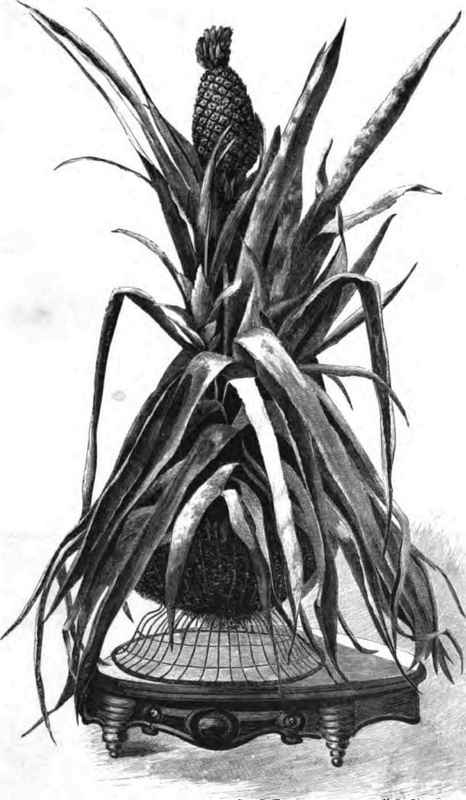
ANTWERP PINE APPLE, grown in a Moss Basket.
[Engraved far the HORTICULTURIST. Printed by F Semers 13 Spruce Street, N. Y)
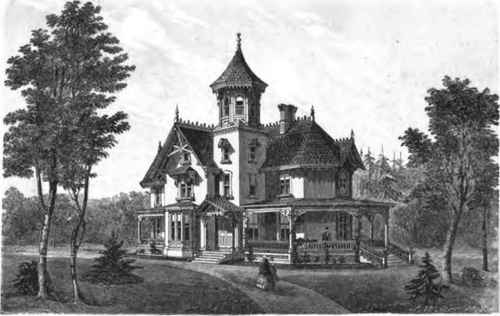
RESIDENCE OF T. M. RIANHARD, Esq.
PENDLETON AVENUE, NEW BRIGHTON, S. I.
Continue to:


My Books

