


The Peach In The North - How To Train It. Part 5
Description
This section is from "The Horticulturist, And Journal Of Rural Art And Rural Taste", by P. Barry, A. J. Downing, J. Jay Smith, Peter B. Mead, F. W. Woodward, Henry T. Williams. Also available from Amazon: Horticulturist and Journal of Rural Art and Rural Taste.
The Peach In The North - How To Train It. Part 5
From the [taints B.B. where the shoots had been stopped, several branches will break, but not more than two should be suffered to grow from each shoot; that number will be sufficient to fill up the tree, allowing the wood a proper distance; and in some cases where the wood appears to be getting too thick or crowded, only one shoot should be allowed to grow; when these have again reached the length of 15 or 18 inches, another stopping takes place at C.C., in precisely the same way as the former (at B.B.,) allowing about the same number of shoots to grow; on these becoming once more 15 to 18 inches in length, a stopping for the third time will be required at D.D., and the shoots laid in as in the former stoppings. These stoppings will in general be sufficient for ordinary trees, but in the case of very strong trees they will require four, and ripen the whole of the wood well. I have said from 15 to 18 inches between each stopping, but it may in particular cases require a little more or less in order to properly regulate the wood over the trellis as well as to preserve the symmetry of the tree. I take for granted whilst this stopping has been going on, no care was wanting to preserve the shoots and leaves, clean, healthy, and free from insects.
At the expiration of our third year the tree has the appearance of No. 7, and will have covered a great many square feet of trellis; it is now full of bearing wood from the stem of the tree to the extremities of the branches, all of which will be properly ripened and matured; the latter is accomplished in England on walls, and there will not be the least difficulty in the splendid climate we here possess. In the spring of the fourth year, the tree demands but little pruning, merely shortening the extremities of the shoots from six to nine or twelve inches, as may be found necessary; our trees are now strong and thrifty; they are also beautifully symmetrical, and we may now expect an abundant crop; at the same time I would entreat of every grower, not to be over severe on his trees by allowing them to bear too freely; rather err upon the opposite side, by well thinning the fruit; by this means the fruit will be more beautiful, and the trees preserved in thrifty growth.

No. 6 - Headed down in spring of third year.
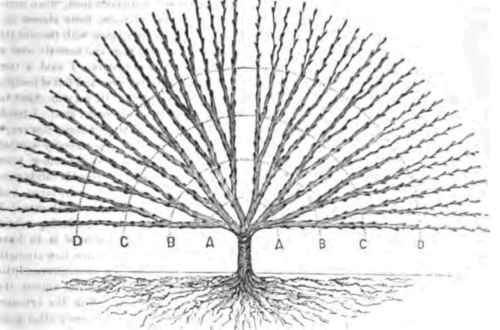
No. 7 - The perfect tree at the end of the third year, capable of producing a fruit crop the following season.
This fourth season young wood must be laid in all over the tree, - say a shoot where each stopping took place, and one equidistant between these stoppings. The extremities of the branches must be trained out; in the case of all moderate growing trees they will require nothing more, but in very thrifty ones they should have one stopping as in the previous year. The future treatment of those trees will be the same as for all trees on trellises - namely, laying in young wood through summer; shortening and thinning it out in the early spring, and the usual routine of culture. A person glancing at the system of training which I have been endeavoring to elucidate, will, if they arc acquainted with the fan systems of training, soon perceive a marked difference between that and this; under that system shoots arc only partially shortened after the first and second year's growth, and some branches, as may be expected, grow much stronger, and after much care and labor, the symmetry of the tree is frequently lost by one or two branches growing much stronger than the others, when the tree becomes what is called one sided; this can never be the case under the system I have been describing, with a moderate amount of care.
Under the old system a few fruit may be had on the third year, whilst under this system none will be had until the fourth.
This to some may appear an advantange, but it really is none, as the crop on the new system, the fourth, and all subsequent years, will be much greater than on the old, and the trees more thrifty and beautiful; the few fruit, therefore, obtained the third year, is not worth considering.
In laying before the readers of the Horticulturist the foregoing system of training, I must be understood it is not one of my own invention, but is that carried out by one of the best practical gardeners in England - Mr. T. Hatch, late gardener to P. J. Milks, Esq., Leigh Court, near Bristol; his fruit has been invariably abundant and fine, and his trees among the finest specimens in England, more beautiful and regular on the walls than any pencil can trace them on paper.
How frequently is a crop of fruit lost by having the flowers destroyed by frost, and bad weather, when in bloom. Now this may be prevented to a very great extent, and at trifling cost, with the trained fruit trees, or indeed Any moderate sized specimens. Let us examine into the came of failure, and we shall be better enabled to find a cure; and if the trees are healthy, it generally takes place in this way. On the disappearance of winter, say the end of March or beginning of April - it of course varies with season and locality - very frequently there are some warm sunny days which speedily bring peaches, nectarines and apricots into bloom, and this is frequently followed by weather cold and unpropitious, which totally destroys the bloom. If the trees, on the first approach of fine weather, had been protected by day from the sun, and kept cool, exposing them freely by night, the trees will be retarded in their blooming until a period much later than they otherewise would have been, and they will set a crop with much greater certainty. Mats, cheap muslin, or in fact any material to protect them from the sun, will answer this purpose.
The common practice is to have the fruit trees come naturally into bloom, and when in this state to protect them by night, and also by day; in bad weather.. Now the trees should be carefully protected from sun by day, and exposed at night - on the first approach of warm days in early spring - that they may be retarded to as late a period as possible. When the trees are bursting into bloom, reverse cautiously your treatment, and protect by night your expanded blooms, and cold bad days - through the day expose them to the genial influence of light and air, and abundant crops will repay the cultivator. Protection, many may imagine to be very expensive, or in other words, " will not pay," but let them try it on their best fruits, and their moderate sized trees. There arc many things which may be had cheaply, that will answer the purpose, and the amount of labor is not great. I feel confident as to the result. J. S.
Washington, D. C, Jan. 3,1852.
Continue to:


My Books

