


The Mysore Hexacentre (Hexacentris Mysorensis)
Description
This section is from "The Horticulturist, And Journal Of Rural Art And Rural Taste", by P. Barry, A. J. Downing, J. Jay Smith, Peter B. Mead, F. W. Woodward, Henry T. Williams. Also available from Amazon: Horticulturist and Journal of Rural Art and Rural Taste.
The Mysore Hexacentre (Hexacentris Mysorensis)
This charming stone climber from India is well worthy the attention of amateur or professional growers of new and rare plants. It was shown first in England, in May, 1852, before the London Horticultural Society, and was pronounced the most attractive among all the new and fine plants exhibited. This is saying a great deal. We copy the following cut and description from Paxtor's Flower Garden:
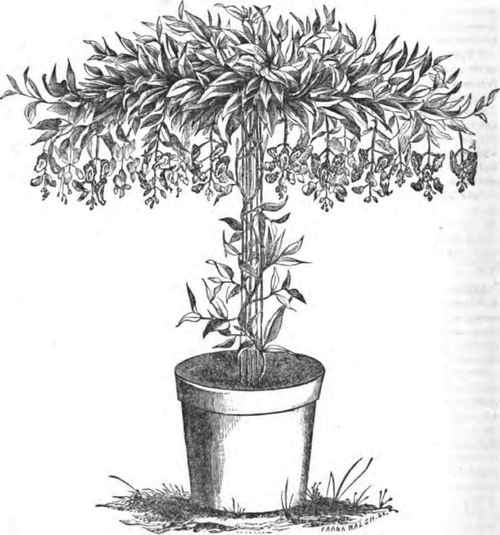
MYSORE HEXACENTRE.
"Among all the fine plants exhibited in the garden of the Horticultural Society last May, none excited such universal interest at that now represented. It formed a small umbrella-like creeper trained oyer trellis in the manner represented in the annexed vignette, the whole circumference of which was loaded with pendulous racemes of most beautiful large yellow and crimson flowers. The plant was sent to Messrs. Vetior, of Exeter, from the Mysore country, which it inhabits, as its name indicates. No doubt it is the best hot-house climber that has been introduced for many years.
"We understand that the plant was sent home by Francis Maltby, Esq., of the H.E.I.C. Civil Service. Our drawing having been taken from an inferior specimen, by no means represents all the character and beauty of the species. One drawing, received from Mr. Maltby since this figure was made, represents the bunches of flowers and buds from fifteen to eighteen inches long, and another with the upper or first flowers dropped, and a large cluster suspended at the end of a flower-stalk of about the same length. It is added that, before the plant is out of bloom, the pendulous flower-stalks are from two to two and a half feet long.
" Whatever may be thought of the so-called species, which Professor NEEs von Esknbeck has separated from the original Hexacentris coecinea, Dr. Wallich's Thunbergia coecinea, nobody will question the entire novelty of the plant before us, whose small not leafy bracts, large corollas and shaggy not smooth anthers, indicate a totally different organization.
"The genus Hexacentris, which signifies six spurs, is named in allusion to two of its stamens, having one spur each proceeding from the base of the anthers, while the other two have each two spurs".
Continue to:


My Books

