


Notices Of Books, Pampblets
Description
This section is from "The Horticulturist, And Journal Of Rural Art And Rural Taste", by P. Barry, A. J. Downing, J. Jay Smith, Peter B. Mead, F. W. Woodward, Henry T. Williams. Also available from Amazon: Horticulturist and Journal of Rural Art and Rural Taste.
Notices Of Books, Pampblets
The North American Sylva : Or a Description of the Forest Twos of the United Steles, Canada, and Nora Sootia, considered particularly with respect to their use in the Arts, and their introduction into commerce; to which is added a description of the most useful of the European Trees. Illustrated by 156 copperplate engravings, by REDONTE, BHSSA, etc. Translated from the French of F. Andrew Michaux. With Notes by J. Jay Smith. In three volumes Published by Robert Pearsall Smith, Philadelphia.
We are happy to learn that the superb edition of this great national work published by Mr. Smith, and which has already been noticed in the Horticulturist, (volume 6, page 541,) is in such demand that copies cannot be supplied as fast as they are called for. This speaks well for the growth of taste among the American people and for the interest they are taking in the productions of their own forests. It is a work that deserves the most complete success, not only for the important information which it contains, but for its elegance. The style of the engravings is good, and the coloring, done in this country, is, in many respects, equal to the original French edition. Those editions have long been out of print, commanding, before this appeared, no less than one hundred dollars a copy; that price was offered to our late American Ambassador in London for Michaux alone. The present edition, better translated than the English one which appeared in Paris, is now to be procured for twenty-four dollars; and with Nuttaxll's Continuation, also, in three superb volumes, the whole is offered for forty Jive dollars.
Prom the nature of this work it can never become a "common book;" indeed, to possess it will always confer a sort of distinction. It is even now somewhat difficult to procure a copy of this new edition, so much time is necessarily employed in coloring the plates by hand, as so few artists exist in this country who can be trusted to work upon them. They give regular support to a number of ladies and gentlemen who do little else than color from morning till night. The result is pictures entirely fit to be framed for ornamenting a drawing-room. By a little study of its valuable plates and comprehensive letter press, all may identify the products of our splendid forests, and learn to love what is so beautiful and worthy of study. If it were only to be able to know exactly all our American Oaks, or if they only were figured by this master of engraving, the work would be cheap, nay invaluable; but in addition, we have in Miohaux and Nuttall all the trees of our continent. The first named author described the trees of the Atlantic slope, and Nuttall continued the labor to the Pacific, including Oregon and California. The trees from these new possessions are already finding their way to our nurseries and gardens, and Nuttall's volumes are therefore indispensable, for his are the only descriptions extant of these western novelties.
* Elizabeth and AGNEs StRICKLAND, authoresses of the Queens of England and Scotland.
Mr. Smith, the editor, happily remarks in his introduction, "It was a singular circumstance, and a happy one for advancing science, that Mr. Nuttall arrived in this country the very year that the younger Miohaux left it. * * * * The two works are now one and homogenous; the former most highly valued by all lovers of trees, and the latter destined to be equally so." We may add that it has proved also fortunate that a publisher has been found to encounter the risk and labor attending the publication of such works, and who was willing to give the personal attention requisite to turn out every copy of the two hundred and seventy-eight plates in such excellent style and condition. It is to be hoped that he will ultimately be entirely remunerated. This he never could have been but for another fortunate circumstance, which might almost be called an accident - the liberal contribution of books and money to several scientific institutions in this country, especially to the Academy of Natural Sciences at Philadelphia. The late William Maolure was in Europe at a period when all literary property was at an enormous discount, owing to the state of war in which France had involved her.
Among other treasures which he purchased and sent home, was Redonte's original copper plates of Michaux's great work. They were in beautiful condition - entirely without a blemish. Mr. Maclure's sole object was to enlighten his countrymen, and he caused a small edition, on very bad paper and executed carelessly by his agents, throughout, to be issued; but it proved an abortion - only purchased for the want of a better. Still, in hope it might sometime have a better fate, he presented the whole of the copper to the late eminent President of the Academy of Natural Sciences, the lamented Samuel George Morton, M. D. He was animated by the same public spirit as Mr. Maclure, and gave the use of the plates gratuitously to the present publisher, on condition only of his producing an edition to, rival the original French copies. This has at length been done at a price that could not have been attained but for such distinguished liberality. We have given this history, both because it is interesting in a literary point of view, as well as to do justice to the gentlemen who have thus raised monuments for the gratitude of their fellow citizens.
We have in the first place the father and son, Miohaux, and Nuttall, three individuals the best qualified for the purpose as authors, now neither claiming nor desiring the slightest compensation for their years of labor, toil, and travel; we have Mr. Maolure and Dr. Morton giving their contributions of the plates gratuitously; and finally Mr. Smith, the editor, himself a devoted lover of the subject, with assistance in correcting the translation, superintending this edition, also, we are informed, gratuitously; and a young publisher, with little hope of even remuneration, placing the work at a very moderate price before the public.
The elder Miohaux is deceased, having fallen a sacrifice to his scientific zeal on the coast of Madagascar; Redonte, the engraver, who has left such a world-wide reputation by his engravings of the work, the Liliacece and Rosacea, etc., is no more; both Mr. Maolure and Dr. Morton have lately paid the debt of nature.
The elder Miohaux commenced the "Sylva," by describing the Oaks of America; his son F. Andre Miohaux. who completed it, still survives, and resides in Paris at the ace of eighty-three years. He displayed a vocation for the natural sciences at an early age, and accompanied his father on his voyage to America. In 1802 he was employed by the French government to explore the country west of the Allegany mountains, and published in 1804 his travels in that then distant and almost unexplored region. A second volume contained a memoir on the naturalization of roots of American forest trees in France. In 1810 he published the Sylcaa. No country can boast a more magnificent or useful account of any part of its natural productions; it unites the advantages of a work strictly botanical, and of one relating to the useful arts, collecting all the scattered details which books or experience could furnish him, with respect to the application of the various kinds of wood to the purposes of life, which are extremely useful and important at the present day.
The fame of both father and son may be regarded as the common inheritance of France and the United States.
If we had more space at our command, it would afford us pleasure to extract some striking remarks of the editor of this edition on planting, and on the value of particular trees in ornamental gardening which are now sadly neglected. What more beautiful, for instance, than the Virgilia lutea, or yellow wood, with its panicles of locust-looking blossoms and its remarkable trunk and deep yellow autumnal foliage, which Mr. Smith strongly recommends, and not too warmly, as a tree to be eagerly sought for. A native of a small district in Tennessee, it has been occasionally seen in nurseries for sale, but its value being little known it is now very rare among us. Mr. Smith's additions can always be known-by being inclosed in brackets, and they constitute no small addition to the value of the work. They embrace notices of the mode of culture, remarks on the beautiful and ornamental, and fitly accompany the more scientific observations of Michaux.
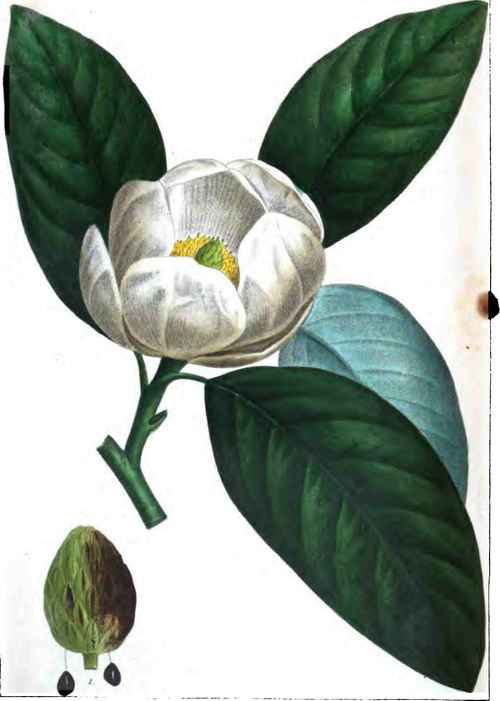
By permission of the publisher of this work, we present in this number a drawing of the Magnolia glauoa as a specimen of its illustrations. This is a beautiful small tree abounding in the swamps of New Jersey and southward, called the "Swamp Laurel" or Magnolia. Its leaves are four or five inches long, green and shining on the upper surface and glaucous or silvery beneath. The blossoms are about three inches in diameter, pure white, and so fragrant that a Magnolia swamp difruses its fragrance for upwards of a quarter of a mile around. It is readily propagated from seed which is easily obtained. The soil should be in part, at least, peat or leaf mold, and the situation somewhat sheltered.
P J Redcute del Gabrin.
Small Magnolia or While Bay.
Magnolia qlauca.
Continue to:


My Books

