


Vitis Aestivalis. Continued
Description
This section is from "The Horticulturist, And Journal Of Rural Art And Rural Taste", by P. Barry, A. J. Downing, J. Jay Smith, Peter B. Mead, F. W. Woodward, Henry T. Williams. Also available from Amazon: Horticulturist and Journal of Rural Art and Rural Taste.
Vitis Aestivalis. Continued
About a year later, Prof. Jackson sent to his brother, in this place (Athens), rooted plants, from which most of those now cultivated here were derived. We believe the Herbemont identical with this vine, as vines in Clarksville, Ga., from Herbemont (also one obtained by Mr. Camak from Herbemont himself, while living, which is still in bearing), prove nothing distinct from Warren. As the latter name indicates the origin of the vine, and as, under this name and Warrenton, it was widely cultivated, at least twenty-five years before known to Herbemont, and as it is still known as Warren by nine-tenths of those who raise it, the name Herbemont should be dropped.
Vine, rather short-jointed for the species, though the most vigorous grower we have. Leaves, five-lobed, very deeply cut; youngest ones, moderately downy be-neath, with a slight brownish tint; half-grown ones, very little arachnoid, of yellowish-green; full grown leaves (above), dark green, with nerves densely .making the leaf beneath a little hoary. Bunches, medium to large size .weighing about twelve ounces), shouldered. Berries, round, three-eighths to one half inch, or over, in diameter, rather closely set Skin, thin, very dark purple, -with light bloom. If not closely pruned, the grapes on the same bunch do not color evenly, varying from light to dark purple. Flesh, tender, melting, entirely free from pulp; very sweet and pleasant jnice,of unusual specific gravity. Quality, "heat," for table or wine. An enormous bearer; quite subject to rot, but, even then, more fruit ripens than of almost any other grape. Generally allowed to overbear, and undoubtedly the best of our native grapes.
Second
Varieties of V. aestivalis, with leaves sublobately angled, or soblobed; not generally with fully developed lobes.
6. Lenoir
Lenoir (Sampter, Thurmond, Early Black, July Sherry, and Devereanx, of Gardening for the South). This grape, which has every characteristic of a native, is not named from its color, but was discovered growing in his hedgerow, many years since, by a gentleman named Lenoir, in Sumpter District, S. 0. He at once brought it into cultivation himself, and distributed cuttings to his neighbors, and (as we learn from our informant, Col. A. G. Summer) it is in that section still more cultivated than any other grape. As this variety, in leaf, fruit, and time of maturing, is decidedly one of the most distinct and easily recognized of those in cultivation, it is evident that the grape known in Ohio as Lenoir, "which differs from Herbemont" (Warren) "only in being of more vigorous growth, wood light-colored, with a light blue cast," is doubtless the Warren itself - a more vigorous grower than which would be hard to find. Col. Summer, who has known the Lenoir for years, and that, too, in the place where it originated, pronounces the grape long cultivated here under the erroneous name of Devereanx, to be in leaf and fruit identical with the Lenoir, and since seeing the latter, we coincide with him in the opinion that it certainly agrees in every particular with the grape known as Lenoir in the nurseries throughout the State.
The leaf of Lenoir is of but medium size, and the most entire of the cultivated varieties of this species, being merely indented, and seldom even sublobed. Young leaves but moderately downy, with a slight brownish tint; the down of terminal leaf not fuscous; older leaves have a yellowish cast beneath, when quite mature, smoothish, and nearly free from the cobwebby down. Bunches, rather small, about six inches long, shouldered, making them some three inches broad at the base. Berries, averaging about four-tenths, but sometimes one-half inch in diameter, pretty even in size, rather compact, or crowded on the bunch. Skin, thin black, covered with a blue bloom. Flesh, sweet, juicy, with a brisk, agreeable flavor. A good bearer, and we have never known it to rot. Quality, "very good;" the birds would say best, as they take it in preference to any other grape. Ripe, early in August. - Vine, resembles Long's more than any other; but by the less downy character and the yellowish tint of the older leaves, and the brownish character of the younger ones, in Lenoir, the two are easily distinguished, even in rows of cuttings. In fruit, the bunches of Lenoir average not two-thirds the weight of Long's. Berries, smaller, of darker color, and ripen three weeks sooner.
Fruit, from Peters, Harnden & Co., Dr. Camak, and Dr. Ward.
7. Longs
The parent vine was found, over thirty years since, by Col. James Long, in the woods of his plantation, near Danielsville, Ga He removed the vine to his garden, and by himself and family it has since been retained as an esteemed variety, not subject to rot, and of great fruitfulness. A sparkling wine, of good quality, has been made from it.
One, of vigorous growth. Leaf, in shape, much like Lenoir, but more apt to eply indented; sometimes sub-three-lobed, of large size, thick. Young at first very hoary, with down, which, in the youngest, is a little fuscous; color of the leaf itself, a clear green, with no shade of brown or red; older leaves, always more cobwebby than any other cultivated variety, giving a whitish appearance beneath, quite distinct from the yellowish shade of Lenoir. Bunch, somewhat shouldered, very compact, of medium to large size, good ones weighing aboot twelve ounces. Berries, average larger than Lenoir, the best being a little over one-half inch in diameter. Skin, thin, very dark purple, with a blue bloom. Flesh, tender, very little pulpy, sweet, and vinous. Quality, "very good." Ripens last of August, or early in September. Fruit, from Dr. C. W. Long.
8. Harris (Old House Grape)
This grape came originally to this place from Iverson L. Harris, Esq., of Milledgeville, whose father, eating the fruit from a vine upon a tree near a deserted house, procured cuttings the next winter, and brought it into cultivation; hence it is sometimes called the Old House Grape. Vine, quite vigorous. Leaves, large, sublobately angled, or sub-three-lobed near the apex, which makes it quite distinct; more distinctly cut than the preceding, being sometimes three-lobed; the leaf has a yellowish shade, moderately downy - less so than Long's, and down less cobwebby. Old leaves, rather smooth. Bunches, medium, shouldered, compact; a little larger than Lenoir. Berries, round, three-eighths to one-half inch in diameter, averaging nearly as large as Long's and Warren. Skin, rather thick for the species, black, covered with a blue bloom. Flesh, little pulpy, sweet, juicy, and agreeable. Quality, "very good." A valuable variety, not subject to rot. Middle of August. Fruit, from Dr. Camak.
9. Norton's Virginia
Leaf, sublobately angled, sublobed, and sometimes (but not generally, like Warren, etc.) fully three or five-lobed; green of the young leaves has a yellowish shade. Young shoots and terminal leaf above, and younger leaves beneath, with a fuscous (changing to hoary), cobwebby tomentum. Nerves, strongly marked, reddish beneath. Older leaves, nearly free from down. Bunches, long, occasionally shouldered; somewhat compact. Berries, pretty uniform in size, about four or five-tenths of an inch in diameter. Skin, thin, nearly black, with a blue bloom. Flesh, quite pulpy, vinous and harsh - not even "good;" not worth cultivating. Said to be a hybrid between Bland and Miller's Burgundy, but is totally unlike either. As Le Conte observes:* "Although, among some families of plants, hybrids occur naturally, or may be formed artificially, yet it is difficult to understand how this ever can be the case in the genus Vitis. In forming a hybrid, it is necessary to emasculate the flower we wish to produce fruit, and to impregnate its pistil with the pollen of some other species; this is impossible in the present instance, on account of the minuteness of the flower, and the parts of fructification." Nor is this all. He might have added another difficulty.
The petals are caducous, and cohere at their tips, forming a little cap, which, in the act of falling off whole, draws over from one side or the other, almost invariably, the pollen from its own stamens upon the pistil. The chances then are, that an operator on so minute a flower, in the act of removing this cap, and then the stamens, would have already fertilized the pistil before applying the pollen of the species or variety selected. We would not, however, assert that hybridization, naturally or artificially, is absolutely impossible, but nearly so; and such being the fact, in general, Norton's Virginia gives us little evidence of being a special exception as any variety we know, being totally unlike its reputed parents, and agreeing sufficiently well in character with the species Aestivalis.
Doubtless, the Delaware as well as other varieties not yet known to the Committee, pertain to Vitis aestivalis; but the foregoing are all that have yet come under our observation.
Hon. Mark A. Cooper, President. - Dear Sir: The Committee ad interim of the Pomological Society Of Georgia, beg leave to submit the foregoing report upon the grape. They hope, by a further report upon the varieties of Vitis labrusca, the coming month, to close up the subject for this season.
Wm. N. White, Chairman. Athena, Sept., 1857.
* See Proceedings Acad. Nat. Sciences, Philadelphia, February, 1853.
Thanks to Mr. Charles Downing for his constant efforts. The present seedling is one out of a lot of seedlings from the Houghton, bnt it is the only superior one in quality and size, as it is one of the finest erect bashes among this family; a vigorous and sturdy grower.
Like its parent, it seems rather more exempt from mould; we have indeed seen no disposition to moulding in any of these seedlings. We urged Mr. Downing to let it be propagated; but, as usual, his modesty is rather in the way of his love of progress and improvement.
[Mr. Berckmans has our thanks for introducing the public to a knowledge of this important acquisition. The fact that it is " not yet propagated for sale," might be an argument for withholding it from publication, but this would be to go upon the plan of getting a stock before letting it be known; a mode too often adopted, but which can have no weight with a journal whose sole aim, in such matters, is to impart information. In this respect, the Horticulturist may be naturally supposed to differ from a work liable to be swayed by a commercial interest.
Houghton's Seedling Gooseberry has heretofore been considered one of the large (and most prolific) kind, and we therefore give a figure of it to contrast the size with, that of Downing's Seedling, which, it will be observed, is of much greater dimensions - Ed].
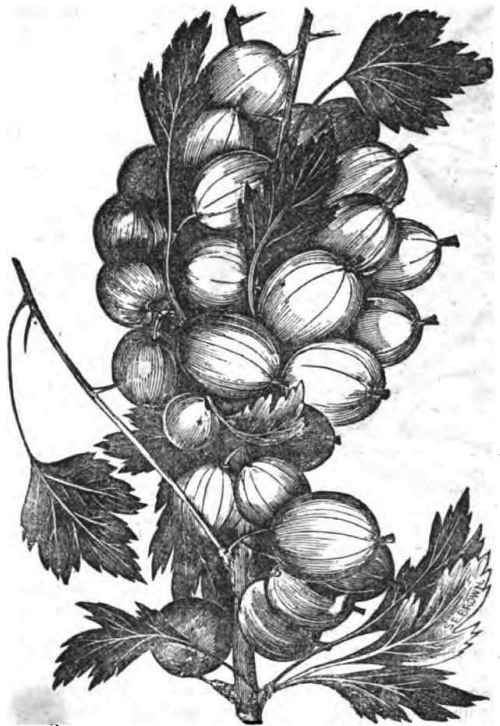
Houghton's Seedling Gooseberry.

Continue to:


My Books

