


The Alexander Pear
Description
This section is from "The Horticulturist, And Journal Of Rural Art And Rural Taste", by P. Barry, A. J. Downing, J. Jay Smith, Peter B. Mead, F. W. Woodward, Henry T. Williams. Also available from Amazon: Horticulturist and Journal of Rural Art and Rural Taste.
The Alexander Pear
The fine native pear to which I have given the above name, originated at the village of Alexander, in Genesee County, the seed having been planted thirty-five or forty years since, by a Mrs, Churchill, who bad brought it from Connecticut. The original tree was about thirty feet in height, and about ten inches in diameter of trunk, and was standing when I first learned its history, but, as I have lately heard, is now dead. M. Calvin, Esq,, of Cheektowaga, in this county (Erie), from whom I obtained the foregoing information, had worked trees from the original one some two years ago, one of which has been in fruit for eight or ten years. Specimens from Mr. Ely's tree were presented at the exhibition of the Fruit Growers' Society, held in this city September 13, 1855, and then first at-tracted my attention, Mr. Ely kindly furnished me with a number of specimens, from which I made a description and drawings. Last season, I was unable to obtain any of the fruit, but daring the recent State Fair, Mr. Ely was present at an informal meeting of pomologists with a few specimens, which, although not so large as those which I had before received, were not wanting in their fine flavor-Several pomologists of eminence who were present, were unanimous in awarding it high praise, and several gentlemen were of opinion that it could be nothing less than that fine pear, the Gray Doyenne, from which it is, however, without doubt, quite distinct.
I am of opinion that it will prove inferior to few of our native varieties, and having compared it with a fine specimen of the Beurre Bosc, which happened to be in eating at the same time. I had no hesitation in deciding that the Alexander was the superior fat flavor, although perhaps not quite so finegrained, and in this opinion I was not alone.
The following is a description; Fruit, medium size, sometimes rather small, irregularly obovate, frequently approaching oblong, and somewhat one-sided. Stalk, from one and one-fourth to one and one-half inch long, rather slender, curved, fleshy at the base, and inserted obliquely (usually at the side of a swollen lip) in a moderately deep cavity, which is often nearly obsolete. Calyx, small, partially closed. Segments, short, and irregular. Basin, narrow, regular, and pretty deep, Skin, rather thick, yellowish-green, nearly overspread with cinnamon-russet, except in the shade, and having occasionally a faint brownish-blush in the sun. Flesh, white, a little coarse, and somewhat gritty at the core, melting, and very juicy. Flavor, sugary, rich, and very fine. Core, small. Seeds, small, nearly black, and pointed. Ripe from September 20 to October 15. Very good. Shoots, rather stoat, yellowish. Leaves, one and one-fourth to one and one-half inch long, narrow, sharply acuminate, deep green, glossy, and scarcely serrated.
Petioles, long and slender.
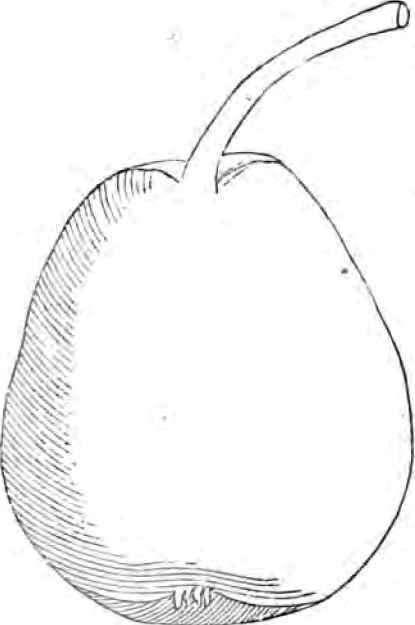
Alexander Pear.
Continue to:


My Books

