


Answers To Correspondents (17)
Description
This section is from "The Horticulturist, And Journal Of Rural Art And Rural Taste", by P. Barry, A. J. Downing, J. Jay Smith, Peter B. Mead, F. W. Woodward, Henry T. Williams. Also available from Amazon: Horticulturist and Journal of Rural Art and Rural Taste.
Answers To Correspondents (17)
(Geo. LESLIE, Toronto.) Your seedling Cineraria flowers came safe to hand. They are all very pretty, and some of them well worthy of being named and propagated. No. 1 is the best in form, with a good, broad, thick petal; center white, with a deep edging of violet purple. Nos. 6 and 8 we think most showy. Kos. 1, 8, 6, 8, 9, and 13, are most worthy of being retained.
(J. G. R. K., Lovettsville, Va.) The shrub to which yon refer, is the Rose Acacia, or Moss Locust, (Robinia kispida,) quite common and very pretty.
The December number was sent as requested.
WILL you give a subscriber some information where the Rough Plate Glass, spoken of in the Horticulturist, Vol. 7, No. 11, Page 519, can be had, and at what price! J. B. B.
It is manufactured in England. Any importer of glass can procure it for you. We can not say what the price is.
Answers To Correspondents #1
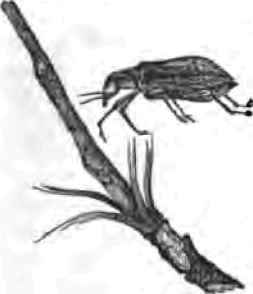
Inclosed I send you specimens of an insect which has anoyed me exceedingly; also an apple shoot, showing the mode in which it operates. As you will observe, it is a species of beetle, very much resembling the Curculio, yet I think it distinct from the Curculio. I find them principally on my Apple and Pear trees, occasionally on the Plum and Cherry; They appear to seek the base of a young shoot, cutting out a piece to the center, intercepting the flow of the sap, upon which they must subsist, consequently the shoot soon dies. Thus some trees planted this spring are nearly destroyed - every shoot was cut off, and nearly as fast as they put forth.
Will you tell me something of the history of this beetle; in what other form to look for it; and the best mode of getting rid of it! Since first I discovered the depredators - now some three weeks - I have endeavored to visit all newly planted trees daily, and others twice a week. By giving them a sudden jar, the insects fall to the ground, and are easily destroyed. In spite of my endeavors to exterminate the race, I constantly discover fresh innovations of the industrious pests, which I think must carry on their busy performances under cover of the night, while I am quietly sleeping.
Allow me to suggest as an interesting and useful department to horticulturists, that a portion of your pages be devoted to the description and history of the different insects obnoxious to plants, trees, and shrubs, accompanied, when practicable, by suitable illustrative drawings. A. G. Hanford - Wauketha, Wis.
A very good suggestion, which we shall be happy to comply with as far as possible. We have made some inquiry of Prof. Harris respecting this weevil, and he has kindly given us the following information:
"The weevil sent you from Wisconsin and forwarded to me, is the Curculio noveboracensis of Foster, now called Ithyeerus noveboracensis. It is not an uncommon insect in Massachusetts, and I have seen specimens from the State of New York and Ohio. Here it may be obtained by shaking small Oak and Maple trees in the morning, during the month of June; the insects then . drop to the ground, without attempting to fly or escape. Nothing further respec eir habits is known to me. We have yet to learn where they lay their eggs, and where t ung live and undergo their transformations. If they are common, and destructive as repi perhaps your correspondent then may be able to pursue their history through their vs es from the egg to the adult weevil".
How is the name Syringa applicable to Philadelphia, the former belonging to natural order Oleaceas and the latter belonging to natural order Saxifragacea, the same order to which belongs the family Deutzia! A Subscriber. - Rochester.
The Philadelphia was formerly called Syringa by some old botanists, and it is yet commonly so called without any propriety. The English name of "Pipe tree" was given to both on account of Turkish pipes being made from them, and they were in this way confounded. The Deutzia is closely allied to the Philadelphia. Syringa should only be applied to the Lilacs.
Will you please inform me whether there is any good kind of Grape other than the Isabella and Catawba, that will grow in our cold northern climate! Also, which is the best time to set them out - fall or spring? A Reader. - New Athena, Pa.
The Clinton and Diana. Plant early as possible in the spring.
Continue to:


My Books

