


Measuring Trees
Description
This section is from the book "The Gardener's Monthly And Horticulturist V29", by Thomas Meehan. See also: Four-Season Harvest: Organic Vegetables from Your Home Garden All Year Long.
Measuring Trees
There is a great amount ingenuity exercised to invent instruments that will readily measure the heights of trees or other objects of similar character. But the traveler need take nothing along with him but a tape line and a jack-knife. First cut a stick thick enough to drive in the earth. Let it be four or five feet long, and drive it into the earth at any spot convenient, only being careful to have it on a part of the ground evidently level to the base of the tree. This will be the stick at 2. Drive another of about the same or any length at any indefinite distance from 2. This will be 1. Then with the eye and a temporary guide find on 1 the exact spot on its surface that will be in exact line with 2, and the top of the tree at 3. We have then a straight line from 3 to 2 and 1. Then, by the eye at 2, striking the spot at 1, we find where the line will strike the earth at 4. We have then a right angle triangle 2, 4, 5. Now we call into our aid the well known geometrical theorem that the proportions of right angle triangles are always the same. With our tape line we find the base line 4 to 5, say 10 feet, and the perpendicular 5 feet. Then we measure on the ground from 4 to 6 and find it, say 100 feet.
The whole question then resolves itself into one which the well known arithmetical rule of proportion readily solves:
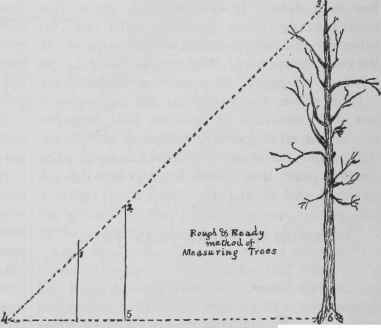
If a base line of 10 feet gives a perpendicular of 5 feet, a base line of 100 gives a perpendicular of 50 feet, which is the height of the tree. This may not come within an inch or two of absolute accuracy as a regular instrument would, but it serves all practical purposes.
Continue to:


My Books

