


June. Number 342. Flower Garden And Pleasure Ground. Seasonable Hints
Description
This section is from the book "The Gardener's Monthly And Horticulturist V29", by Thomas Meehan. See also: Four-Season Harvest: Organic Vegetables from Your Home Garden All Year Long.
June. Number 342. Flower Garden And Pleasure Ground. Seasonable Hints
A city paper recently noted that a great change was coming over the community in regard to having pleasant country homes. Just before the war for the Union, there was a growing love for the home in the country where the wealthier portion could spend their summers, while residing in the city during the winter time. The war broke up most of those who were able to enjoy this luxury. Numbers became suddenly rich, who had no previous taste for country life. These for the most part would build large and showy residences in the city, and very few cared for the country residence. Again there came the development of the railroad system, and improvements in ocean traveling by which one could go to the uttermost ends of the earth in a short time; and the winter gains were spent in summer journeying. Of late, the paper says, there has been another marked change. The railroads leading to the suburbs have brought rural scenes so near the cities that people of taste build again as they once did; and, if they are wealthy enough to afford it, "take their vacation" in the winter, and go to Florida or California, and stay quietly at home during the summer season.
It is said, indeed, to be coming to be just the thing for those who have country homes, with business in the cities, to take their rests in summer there.
Just what may be the predisposing causes may be a question; but it is certain that the love of country life and country homes is more intense than it was a few years ago; and pretty country places are getting more common than they used to be.
We are the more encouraged to continue, under our seasonable hints, to make suggestions for the tasteful arrangement of country grounds. Much of the pleasure we derive from gardening is from the cultivation of a correct taste in these things. Usually about this time those who propose to build select sites, and start with the building. A point seldom considered by architects is to adapt the styles of the house to the character of the ground. But the truth is that whether a house is beautiful or not will often depend very much on the character of the spot on which it is located. A house that would be regarded as beautiful in the city, may be not beautiful in a country spot; and not beautiful simply because it is out of all character with the surroundings. Yet often the owner is left to judge from a lot of pretty pictures or plans what to select for his taste. We sail down the Rhine, and admire the castellated structures we see on its rugged hill-tops. We pronounce them beautiful.
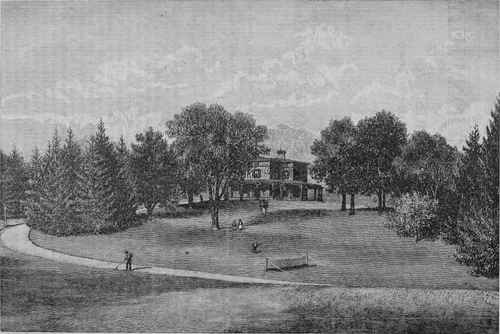
Barron Court - Residence of John C. Barron, Tarrytown, N. Y.
But we should laugh at these buildings if they were to be set down on our broad and level prairies. For a broad topped eminence a broad two-storied building will look much more beautiful than the lofty structures; and the castellated styles should be voted wholly out of order. To illustrate this point we give here a sketch of the house and grounds of Barron Court, the residence of Dr. John C. Barron, at Tarrytown, New York. There is nothing particularly striking about the architecture. Among a lot of pretentious structures in the suburbs of our cities, it would be passed unnoticed. But on this slightly elevated plateau, and arranged as it is between distinct groups of planting, it becomes a part of a singularly beautiful and very pleasing picture. The landscape gardening has of course much to do with the pleasurable effect. The Norway Spruces are placed by themselves, and form a distinct element of variation in the picture; while these again add much to the beauty of the curve in the road which winds so gracefully around them.
In lawns that have been raised from grass seed sown the past spring, many weeds will appear. The perennial ones should be weeded by hand. The holes made by removal of roots can have a little earth put in. The creeping grasses will soon cover the bare surface. Lawns that have been cut very close for several years, will suffer much from creeping weeds, which get all the sunlight on their foliage they require to keep them healthy. Unfortunately there is no way to get rid of these but by letting the grass grow for a season, which smothers out the weeds. A good help, however, is, to sow in the fall seeds of some low growing tufty grass, which mowing does not weaken much. The Sheep Fescue, Festuca ovina, is a good one for this purpose. We are inclined to think that even for the main grass in lawn making it has some good points. So far, the Kentucky Blue Grass, Poa pratensis, has had no competitor. The good point in a first-class lawn grass is that it shall grow so stocky as to crowd out all competitors.
Trees transplanted last sping, may not be pushing into growth as rapidly as desirable. A pruning knife is a better friend in such cases than the watering pot. The last year's growth may be cut back to near where it started from. Sometimes the earth has not been packed close enough to the roots, to enable them to draw nourishment properly. In such cases a packing or pounding with a heavy paving rammer, is better than a good watering. When a good watering seems necessary, a basin should be made by draining the earth away from the trunk, and water filled in lightly so as not to press the earth together too tightly by the force of the water. An essential feature of good healthy soil is to be porous. If the particles be packed tightly together, so as to obliterate the minute air spaces that render it porous, earth dries out all the faster for having been watered.
Continue to:


My Books

