


The Mangrove
Description
This section is from the book "The Gardener's Monthly And Horticulturist V28", by Thomas Meehan. See also: Four-Season Harvest: Organic Vegetables from Your Home Garden All Year Long.
The Mangrove
The Mangrove (Botanical Order, Rhizophora-ceae) is one of nature's most interesting and wonderful products. There are about twenty species of the Mangrove, all of which are natives of the tropics. It flourishes on the seacoasts, and mudflats along the estuaries and at the mouths of large rivers. In these places, its netted, intertwining roots often form impassible barriers to the bold explorer who attempts to invade, either by land or water, the dark shadows of its abode.
Most of the species (like the Banyan, Ficus In-dica,) send down auxiliary stems or roots from their branches, and when fairly established, spread with great rapidity, by means of these secondary roots, along the oozy river-banks, and form dense, dark, loathsome forests, among whose endless interfacings huge purple and black crabs, slimy, sleepy alligators, and aquatic birds disport and hunt their prey. The leaves are dark, glossy green. The wood is hard and durable, but of no commercial value. The seeds are enclosed in a pod, and begin to grow while still attached to the parent. The thick radicle grows downward, the young cotyledons or seed-leaves push forth their heads, and about ten days after the seeds begin to germinate, the fruit, with the young Mangrove attached, falls into the muddy receptacle prepared by Nature, startling with its splash innumerable birds, which shriek and wail as they whir away through the gloom, and attract to the spot some voracious alligator on the lookout for a victim.
When the tide covers the roots, few landscapes can be seen more depressing and weird than when sailing in a small boat among the mazes, and under the numberlessleafy arches of a Mangrove forest. The voyager who ventures within the labyrinth, must use the greatest care, or the bottom of his boat may be torn out by a twisted, gnarled root, and leave him at the mercy of the alligator, whose savage eyes follow his every movement.
When the tide recedes, a sickly odor rises from the slime, bearing malaria in its breath, and threatening the intrepid mariner with delirium and death. The natives of the countries where the Mangrove grows, attribute all kinds of diseases to the odor rising from its roots; but there can be no doubt, that while ever growing where the dread malaria lurks, the Mangrove forest helps to sweeten the air and lessen the death dealing power of the malarial vapor rising from the mud in which it delights to flourish.
The Rev. C. Kingsley, in "Westward Ho!" thus graphically and truthfully paints a Mangrove forest:
"The shore sank suddenly into a low line of Mangrove wood, backed by primeval forest. The loathy floor of liquid mud lay bare beneath. Upon the endless web of interarching roots, great purple crabs were crawling up and down. The black bank of dingy leathern leaves above; the endless labyrinth of stones and withes - for every bough had lowered its own living cord, to take fresh hold of the foul soil below; the web of roots which stretched far away inland - all seemed one horrid complicated trap for the voyager. There was no opening, no relief; nothing but the dark ring of Mangroves, and here and there an isolated group of large and small, parents and children, bending and spreading, as if in hideous haste to choke out air and sky. Wailing sadly, sad-colored Mangrove-hens ran off across the mud into the dreary dark. The hoarse night-raven, hid among the roots, startled the voyagers with a sudden shout, and then all was again silent as the grave. The loathly alligators, lounging in the slime, lifted their horny eyelids lazily, and leered upon you as you passed with stupid savage-ness. Lines of tall herons stood dimly in the growing gloom, like white fantastic ghosts.
All was foul, sullen, weird as witches' dream".
Such is the Mangrove forest; "A pillared shade Upon whose grassless floor . . . ghostly shapes May meet at noontide - Fear and trembling Hope, Silence and Foresight - Death the skeleton, And Time the shadow." - Wordsworth.
Germantown, Philadelphia.
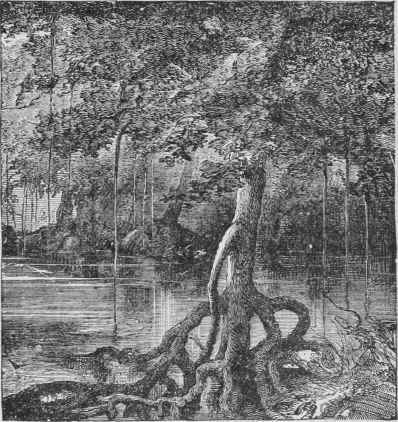
A Mangrove Forest.
Continue to:


My Books

