


July. Number 331. Flower Garden And Pleasure Ground. Seasonable Hints
Description
This section is from the book "The Gardener's Monthly And Horticulturist V28", by Thomas Meehan. See also: Four-Season Harvest: Organic Vegetables from Your Home Garden All Year Long.
July. Number 331. Flower Garden And Pleasure Ground. Seasonable Hints
Every now and then a perfect craze possesses people in behalf of some new thing. In our country half a century ago, there was a craze for a particular kind of mulberry; and later a craze on new kinds of grapes, when even a single eye of some one variety would sell for at least its weight in silver, if not in some cases for its weight in gold.
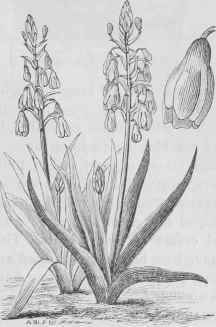
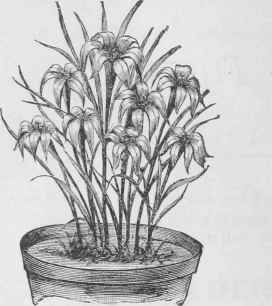
Hyacinthus candicans.
There have been crazes in catalpa and other trees, and crazes in roses and various flowers. In Europe there was the great craze in tulips, and in some respect the mania extended to hyacinths, and other bulbous flowers; and though there has been a good deal of the commercial money-making spirit evolved in all these crazes, the genuine love of trees, plants and fruits, has underlied them all. In regard to the so-called Dutch bulbs, the genuine love has been hearty and continuous, and so far as our country is concerned, has stretched out its arms, until bulbs of every character and variety are being gathered within the floral circle. A few of these are best planted in spring; but, a large number are hardy, and should be planted in autumn, and hence are quite in place under our " Seasonable Hints." The hyacinth, of course, is easily elected President of the Bulb Republic. As we buy them they have been subjected to treatment. The little fellows are not permitted to waste their substance, but the blossoms are picked off, till the bulb is large enough and strong enough to make a large fine spike. Then we admire them. This is why bulbs once flowering with us do not do so well the second year.
Americans could make them come in again in a few years, if they had the time to wait, and the patience of the Hollander. Our time is supposed to be more valuable, so the Dutch bulbs are bought. The size of a bulb, is however, no criterion of its value. A first-class bulb ought to have but one flower spike, and this spike should be thrown well up above the leaves. The bulb that sends the leaves up beyond the spike is defective. Not always, however, is this [the fault of the bulb - the treatment by the grower has a great influence. So far as we know there is no method by which the buyer can be sure, absolutely sure, of a first-class bulb; and we are left to the poor consolation of believing that the highest price bulb is generally the best, and then we have to "shut our eyes, and open our purse, and see what luck will send us " - slightly varying the nursery phrase. There has not been much improvement in new races of hyacinths, as there has been in other plants. During the American Centennial in Philadelphia, a new species called Hyacinthus candicans was introduced.
It is well worth cultivating for its own beauty; and may be the parent of a new class some day.
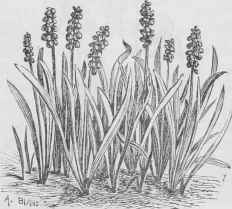
Hyacinthus botryoides.
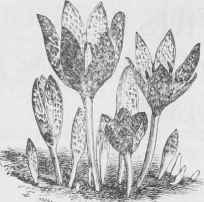
Colchicum autumnale.
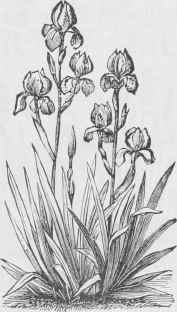
Iris Germanica.
A remarkably pretty hyacinth, is the species known as grape hyacinth, Hyacinthus botryoides, of the older botanists; though now Muscari race-mosa. It has become wild in many places in the eastern part of the United States, though worthy of culture where it does not grow naturally. There are white and other shades cultivated, in Europe, as well as the blue so common here. Tulips, in their various classes of early, single, double, parrot, and others, are well known, as are snow drops and crocusses; while the narcissus in many classes have jumped into notoriety as the craziest of all the floral crazes of many years. The different species have here been so hybridized and crossed, that in the endless variety no one hardly knows one from another.
The meadow saffrons flower even earlier than the crocus; even in the fall of the year of planting if the season be favorable. A sketch of one species, Colchicum autumnale, is herewith appended.
In the Old World Anemone and Ranunculus are very popular, but have not received the attention here that their beauty deserves. They do not continue so long in bloom as other things, and this may be a little against their popularity. The Iris is rather a summer flower than a spring flowering tuberous plant; but it is one of those that requires fall planting in order to secure the best success. A number of species are native to our own country, and thrive well under culture. The Chinese or Kaempferi class has added much to our treasures during the few past years; but the German Iris, of which we annex an illustration, furnishes most of the variety that adorns our gardens.
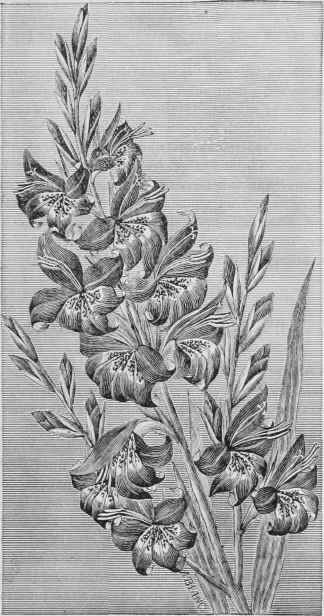
Gladiolus Saundersoni.
We need not - for our readers surely - take space to paint the virtues of the lily, but may say that it set early in the fall in very rich ground, not less than four inches beneath the surface, and in soil not very dry, they will paint themselves more superbly than we are accustomed to see them. Among gladiolus there are some varieties of the communis and ramosus types that are tolerably hardy, and are best planted in fall. These branch more than hybrids of the pure gandanensis type, as the illustration annexed shows.
In regard to Amaryllis, the most are from the Cape of Good Hope and are not hardy; but a number are well adapted to be set out in the fall in American gardens. One of these, the Atamasco or Fairy lily has had none too much said in our pages recently, and the Jacobae Lily, Amaryllis formosissima, is another hardy kind.
Of course those botanically inclined will rise to remark that neither of these are true Amaryllis now, but have other botanical appellations.
Then there are a large number of bulbs of our own country, that are well worthy of culture, and may be sent out in the fall of the year. There are beautiful things among even so commonplace a family as the onion, or botanically the genus Allium; and the Brodiaes, Calliproras and Calochortus of the far west should by no means be overlooked. The latter genus which comprises the well-known Mariposa Lilies are particularly handsome. The annexed illustration is of a species that furnishes the most pleasing variety.
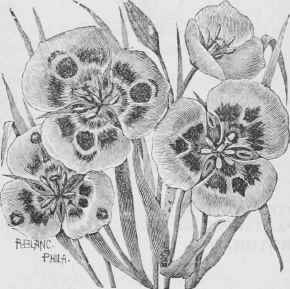
Calochortus venustus.
For the cuts used to illustrate this whole article (except the last), our readers are indebted to Mr. Blanc, of Philadelphia, the well-known artist, who makes a specialty of floral and garden work.
The culture of bulbs, such as we have referred to, has been more or less undertaken for years; but often without the success the gardener desires. The common idea is that bulbs are generally found in poor dry places in a state of nature, and natural conditions should be followed by the cultivator, as far as possible. But the experienced cultivator knows better. To have the best success he must have very rich soil, very deep soil, very cool soil, and soil that will never be tempted to dry out when the first uncertain wooing of the spring sun is attempted.
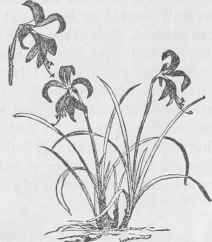
Amaryllis formosissima.
We are satisfied that dry, poor soil is the main cause of fungus disease and difficulty of which so many complain in out-door bulb growing.
Continue to:


My Books

