


How To Grow Strawberries
Description
This section is from the book "The Gardener's Monthly And Horticulturist V28", by Thomas Meehan. See also: Four-Season Harvest: Organic Vegetables from Your Home Garden All Year Long.
How To Grow Strawberries
By George Knapp. Published by H. D. Watson & Co. Greenfield, Mass.
Books on strawberries and other small fruits, are common in every library, but they are usually half filled with description of varieties; and, as these praised by one grower to-day, are condemned by the same pen to-morrow, render the books of but little value a year or two after. Hence, there is plenty of room for cheap books on strawberry culture, though issued every year. This view is forcibly impressed on us by this little quarter-dol-ar, paper-covered book of 54 pages, which not only gives a full description of all the varieties talked about at the present time, with critical notes of their comparative merits, but also full details of the newer modes of culture, not known to the authors of the standard works.
It is, for instance, only in recent years, since the Gardeners' Monthly pointed out the great value of potting strawberries for transplanting, over the old-fashioned plan of digging up the runners straight from the plant, that the idea has reached a point of general practical importance, and we find no mention of it in the usual standards.
This little book is fully up with the times, and contains all that the modern strawberry grower will want to know. We heartily commend it to all who love to grow this delightful fruit.
As a sample of the book, we extract the following about potted runners:
"Though of comparatively recent introduction, so great has been the demand for pot-grown strawberry plants, that of itself it has grown to be a most important feature of the nursery business; being grown and set at a time when other plants cannot be properly or successfully handled, it becomes a doubly profitable industry. The value of potted plants is two-fold; by setting them the grower is enabled to secure a fair crop the first season after planting, and should circumstances prevent him from obtaining his plants at the proper season in the spring for planting layer plants, he may set potted plants during the hottest days of July and August with perfect safety. When one is obliged to buy, it will not pay him to set pot-grown plants only in small quantities, when fruit is desired as quickly as possible, or for home consumption only. Another advantage of potted plants is tor experiment; if the planter wishes to test a new variety, by setting a few potted plants he may obtain sufficient fruit, the following season, to enable him to judge with some degree of accuracy, whether it will prove worthy of extended cultivation with him.
"The price of pot-grown plants is about double that of ordinary layers at the nursery; to which cost must be added that of transportation which, in long distances, is quite an item. Those who already have a bed of plants, may grow potted plants from it after a little practice, at a small expense, by observing the following directions:
"After the parent plant has thrown out runners, prepare a number of two-inch pots, filled with fine, light earth; with a hand trowel make a hole directly beneath the newly formed plant, sink the pot in the hole to a level with the earth, force the plant into the pot, being careful not to break it at the crown, nor to cover too deeply. In from ten days to two weeks the pot is completely filled with well-grown and healthy roots; the runner is then separated from the parent plant, the pot taken up, and the plant removed from it, together with the ball of earth adhering to the roots, and planted. Figure I represents a potted plant turned out of pot. When prepared for shipment, the plants are wrapped singly in paper and carefully packed".
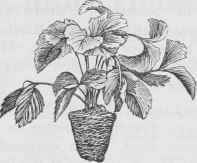
Fig. 1.
Continue to:


My Books

