


Ridging
Description
This section is from the book "A Dictionary Of Modern Gardening", by George William Johnson, David Landreth. Also available from Amazon: The Winter Harvest Handbook: Year Round Vegetable Production Using Deep Organic Techniques and Unheated Greenhouses.
Ridging
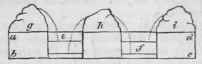
Ridging is digging the soil into a a a parallel ridges in this form - so as to expose it thoroughly to the action either of the atmosphere or of frost.
M. Schluber says, "that freezing re- duces the consistency of soils most re- markably, and that in the case of clays and other adhesive soils, the diminution of this consistency amounts to at least fifty per cent".
In hoeing clay he found it reduced from sixty-nine to forty-five of the scale already stated, and in the ordinary arable soil from thirty-three to twenty, He satisfactorily explains this phenomenon, by observing that the crystals of, ice pervading the entire substance of the frozen sod, necessarily separate the particles of earth, rendering their points of contact fewer.
Ridging, however, should not be confined to the winter, for in summer the extra exposure to the air and heat is highly promotive of vegetation - it im- pregnates the soil with oxygen, promotes the decay of stubborn vegetable remains, and disturbs predatory vermin.
Mr. Barnes says, "I keep all ground, as soon as a crop is done with, well trenched, burying all-the refuse I possibly can in a green state, casting the earth into rough ridges, tumbling those ridges over with a strong fork on frosty mornings in winter and spring, and during hot sunny days in summer, continually changing the crops. Keeping the hoe at work at all seasons in suitable weather, forking up all odd corners and spare ground without loss of time. By this management, I find the ground is always in good condition and never tired by cropping, some judgment only being exercised in applying such properties again to the soil that have been taken from it, or that are likely to be required by the succeeding crop".
An effectual mode of ridging is thus described:
"Let a, b, c, d, represent a section of the ground to be trenched two feet deep. In the first place the ground is measured out in longitudinal beds four feet wide; this done, the top spit of the bed c, is laid on the bed g, and the second spit of the bed c, is laid on h. The first or top spit of the bed /, is then laid on h, so that the top soil and subsoil are kept on separate and alternate beds, and may be mixed, reversed, or returned as taken out, at the will of the operator. By this method the advantages are - much greater exposure of surface to the action of the weather; the opportunity of incorporating with the soil any desirable or obtainable manures, and at any desired depth; a thorough blending of the soil to the depth of two or three feet; and it also facilitates the operation of draining, where necessary. It is needless to add, that when the first thrown-out beds are sufficiently pulverized, they are levelled down, and others thrown out in the same manner; g, h, i, represent the ridges thrown out and left as rough as possible." - Gard. Chron.
Fig. 148.
Continue to:


My Books

