


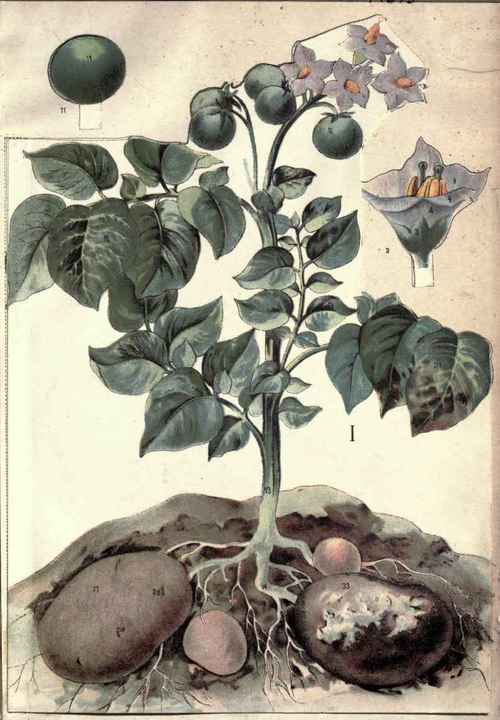
Key To The Model Of A Potato Plant. Section I
Description
This section is from the book "Commercial Gardening Vol1", by John Weathers (the Editor). Also available from Amazon: Commercial Gardening, A Practical & Scientific Treatise For Market Gardeners.
Key To The Model Of A Potato Plant. Section I
General View Number references as for Section V below.
Section II. Epidermis Of The Plant
1. Flower.
2. Fruit.
3. Diseased Leaf.
4. Healthy Leaf. (a) Midrib. (b) Vein.
5. Stem.
6. Healthy Tuber.
7. Diseased Tuber.
8. 9, Roots.
Section III. Assimilation
Number references as for Section II above.
(a) Denotes Inorganic Materials. (b) Denotes Organic Materials.
Section IV - The Flow Of Sap
Number references as for Section II above.
(a) Denotes Inorganic Sap. (b) Denotes Organic Sap.
Section V
1. Flower (reduced).
2. Flower (natural size).
3. Calyx.
4. Corolla.
5. Stamens.
6. Style with Stigma.
7. Ovary.
8. Pollen Passage.
9. Petals.
10. Fruit (reduced).
11. Fruit (natural size).
12. Seeds.
13. Stem.
14. Roots.
15. Healthy Leaf (Upper Surface).
16. Epidermis of Leaf.
17. Palisade Cells with Chlorophyll Granules (very highly magnified).
18. Leaf Vein with Sieve Tubes (very highly magnified). 19 Spongy Parenchyma (very highly magnified). 20. Stomata.
21. Diseased Leaf (Upper Surface).
22. Epidermis destroyed by Fungi (very highly magnified)
23, 24, Palisade Cells and Spongy Parenchyma destroyed by Fungi (very highly magnified).
25. Stomata.
26. The Potato Disease (Section of the Leaf).
27. Healthy Tuber.
28. Eyes.
29. Skin.
30. Starch Grains coloured blue by Iodine (very highly magnified).
31. Section with Cellulose Threads.
32. Back View of Healthy Tuber.
33. Diseased Tuber with Fungus Growths.
34. Destruction of Skin by Fungi.
35. Destruction of Starch Grains by Fungi.
36. Destruction of Cellulose Threads by Fungi.
37. Back View of Diseased Tuber.


Continue to:


My Books

