


Some Studies Of Root-Grafting
Description
This section is from the book "The American Garden Vol. XI", by L. H. Bailey. Also available from Amazon: American Horticultural Society A to Z Encyclopedia of Garden Plants.
Some Studies Of Root-Grafting
THE PRACTICE of grafting upon pieces of roots originated with Thomas Andrew Knight so long ago as 1811. His first experiments were upon pears, but he extended the operation to some stone fruits. Knight supposed that root grafting would prove useful only in the case of rare plants which could not be readily increased by seeds or cuttings. But it has become a widespread practice in the United States for the propagation of various fruits, particularly the apple. Its use has introduced several knotty problems into our pomology, some of which have been discussed these many years with no apparent hope of solution.
We ought to be able by this time to arrive at definite conclusions concerning some of these perplexities. And there are, no doubt, facts enough in the possession of nurserymen and fruit-growers to settle them, but there appears to have been no analytical and judicial attempt to record and digest such knowledge. It is the purpose of this essay to classify advantages and disadvantages, in the hope that some definite information may be obtained. Such personal opinions as I have expressed are the result of much study extending through a considerable length of time ; but I am aware that all of them may be wrong.
The graftage of fruit stock may be analyzed as follows :
1. Budding.
2. Grafting proper, including a. Whole-stock-grafting, b. Piece-stock-grafting, including.
(a) Crown-piece-grafting, (b) Piece-root-grafting, or root-grafting proper.
The advantage of budding over the grafting of whole roots lies chiefly in the ease and cheapness with which the operation is performed. The disadvantages are chiefly two: budding does not allow of deep setting in order to induce roots to form from the cion itself, and it sometimes makes a crook in the base of the tree. In the old apple-growing regions, the first disadvantage is of small account, but in parts of the west and northwest it is essential to procure trees "on their own roots" by setting the cion deep.
The advantages of whole-rooted trees, whether budded or grafted, lie in the production of a deeper, finer and more symmetrical root system than appears to be produced by piece-roots, and in the fact that such trees make a better growth the first two or three years, due to the greater force which resides in large roots. The disadvantages of whole roots are two: the greater cost of the trees; the roots are so large that they are not readily set deep enough to allow roots to strike from the cion.
The advantages of crown-piece-grafts over root-grafts proper or piece-root-grafts are said to be many, but I have not had opportunities to study this matter fully, and therefore cannot express a definite opinion. It is maintained by many that the crown-piece produces a more vigorous growth than the lower pieces, that it is hardier, and that the union with it is better. The crown-piece is usually larger and stronger than lower pieces, and larger and better cions are commonly used upon it. But the differences in behavior between crowns and roots are probably due quite as much to relative sizes and lengths in individual cases as to differences in structure and position. The notion that the "vital energy " resides in the crown is, of course, untrue.
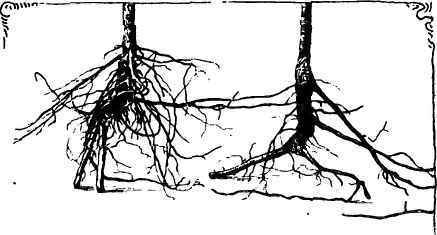
Fig. 1. Bud and Root-Graft.
The advantages of piece-root-grafts are these: I:
They cheapen propagation by making two or more trees from one root. 2. Allow of deep setting, in order that roots may start from the cion- 3. Allow the propagation of rare plants which cannot be increased readily in other ways. 4. Accelerate or induce the rooting of cuttings by working the cutting upon a temporary root, as the quince upon the apple. This is essentially the same as 2, but the root is never expected to be permanent.
The disadvantages of piece-root-grafts are certainly two : 1. The roots are comparatively weak the first year or two, and the tree makes a shorter growth than upon whole roots. 2. The roots are apt to be prongy. onesided and shallow. It is said, also, that piece-rooted trees are shorter lived than whole-rooted trees, that they are more apt to twist or tip over on high and hard subsoils, and that they are less hardy; but upon these questions I do not care to express an opinion.
The comparatively weak growth of piece-rooted trees in the nursery is well known. The amount of growth of course depends upon the amount of root used, the soil and the length of the season, but as ordinarily made in the eastern states, the piece-rooted tree usually does not make sufficient growth the first year to form the body of a good tree. And this is certainly sometimes true of western grown trees, for the poorest trees that I ever set were root-grafts from a leading nursery in one of the prairie states. The terminal bud of the first year's growth is apt to winter-kill, causing a crook to form in the trunk. It is a common practice to cut back the first year's growth to two or three buds. The root is then strong enough to push out a good growth the next year. In Figs. 2 and 3 the relative growths of whole-rooted and piece-rooted trees are shown, as well, also, as the root systems. Fig. 3 shows, at the left, a small bundle of two-year-old piece-roots, and opposite a bundle of two-year-old buds. Fig. 2 shows, at the left, three-year-old piece roots and, on the right, two-year-old buds. Fig. 1 also shows the same differences.
All these trees are Mann apple, procured in western New York. These represent about the average comparative sizes of trees of all varieties which have come under my observation, and a series of photographs sent me by C. M. Stark, of the Pike County Nurseries, Missouri, shows, similar differences in size and shape.
All the illustrations - from photographs - accompanying this essay show the characteristic differences of root formation between piece-rooted and whole-rooted trees. In piece-rooted stock the roots tend to run out horizontally and to make a few large and prongy roots; and there is also a decided tendency to one-sided root development. I have observed these peculiarities in both eastern and western trees. Whole-rooted trees possess a symmetrical and deep root system. I am aware that the root system varies with the variety, but in the same variety I have always noticed the above differences between piece-rooted and whole-rooted trees. The shallow root system appears to characterize crown-piece trees as well as piece-rooted trees, although my observation upon this point has been limited. Fig. 1 shows the root-system of a two-year-old budded apple tree on the left, and that of a three-year-old root-grafted tree on the right.
Upon first thought, it seems strange that piece-rooted trees should possess, as a rule, a different root system from others, but the explanation is not difficult to find. Roots rarely start equally from all sides of the end of a cutting, and those, upon any side, which get the first and best start are likely to maintain the advantage. Fig. 4 - also from a photograph - shows the young roots upon two growing piece-rooted stocks. The roots in each case have started from one side of the cutting. In whole-rooted budded trees, the stock is not removed from the earth and the natural root system is not disturbed. In whole-rooted grafted trees the roots are usually trimmed at their tips, and from each severed tip a one-sided system is likely to form ; but as there are often two or three original roots to the stock, the combined one-sided systems are apt to produce more or less symmetry, for the new roots usually push outwards from the axis of the tree. And there also remains the fact that, even if the grafted stock possesses but a single root, there is a greater length of it than in the piece-root, and more roots can start from it and it can give a better root system.
But it would seem that even then the root system of the whole-rooted grafted tree must be more superficial than that of the whole-rooted budded tree; and one intelligent nurseryman says that such is the case, but I have not had the opportunity to observe it. The deep-rooted character of a tree is certainly lessened when the ends of the descending roots are cut off, for thereupon the roots begin to branch.
All the foregoing facts do not prove that piece-rooted trees are shorter lived or less hardy than whole-rooted trees, but they certainly indicate lines of definite investigation. The piece-root apparently serves an excellent and perhaps indispensable purpose in the northwest, where great hardiness is required by allowing the use of a long cion, which may be set deep in order that roots may start from it. In this manner an own-rooted tree is secured, as the piece-root only serves as a temporary mother for a cutting. The cion represents a variety of known hardiness, while seedling stocks are variable, and there is probably only an occasional one which is hardy enough to endure very severe climates. In the east, piece or root-grafting is falling into disfavor. - L. H. Bailey, before Nurserymen's Association.
Continue to:


My Books

