


Remedies For The Striped Cucumber Beetle
Description
This section is from the book "The American Garden Vol. XI", by L. H. Bailey. Also available from Amazon: American Horticultural Society A to Z Encyclopedia of Garden Plants.
Remedies For The Striped Cucumber Beetle
There are probably few injurious insects for which more remedies and preventives have been recommended than for the striped cucumber beetle (Dia-brotica villata), the everywhere abundant yellow "bug" with black stripes along its back, which attacks squashes, cucumbers, melons, and in fact nearly all cucurbitaceous plants. A large proportion of these remedies are doubtless worthless, if, indeed, not positively injurious.
In order to get at a more definite knowledge of the value of these various substances, the writer undertook, last season, at the Ohio Agricultural Experiment Station, a series of experiments, in which it was designed to give each a field test, and to arrive, if possible, at some reliable conclusions for the guidance of the interested public.
The methods that have been proposed for preventing the injuries of this insect may be divided into four classes : . Keeping away by strong odors supposed to be offensive to the insects. 2. Coating the plant with substances so as to make a mechanical barrier to the insect. 3. Coating the plants with poisonous substances. 4. Fencing out the insects.
Four experiments with the first class of preventives were conducted, the substances used being hen manure, cow manure, kerosene and crude carbolic acid. The latter was the most effective of the four, having an evident effect in keeping away the beetles ; but even it was not a complete success. The three other substances were practically worthless.
Two substances of the second class were tried - saltpeter and gypsum. The former proved worse than useless, while the latter had quite a decided effect in saving the plants ; not sufficient, however, to make it reliable where the beetles are as thick as they often are in many parts of Ohio.
The same may be said of substances of the third class - the diluted poisons. We tried both slug shot and peroxide of silicates. The former proved directly injurious to many of the young leaves to which it was applied, perhaps because it had been on hand for some time. The peroxide had a decided saving effect, and where the beetles were not very thick, would probably bring the plants through in good condition. But the trouble with all these substances is that the beetles burrow down in the earth about the stem, and devour it, often cutting it completely off Very often they burrow down in the soil long before the plants have appeared above ground, and eat the stem and seed-leaves so that the plants never come up.
Obviously the only way to prevent this sort of injury is to fence out the insects. Of the various forms of apparatus for this purpose, some are shown in the figures.
Perhaps the simplest method, and one which X am told in largely practiced in some of the great melon growing sections of the state, is that of laying a piece of thin cloth over the hills before the plants are up, covering the edges of it with loose earth. We tried this quite extensively and found that it worked very well while the plants were young, but was liable to cripple them if left on too long. To obviate this difficulty, we tried various methods of holding the cloth up in the middle. One of the simplest and perhaps most satisfactory method is to take two pieces of wire and put their ends in the ground so as to form a double arch, like the center arch of a croquet ground. Over this the cloth is laid, the edges being held down by loose earth as before, and as shown in Fig. 7. Or the wires may be twisted around each other, as shown in Fig. 3 ; or a single long wire may be bent as shown in Fig. 2. A half barrel hoop makes a very good substitute for the wire, as may be seen in Fig. 5.
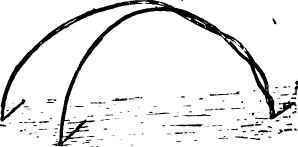
Fig. 2
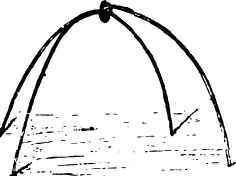
Fig. 3.
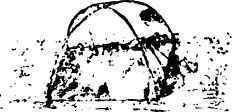
Fig. 7.
The best cloth we found for the purpose is the lightest grade of plant cloth sold by seedsmen. This can be purchased in quantity for three or four cents a yard, and one set of covers properly cared for ought to last at least three seasons. After they have been used on the early squashes and melons they are ready for the late cucumbers. They require little storage room between seasons. We also tried boxes covered with thin cloth, Fig. 4, and found them less desirable than the cloth, because they do not admit sunshine and air as well, so that the plants do not grow as rapidly and vigorously. When the plant reaches the top, also, it can not lift the cloth with it, while with the cloth alone it can raise it without difficulty.
We also tried a wire screen protector, made by A. I. Root, Medina, Ohio, shown at Fig. 6. This serves an excellent purpose, especially for melons and cucumbers, but is more expensive than the forms above described.
It is necessary to keep the covers on until the plants have put out five or six leaves, and perhaps in case of cucumbers and melons even longer; for the beetles sometimes attack them in great numbers after the covers are removed. Clarence M. Weed.
Remedies For The Striped Cucumber Beetle #1
I suppose all these hoops and covers are nice things to play with (May, 279). I have been growing all sorts of squashes, melons, cucumbers, etc., for the past thirty odd years, and never found any use for such contrivances. The bugs attack my melons and squashes, I suppose, as badly as any one's else. When they are all gathered to the fruit I dust them over with a handful of fine bone-meal and bid them good-bye. If I have lost a hill of cucurbitaceae by the beetles I have never found it out. So I get "tired" when I see a fellow fixing snow-bird traps in a melon patch to head off beetles! - W. F. Masshy, N. C. Experiment Station.
Continue to:


My Books

